Strikes, Ballots, Peace Terms, Power Plays
Five fast-moving stories, clearly explained: Iran–Israel strikes, Armenia’s election, a Europe–Ukraine peace outline, the UK’s teen social media plan, and Xi’s high-stakes visit to North Korea — plus how the left and right see each one.
Episode Infographic
Show Notes
Welcome to Right versus Left News—your daily briefing on the stories that matter, told from both sides of the aisle. I'm your AI host - Chris, and each day I bring you the most important political and cultural news, with perspectives from conservative and progressive voices. No spin, no agenda—just the facts and the opinions that shape our national conversation. Let's dive in...
Here’s a quick rundown of today’s five big stories.
First, Iran and Israel exchanged strikes overnight — the first direct fire since the April 8 ceasefire — with President Trump urging restraint even as Israel hit back. Second, Armenia’s ruling Civil Contract party claimed victory in a parliamentary election seen as a test of Russian influence. Third, in London, the leaders of the UK, France, Germany, and Ukraine issued a joint statement sketching five conditions for what they call a just and lasting peace with Russia. Fourth, the UK is poised to announce restrictions on harmful social media for under-16s. And fifth, China’s Xi Jinping arrived in North Korea for a rare, high-stakes summit with Kim Jong Un. These developments all broke within the last 24 hours, according to the Associated Press, Axios, and official readouts.
[BEGINNING_SPONSORS]
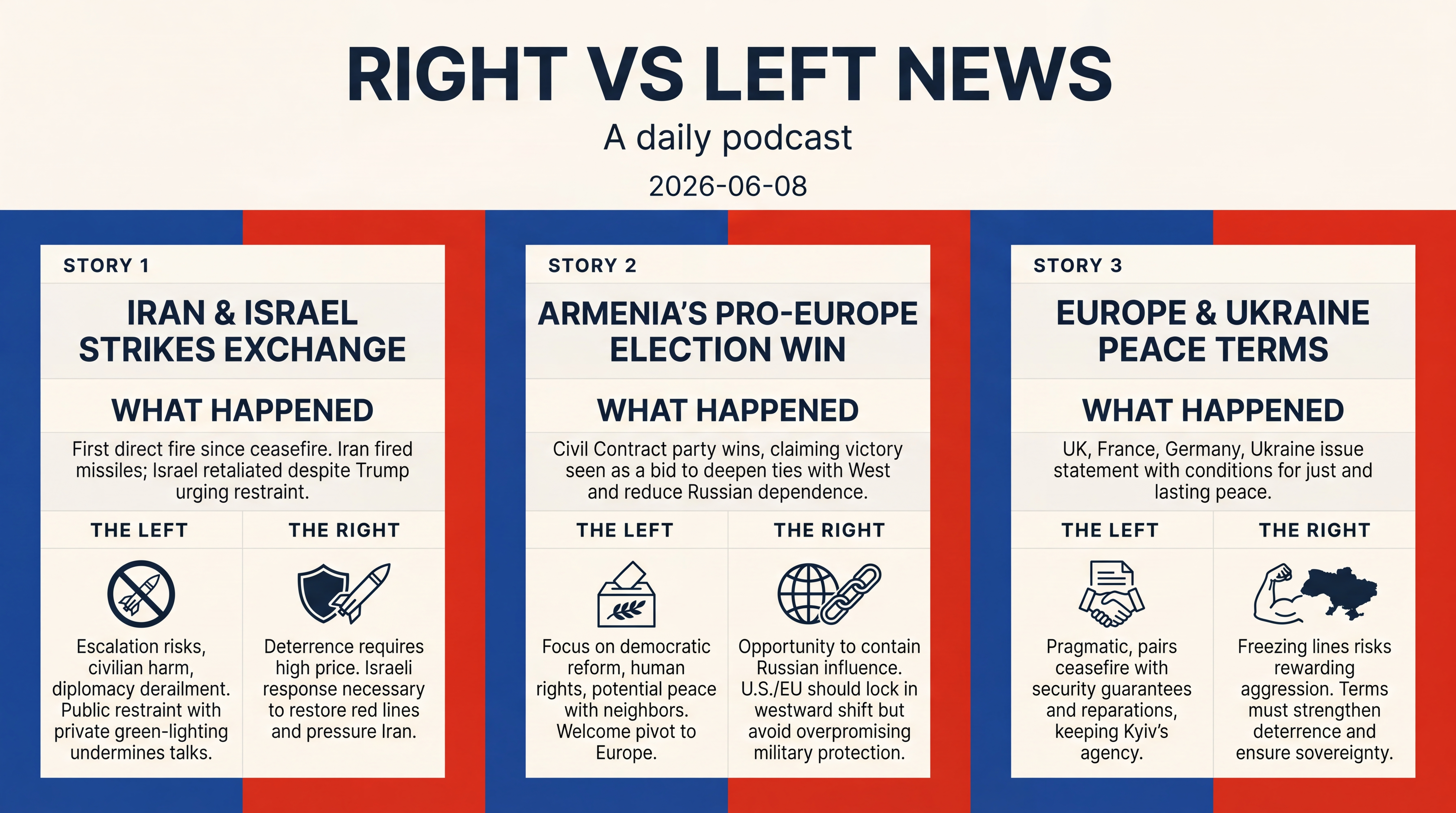
Story one... Iran fired missiles at Israel on Sunday, June 7 — the first such bombardment since the April 8 ceasefire. Within hours, Israel struck military targets in central and western Iran. President Trump said he would ask Prime Minister Netanyahu not to retaliate, but Israel proceeded anyway. Analysts warn the exchange could broaden the conflict.
From the right, commentators argue deterrence works only if Iran pays a high price, and they credit U.S.-Israeli missile defenses with blunting Tehran’s leverage. Conservative coverage emphasizes maintaining pressure on Iran’s capabilities — the view is that Israeli strikes are necessary to restore red lines and keep negotiations from rewarding aggression.
From the left, outlets highlight the risks of escalation, civilian harm, and the danger that tit-for-tat strikes could derail fragile talks. Skeptics warn that urging restraint in public while green-lighting retaliation in practice could undermine diplomacy and widen the war beyond Israel, Lebanon, and Iran.
Story two... In Yerevan early Monday, June 8, Prime Minister Nikol Pashinyan claimed victory as preliminary results showed his pro-Europe Civil Contract party taking roughly 49.8 percent of the vote in parliamentary elections. Coverage frames the result as a bid to deepen ties with the West and reduce dependence on Moscow after years of regional turmoil.
From the right, foreign-policy voices see an opening to contain Russian influence in the South Caucasus — while urging realism about security guarantees and energy routes. They argue the U.S. and EU should lock in Armenia’s westward shift but avoid overpromising military protection.
From the left, European outlets focus on democratic reform, human rights, and a potential peace track with Azerbaijan and Turkey — welcoming a pivot to Europe while calling for vigilance on media freedom and opposition rights, including cases involving detained rivals.
Story three... On Sunday, June 7, at 10 Downing Street, the UK, France, Germany, and Ukraine released a joint statement laying out conditions for what they call a just and lasting peace. The outline includes an immediate ceasefire, talks beginning from the current line of contact, binding security guarantees for Ukraine, and making Russia financially accountable via frozen assets.
From the right, some commentators caution that freezing lines risks rewarding aggression and locking in Russian gains. They press for terms that strengthen deterrence — more weapons production, tougher sanctions enforcement, and assurances that any talks don’t undercut Ukraine’s sovereignty.
From the left, negotiation-friendly voices call the statement pragmatic: pair a verifiable ceasefire with security guarantees and asset-based reparations, while keeping Kyiv’s agency front and center. The framework is presented as a way to marshal Europe’s industrial base for sustained support.
[MIDPOINT_SPONSORS]
Story four... The UK government is poised to restrict under-16s’ access to harmful social media platforms, with Prime Minister Keir Starmer expected to outline the plan today, Monday, June 8. The proposal would keep access to safer services while curbing platforms deemed risky, following consultations and pressure from child-safety advocates.
From the right, free-speech-oriented voices warn that sweeping bans and age-verification rules could expand state power over online speech, creating risks for privacy and dissent. They argue that once government decides what platforms are permissible, the scope tends to grow.
From the left, progressive outlets emphasize youth mental-health harms and argue that platforms are engineered for addiction. Advocates urge restrictions alongside design changes — like limiting infinite scroll — to better protect kids.
Story five... China’s Xi Jinping arrived in North Korea on Monday, June 8, receiving a lavish welcome before talks with Kim Jong Un. Xi described the relationship as entering a new historical starting point — signaling Beijing’s intent to reassert influence after Pyongyang’s deepening security and economic links with Russia.
From the right, hawkish analysts see the visit as part of a broader China–Russia–North Korea alignment challenging U.S. interests in the Indo-Pacific. They call for tighter export controls, faster regional missile defense, and pressure on illicit finance networks that prop up Pyongyang.
From the left, center-left commentators note that China’s leverage could, in theory, restrain the North’s worst escalations — if Beijing chooses to use it. Any real progress would likely require renewed multilateral talks tied to economic incentives and humanitarian safeguards, even as prospects remain dim.
That’s the recap... Israel–Iran tensions spike again; Armenia’s voters endorse a westward track; Europe and Ukraine sketch peace terms; Britain prepares to curb teen social media; and Xi’s North Korea trip underscores shifting power blocs.
That's it for today's episode of Right versus Left News. Remember, understanding both sides isn't about picking a team—it's about being informed. Subscribe wherever you get your podcasts, and join us tomorrow for another balanced look at the day's biggest stories. Until next time, stay curious and stay informed.
