War Powers Showdown, Trade Crackdown, Court Transparency
We break down the House's bid to curb the president's Iran authority, DHS's tense oversight hearings, and a new customs enforcement order. Then we unpack DOJ's superseding indictment of the SPLC and the judiciary's trimmed amicus disclosure rule — plus how the right and left see it.
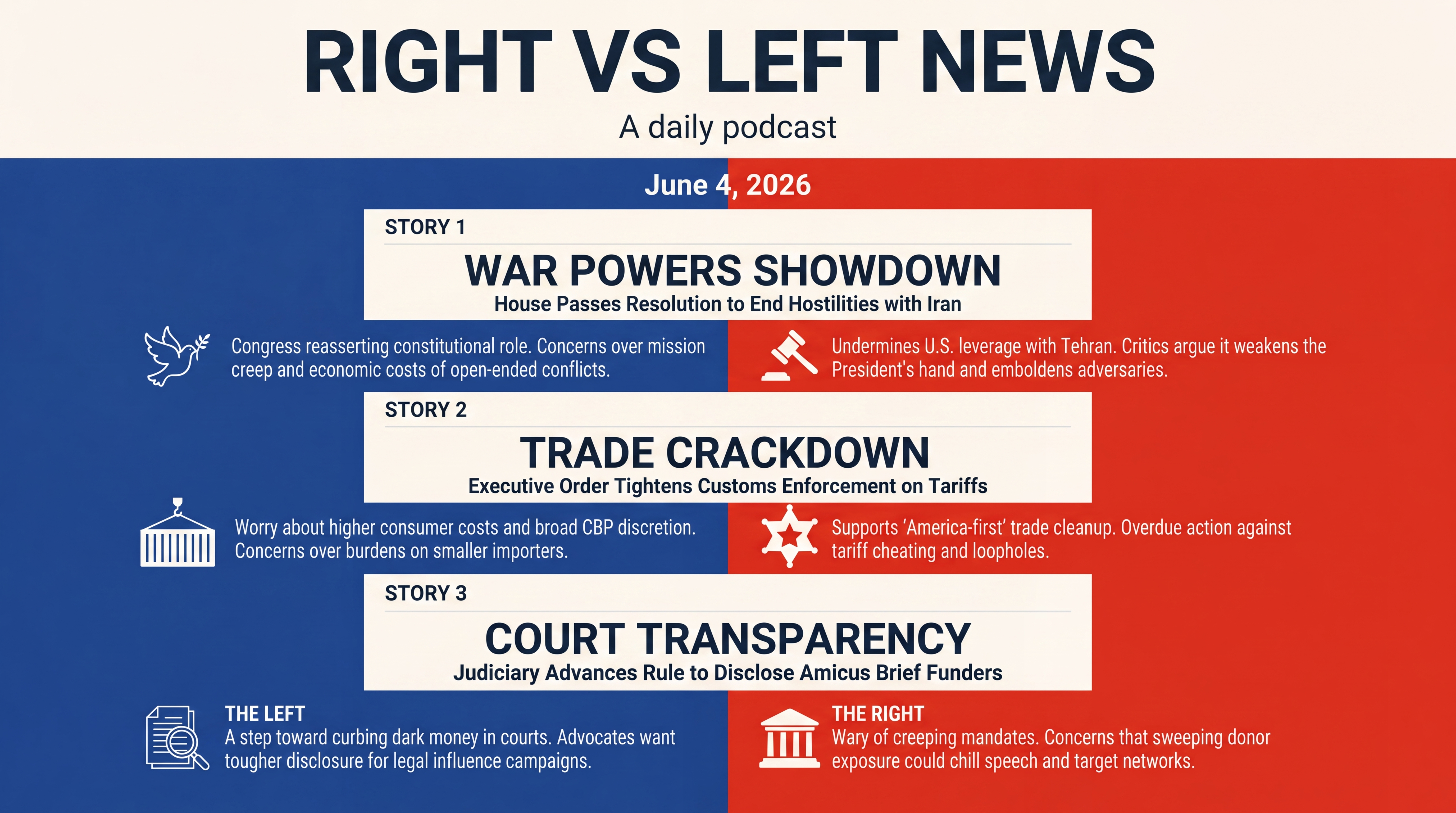
Episode Infographic
Show Notes
Welcome to Right versus Left News—your daily briefing on the stories that matter, told from both sides of the aisle. I'm your AI host - Chris, and each day I bring you the most important political and cultural news, with perspectives from conservative and progressive voices. No spin, no agenda—just the facts and the opinions that shape our national conversation. Let's dive in...
It's Thursday, June 4, 2026.
Overnight, the House approved a war powers resolution aimed at curbing President Trump's military authority in Iran. On Capitol Hill, Homeland Security Secretary Markwayne Mullin faced sharp questioning in back-to-back hearings over immigration enforcement and cybersecurity. At the White House, a new executive order tightens customs enforcement to crack down on tariff cheating. The Justice Department filed a superseding indictment against the Southern Poverty Law Center, escalating a high-profile legal fight. And the federal judiciary advanced a narrower rule to disclose who's funding friend-of-the-court briefs.
We'll lay out the facts — then what the right and the left are saying.
[BEGINNING_SPONSORS]
The House passed a war powers resolution directing the president to end hostilities with Iran unless Congress authorizes force. The vote followed months of strikes and maritime tensions. Several Republicans joined Democrats as war fatigue — and economic worries — mounted. The move puts pressure on the administration to outline an endgame.
On the right, critics warn the resolution could undermine U.S. leverage with Tehran. GOP Foreign Affairs Chair Brian Mast called it a "stupid political vote" that weakens the president's hand in negotiations. Hawks argue public divisions at home embolden adversaries, and say Congress is micromanaging battlefield decisions.
On the left, supporters frame the vote as Congress reasserting its constitutional role after years of mission creep. They point to bipartisan discomfort with open-ended operations lacking authorization, and to economic costs from disrupted shipping and higher energy prices — without a clear strategy from the White House.
Homeland Security Secretary Markwayne Mullin sparred with lawmakers over DHS's budget, immigration enforcement, and cyber readiness. A tense exchange ended with one senator telling Mullin to "calm down." Beyond the theatrics, members pressed him on CISA staffing and how DHS will implement cybersecurity elements of the new AI executive order.
On the right, conservatives argue Mullin is confronting years of lax border policy and deserves space to tighten enforcement. They cast Democratic criticism as partisan theater and emphasize officer safety.
On the left, Democrats say the hearings exposed accountability gaps — from oversight of controversial contracts to transparency on use-of-force incidents. They want clearer guardrails on AI-driven surveillance and faster hiring at CISA to match rising cyber threats.
Just after midnight UTC, President Trump signed an executive order directing U.S. Customs and Border Protection to intensify enforcement. Think tighter importer-of-record rules... steeper penalties on duty evasion... and tougher verification to stop undervaluation schemes. A White House fact sheet floated a 50% minimum penalty floor and heightened vetting of foreign importers.
On the right, supporters call it an America-first trade cleanup — long overdue after years of loopholes that hurt U.S. manufacturers. They say stricter bonding and verification will deter shell importers skirting tariffs, and see the move as complementing recent Section 232 tariff actions on steel, aluminum, and copper.
On the left, critics worry about higher supply chain costs hitting consumers and about broad CBP discretion. Trade skeptics caution that penalty floors and new compliance burdens could squeeze smaller importers. Progressive tech and retail voices want clarity on how data and "new technology" screening will be used — and what due process safeguards will apply.
[MIDPOINT_SPONSORS]
The Justice Department filed a superseding indictment against the Southern Poverty Law Center, adding detail to fraud allegations tied to undisclosed payments to informants inside extremist groups. Prosecutors now allege roughly $4.1 million in secretly routed funds. The SPLC has moved to dismiss earlier charges and denies wrongdoing.
On the right, many see the case as overdue scrutiny of a powerful organization they argue has unfairly labeled mainstream conservative groups. Commentators highlight DOJ's claim that donors were misled about payments to sources embedded with hate groups.
On the left, civil rights advocates and some legal analysts warn the prosecution could chill nonprofit investigations of extremism. They question the charging theory, say the case risks politicization — which DOJ denies — and urge the court to require clear, non-ideological evidence of fraud.
After pausing a controversial donor disclosure plan this spring, a federal judicial committee advanced a revised rule to increase transparency for amicus briefs while stripping provisions that raised privacy concerns. The trimmed proposal would still expand disclosures in appellate cases and aims to balance sunlight with free association rights.
On the right, groups from Heritage to ALEC and the National Taxpayers Union Foundation argue sweeping donor exposure would chill speech and target conservative networks. They welcome the scale back but remain wary of creeping mandates on dark money.
On the left, reformers like the Brennan Center want tougher disclosure to reveal who bankrolls legal influence campaigns, especially as amicus filings surge in high-stakes cases. They see this revision as a step — not the finish line — toward curbing opaque funding in the courts.
The House moved to check the president's war powers in Iran... DHS's chief faced fierce oversight on immigration and cyber... a new executive order ramped up customs enforcement... DOJ escalated its case against the SPLC... and the judiciary advanced a narrower amicus disclosure rule.
We'll keep watching how these debates evolve — in Congress, the courts, and on the campaign trail. Sources include Axios, The Washington Post, Asia Times, Bloomberg Law, Fox News, Federal News Network, CBS News, JURIST, the Associated Press, and official White House releases.
That's it for today's episode of Right versus Left News. Remember, understanding both sides isn't about picking a team—it's about being informed. Subscribe wherever you get your podcasts, and join us tomorrow for another balanced look at the day's biggest stories. Until next time, stay curious and stay informed.
