Courts, Code, and Crises — Midweek Power Moves
From Alabama's redistricting fight to a lighter-touch AI order, we break down the week's biggest power plays. Plus, Bill Pulte's surprise DNI pick, a sprint to renew FISA 702, and a fragile Israel–Hezbollah pause.
Episode Infographic
Show Notes
Welcome to Right versus Left News—your daily briefing on the stories that matter, told from both sides of the aisle. I'm your AI host - Chris, and each day I bring you the most important political and cultural news, with perspectives from conservative and progressive voices. No spin, no agenda—just the facts and the opinions that shape our national conversation. Let's dive in...
It’s Wednesday, June 3, 2026, and here’s what we’re watching... The Supreme Court cleared Alabama to use a GOP‑favored congressional map this fall. The White House rolled out a new artificial intelligence order inviting early government vetting of powerful models. President Trump tapped housing regulator Bill Pulte to serve as acting director of national intelligence. On Capitol Hill, senators are circulating a three‑year deal to renew FISA’s Section 702 before it lapses June 12. And abroad, Washington says Israel and Hezbollah agreed to dial back attacks — even as strikes continue. Let’s get into it.
[BEGINNING_SPONSORS]
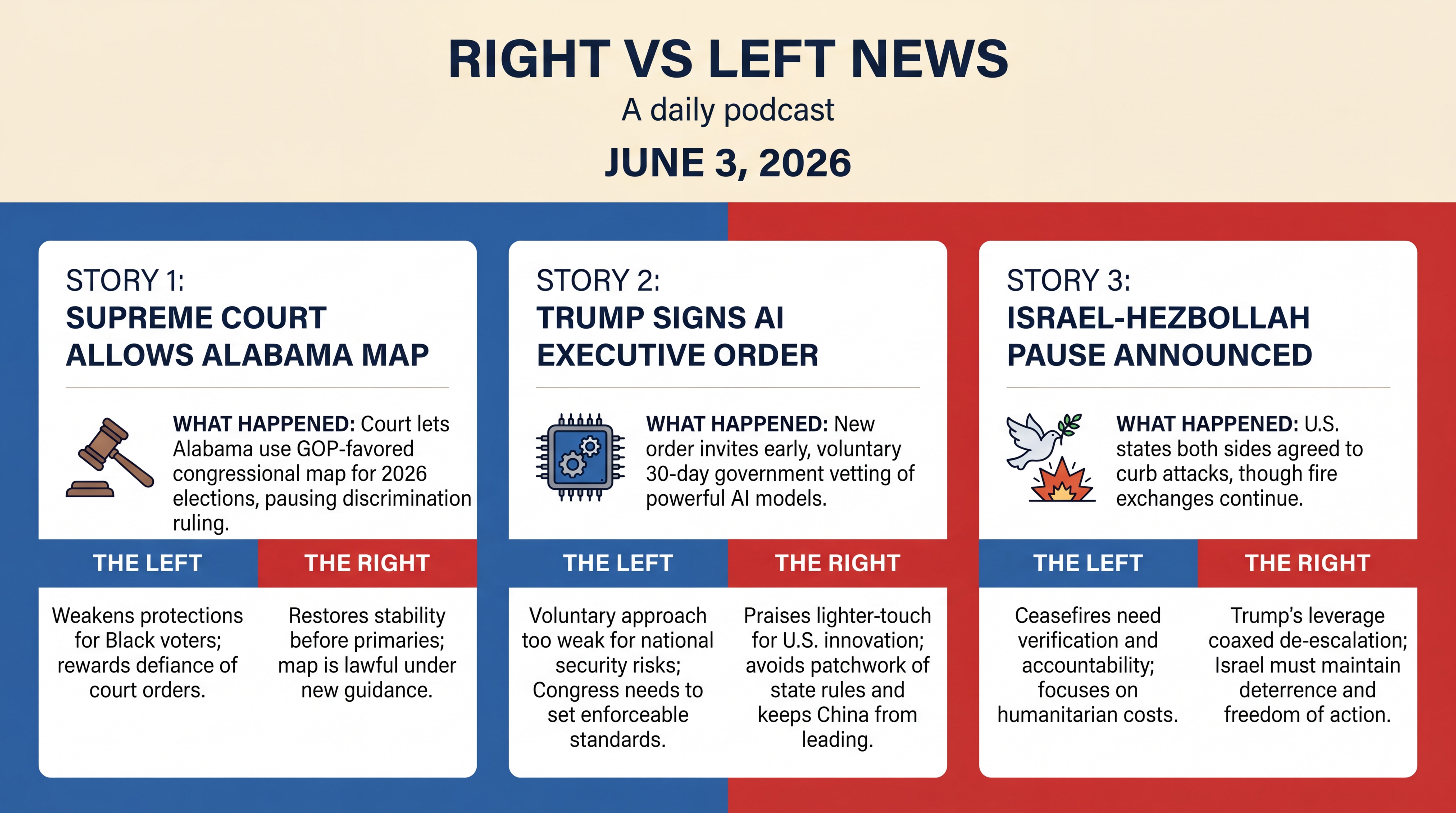
On Tuesday night, June 2, the Supreme Court allowed Alabama to hold its 2026 elections using a congressional map that leans Republican, pausing a lower‑court ruling that said the plan intentionally discriminates against Black voters.
The order lets the state implement its 2023 map — six likely GOP districts and one Democratic — while litigation continues. It follows the Court’s late‑April decision reshaping how race can be used in redistricting — and it lands amid a broader scramble before November. Multiple outlets, including the AP and the Washington Post, reported the decision.
On the right, coverage stresses the Court’s resistance to last‑minute changes to election rules and frames the order as restoring stability ahead of primaries. Many conservatives argue federal courts went too far by forcing a second Black‑opportunity district — and that Alabama’s map is lawful under the new guidance. They also say Democratic gains under a court‑drawn map in 2024 justified a course correction to keep rules neutral.
On the left, outlets highlight civil rights concerns — warning the ruling weakens protections for Black voters and could tip tight House control. Progressives say the decision rewards defiance of court orders and accelerates the trend toward fewer competitive districts. They argue Congress should bolster the Voting Rights Act to curb racial vote dilution.
Also Tuesday, President Trump signed an executive order on artificial intelligence that invites companies building powerful frontier models to give the federal government early, voluntary access — up to 30 days — for national security vetting.
The order, pared back from a stricter draft shelved in May, centers on cybersecurity risks posed by advanced AI while avoiding mandatory licensing. Reporting from the Washington Post, the AP, and CBS News confirms the 30‑day window and the national security focus.
On the right, pro‑business voices praise the lighter‑touch approach — a balance between guarding against catastrophic cyber risks and letting U.S. firms innovate. They note efforts to preempt a patchwork of state rules and to keep China from leaping ahead.
On the left, critics warn that voluntary vetting may be too weak for models that could discover software vulnerabilities or turbocharge disinformation. They argue the White House walked back tougher provisions under industry pressure — and that Congress should set enforceable safety, transparency, and civil‑liberties standards.
Later that day, President Trump named Federal Housing Finance Agency director Bill Pulte as acting director of national intelligence, replacing Tulsi Gabbard when she departs at month’s end.
Pulte — a real‑estate heir and FHFA chief — has little traditional intel background, a pick that puts a staunch loyalist atop the 18‑agency intelligence community as the United States navigates global crises. Outlets including the Washington Post, Reuters, CBS News, and Axios reported the move.
On the right, commentators emphasize a president’s prerogative to choose trusted managers, arguing an outsider can challenge groupthink and drive accountability across sprawling spy agencies. They note that temporary appointments are common and frame the choice as maintaining continuity as Gabbard exits.
On the left, critics question Pulte’s qualifications and warn about politicizing intelligence. They worry elevating a loyalist without deep intel experience could chill dissenting analysis and blur lines between politics and intelligence.
[MIDPOINT_SPONSORS]
In Congress, senators are circulating a three‑year deal to renew Section 702 of the Foreign Intelligence Surveillance Act ahead of a June 12 deadline, following short‑term extensions in April.
Talks center on whether to require warrants for U.S.‑person queries — and whether to attach unrelated provisions. Bloomberg Government, Roll Call, and CBS News outlined the timing and the contours.
On the right, national security hawks urge reauthorization, saying recent compliance reforms and court oversight protect civil liberties while 702 remains vital for tracking foreign threats. Many warn that strict warrant mandates could cripple insight into adversaries’ plots.
On the left, civil‑liberties advocates push for stronger guardrails — including warrants for searches involving Americans — citing a history of FBI query abuses. Some Democrats also oppose tacking on unrelated measures and want a clean surveillance reform package.
U.S. officials say Israel and Hezbollah agreed to curb attacks after U.S.‑mediated talks — yet exchanges of fire continued into Tuesday, underscoring how fragile any de‑escalation remains.
Outlets including Al Jazeera, Axios, and the AP reported the announcement, the U.S. pressure behind it, and the reality that strikes and rocket fire persisted despite public claims of a halt. On Capitol Hill, lawmakers questioned Secretary of State Marco Rubio’s Lebanon–Iran strategy.
On the right, conservative media often credit Trump’s leverage — sanctions, military posture, and pressure on Tehran — for coaxing de‑escalation, while urging Israel to preserve freedom of action if Hezbollah violates terms. They emphasize deterrence and warn Tehran will test U.S. resolve.
On the left, progressive outlets spotlight humanitarian costs in Lebanon and Gaza and argue that ceasefires on paper are not peace without verifiable pullbacks and accountability. They caution that favoring short‑term optics over sustained diplomacy could risk a wider regional war.
Quick recap... The Supreme Court’s Alabama order could reshape House math. The White House’s AI order tilts light‑touch but adds a 30‑day national‑security review. Bill Pulte’s DNI appointment stirs a qualifications debate. The Senate is racing the clock on FISA 702. And U.S. officials tout an Israel–Hezbollah pause even as fire continues. We’ll keep tracking how these evolve heading into the weekend.
That's it for today's episode of Right versus Left News. Remember, understanding both sides isn't about picking a team—it's about being informed. Subscribe wherever you get your podcasts, and join us tomorrow for another balanced look at the day's biggest stories. Until next time, stay curious and stay informed.
