
Courts, Tariffs, Primaries — and a Quieter Storm
A narrow court ruling on the Pentagon’s transgender policy, a tariff recalibration with real-world stakes, six-state primaries, Florida’s first-of-its-kind lawsuit against OpenAI, and a subdued — but still risky — hurricane outlook. Fast, clear analysis with perspectives from across the spectrum.
Episode Infographic
Show Notes
Welcome to Right versus Left News—your daily briefing on the stories that matter, told from both sides of the aisle. I'm your AI host - Chris, and each day I bring you the most important political and cultural news, with perspectives from conservative and progressive voices. No spin, no agenda—just the facts and the opinions that shape our national conversation. Let's dive in...
Here’s what we’re watching today... A federal appeals court says the Pentagon went too far with its transgender service ban. The White House tweaks metals tariffs with real economic ripple effects. Voters in six states head to the polls. Florida sues OpenAI in a first-of-its-kind case. And hurricane season kicks off with a quieter outlook — but big preparedness questions. Let’s get into it.
[BEGINNING_SPONSORS]
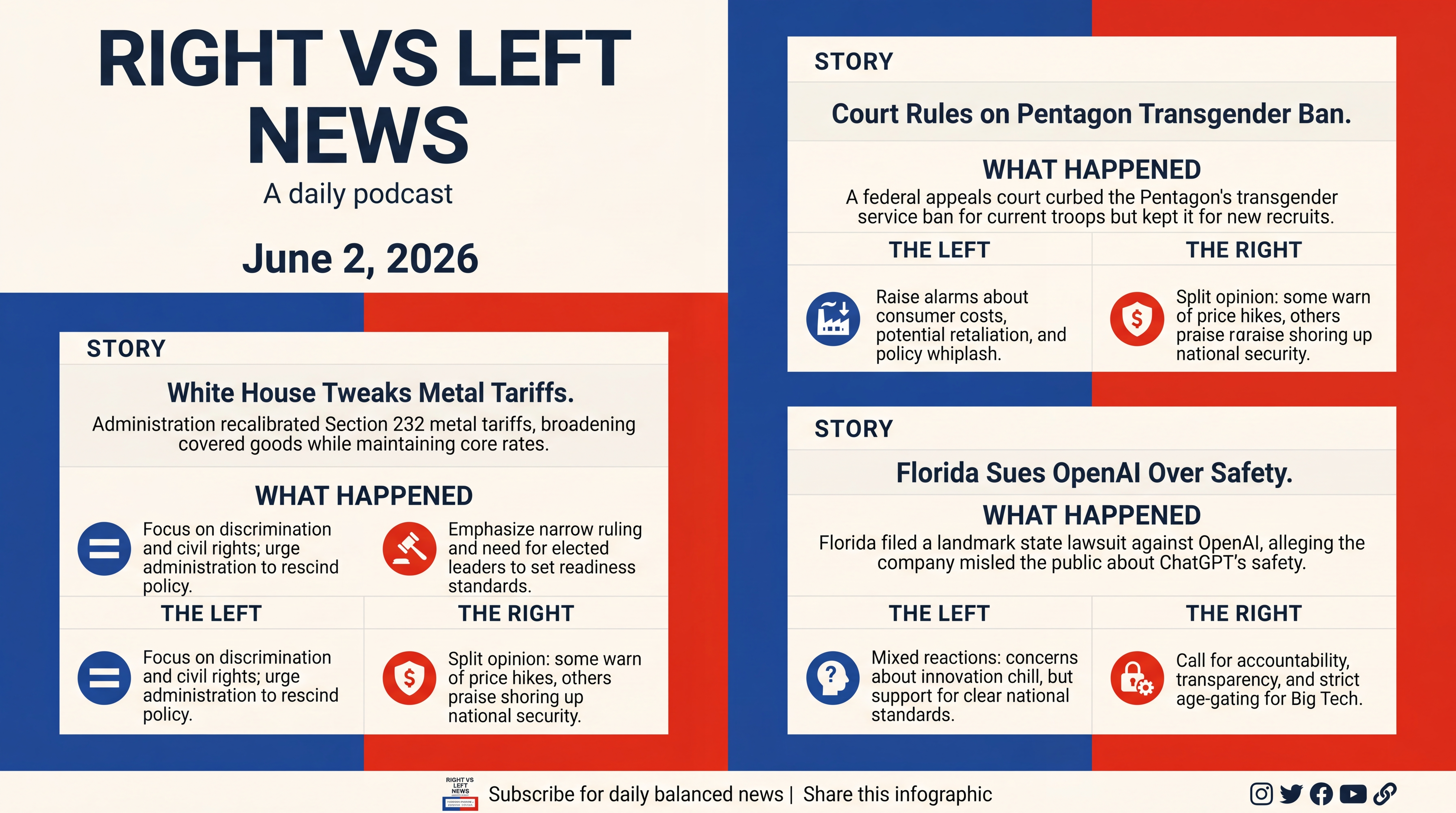
A divided D.C. Circuit appeals panel ruled Monday that the Pentagon’s policy barring transgender service members from serving or enlisting went too far — at least as applied to people already in uniform. The court kept protections in place for the named plaintiffs, preventing their removal, but it did not open the door to new transgender recruits. Major outlets highlighted the two to one decision and its limited scope.
On the right, the emphasis is on how narrow the ruling is, and on the view that readiness and unit cohesion — not social policy — should drive standards. It’s a legal setback, they say, but most of the administration’s approach still stands for new applicants while appeals continue. The bottom line — elected leaders, not judges, should set deployability and medical readiness rules.
On the left, the focus is on discrimination and constitutional concerns. Progressive voices argue the policy was driven by impermissible bias and urge the administration to narrow or rescind it rather than fight on — treating this less as a staffing rule and more as a civil-rights issue.
Over to the economy. The White House issued a new proclamation adjusting how Section 232 metal tariffs are calculated and applied, while keeping headline rates — a 50 percent duty on most primary steel, aluminum, and copper — largely in place. The move broadens which derivative goods are covered and sets implementation dates this month. Analysts are already unpacking the mechanics.
On the right, opinion splits. Free‑market conservatives warn tariffs are a tax on Americans that raise prices and distort supply chains. Populist and industrial‑policy conservatives, meanwhile, praise the shift as shoring up critical capacity and national security.
On the left, center‑left economists and business groups raise alarms about consumer costs, potential retaliation, and policy whiplash after recent court fights over tariff powers. Progressives push for negotiated supply‑chain resilience over broad tariffs — arguing certainty beats across‑the‑board duties.
Across the map, it’s primary day in six states — California, Iowa, Montana, New Jersey, New Mexico, and South Dakota. Voters are choosing key gubernatorial, congressional, and Senate nominees, with results expected this evening.
On the right, watch enthusiasm in GOP congressional primaries — can anti‑establishment challengers turn online energy into votes? Expect an emphasis on crime and the border in House races, and on whether the party’s ground game — including mail‑in ballot chasing — is improving.
On the left, progressives are testing economic populists and labor‑backed candidates against moderates in deep‑blue terrain, while watching youth turnout and the salience of abortion rights in suburban districts. Analysts will read the returns as an early barometer for how social issues — from LGBTQ rights to book bans and campus speech — are motivating the base.
[MIDPOINT_SPONSORS]
Back to tech and the courts. Florida filed a first‑of‑its‑kind state lawsuit against OpenAI and CEO Sam Altman, alleging the company misled the public about ChatGPT’s safety — citing incidents tied to violence, self‑harm, and youth addiction. The state attorney general says internal warnings were ignored. OpenAI points to ongoing safety work and content protections.
On the right, many see long‑overdue accountability for Big Tech — calling for strict age‑gating, liability for negligent design, and transparency into training data and safety testing. Republican attorneys general view litigation as a way to force disclosures they say regulators have been too slow to require.
On the left, reactions are mixed. Many share child‑safety concerns but warn splashy lawsuits can chill innovation or scapegoat AI for deeper failures in mental health and gun policy. Civil‑liberties voices stress evidentiary rigor — what the system actually did — and push for clear national standards over state‑by‑state crackdowns.
And with June here, hurricane season has officially begun. NOAA’s outlook calls for a below‑normal Atlantic season — still dangerous, but likely quieter — and federal agencies are urging coastal residents to prepare now. The Coast Guard has issued readiness guidance, Weather.com recapped what to expect, and the World Meteorological Organization summarized the reduced‑storm forecast.
On the right, the emphasis is on readiness over rhetoric — hardening grids and ports, speeding permits for levees and flood control, and ensuring FEMA can operate even amid budget fights. Commentators caution against using seasonal outlooks to justify sweeping climate policy, arguing dollars should prioritize evacuation routes, generators, and resilient infrastructure.
On the left, preparedness and climate resilience go hand in hand — more funding for modern stormwater systems, backup power for hospitals, and buyouts in repeatedly flooded neighborhoods. Advocates note that quieter than average can still be catastrophic for vulnerable communities, and they press for robust local adaptation plans and steady disaster‑mitigation funding.
Quick recap... A court curbed the Pentagon’s transgender ban for current troops. The White House recalibrated metal tariffs. Voters in six states are casting primary ballots. Florida opened a landmark lawsuit against OpenAI. And hurricane season started with a calmer — but not harmless — forecast. We’ll keep tracking results and reactions through the night and into tomorrow.
That's it for today's episode of Right versus Left News. Remember, understanding both sides isn't about picking a team—it's about being informed. Subscribe wherever you get your podcasts, and join us tomorrow for another balanced look at the day's biggest stories. Until next time, stay curious and stay informed.
