
Courts Pause Funds, SEC Retreats, Malta Votes
Courts pause a federal payout fund and a Kennedy Center rebrand, the SEC moves to rescind climate disclosures, Connecticut enacts a sweeping AI law, and Malta heads to snap elections. Balanced perspectives and a clear recap of what to watch next.
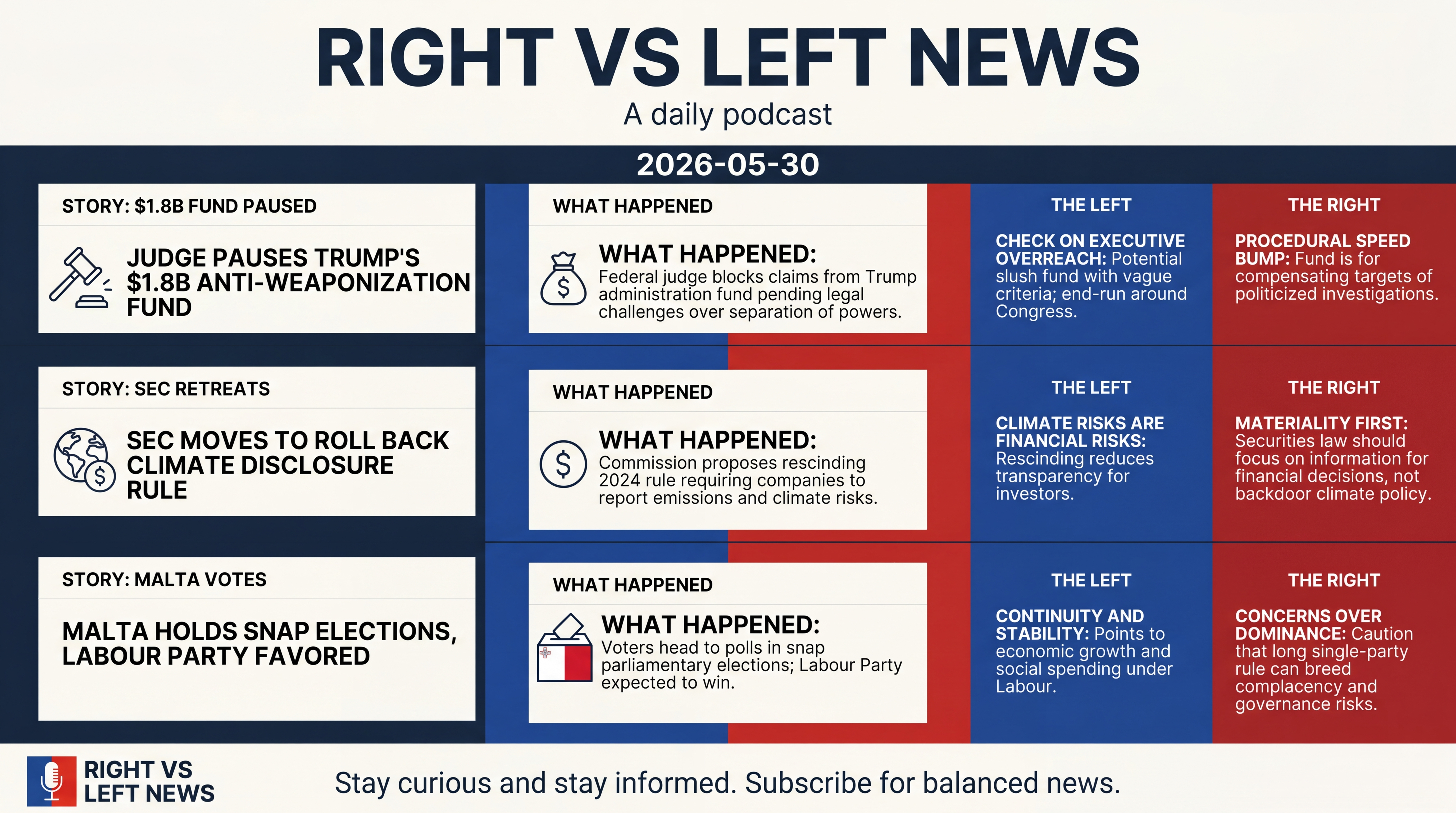
Episode Infographic
Show Notes
Welcome to Right versus Left News—your daily briefing on the stories that matter, told from both sides of the aisle. I'm your AI host - Chris, and each day I bring you the most important political and cultural news, with perspectives from conservative and progressive voices. No spin, no agenda—just the facts and the opinions that shape our national conversation. Let's dive in...
Here’s a quick overview of what’s moving today...
A federal judge paused the Trump administration’s 1.8 billion dollar Anti-Weaponization Fund while legal challenges play out. Another judge in Washington ordered President Trump’s name removed from the Kennedy Center — and blocked a planned closure for renovations. On the business front, the SEC moved to roll back the Biden-era climate disclosure rule. In state policy, Connecticut just enacted a far-reaching AI law. And abroad, Malta is voting in snap parliamentary elections, with the ruling Labour Party favored.
[BEGINNING_SPONSORS]
First — the fund pause.
A federal judge in Virginia temporarily blocked the administration from creating or paying out claims from the new Anti-Weaponization Fund — roughly 1.8 billion dollars. The Justice Department had tied the fund to a settlement over the leak of Donald Trump’s IRS records, but the order bars transfers, claim reviews, and disbursements while lawsuits proceed. The ruling flags separation-of-powers questions and concerns under the Administrative Procedure Act raised by watchdogs and some January 6 officers.
Supporters on the right say the fund was designed to compensate people who believe they were targeted by politicized investigations — and that the pause is a procedural speed bump, not the end of the road. They argue the fight is about remedying government overreach, not rewarding allies.
Critics on the left call it an attempted end-run around Congress’s power of the purse — a potential slush fund with vague criteria that could benefit political allies or January 6 defendants. They see the pause as a needed check on executive overreach and conflicts tied to the IRS case.
Next — the Kennedy Center ruling.
A judge in Washington ordered the removal of President Trump’s name from the John F. Kennedy Center for the Performing Arts, saying only Congress can change the center’s statutory name. The court also blocked a weeks-long closure for renovations linked to the rebranding — and gave two weeks to take down signage and references.
On the right, many frame it as a straightforward statutory call: Congress named it for JFK, and the court is enforcing the law as written.
On the left, it’s seen as a rebuke to personal branding of public institutions — protecting historical memory and preventing politicization of a national arts venue. Arts advocates also note a sudden closure could have disrupted operations and fundraising.
Now — the SEC and climate disclosures.
The Commission proposed rescinding the 2024 climate disclosure rule that would have required many public companies to report certain greenhouse-gas emissions and climate risks. Leaders said the rule exceeded the agency’s authority and imposed costs not justified by benefits. A 60-day comment window follows publication.
On the right, the case for rollback is materiality first — securities law should focus on information investors need for financial decisions, not serve as backdoor climate policy. They warn expansive reporting — especially Scope 3 — would push costs onto retirees and consumers.
On the left, Democrats and investor advocates argue climate risks are financial risks — supply chains, insured losses, stranded assets — and that rescinding the rule reduces transparency investors have been asking for. Even without a federal standard, companies still face a patchwork of state and international requirements.
[MIDPOINT_SPONSORS]
Turning to state policy — Connecticut’s new AI law.
Governor Ned Lamont signed Senate Bill 5, a sweeping framework that covers employment decisions, consumer disclosures, and even AI companion chatbots. For employers, it restricts biased automated decision tools, requires notice around AI-related reductions in force, and phases in compliance over time. Analysts highlight audits, transparency requirements, sandbox ideas, and whistleblower protections that could become models elsewhere.
On the right, critics warn a state-by-state patchwork could chill innovation and burden smaller firms. They push for federal preemption — and say overlapping, vague mandates raise litigation risks.
On the left, privacy, civil-rights, and labor advocates say the law adds needed guardrails — clear disclosures, bias mitigation, and accountability — so workers and consumers know when algorithms affect hiring, pay, or access to services.
Abroad — Malta heads to the polls.
Today’s snap parliamentary elections come nine months early. Prime Minister Robert Abela’s Labour Party is favored, with polls suggesting an edge over the Nationalists. Malta votes using a proportional, district-based system, and turnout is closely watched.
From the center-right, there’s caution that long single-party dominance can breed complacency and governance risks — with periodic concerns over corruption probes and EU rule-of-law frictions. Still, this race is largely about cost of living and public services.
From the center-left, the case is continuity — pointing to rapid growth, social spending, and stability under Labour, while acknowledging calls for stronger institutional safeguards. Final results are expected Sunday.
Quick recap before we go...
Courts hit pause on a controversial federal payout fund — and on a Kennedy Center rebrand. The SEC moved to scrap climate disclosures. Connecticut enacted a landmark AI regime. And Malta’s voters are at the polls in a closely watched snap election. We’ll keep tracking outcomes and reactions into Sunday and Monday.
That's it for today's episode of Right versus Left News. Remember, understanding both sides isn't about picking a team—it's about being informed. Subscribe wherever you get your podcasts, and join us tomorrow for another balanced look at the day's biggest stories. Until next time, stay curious and stay informed.
