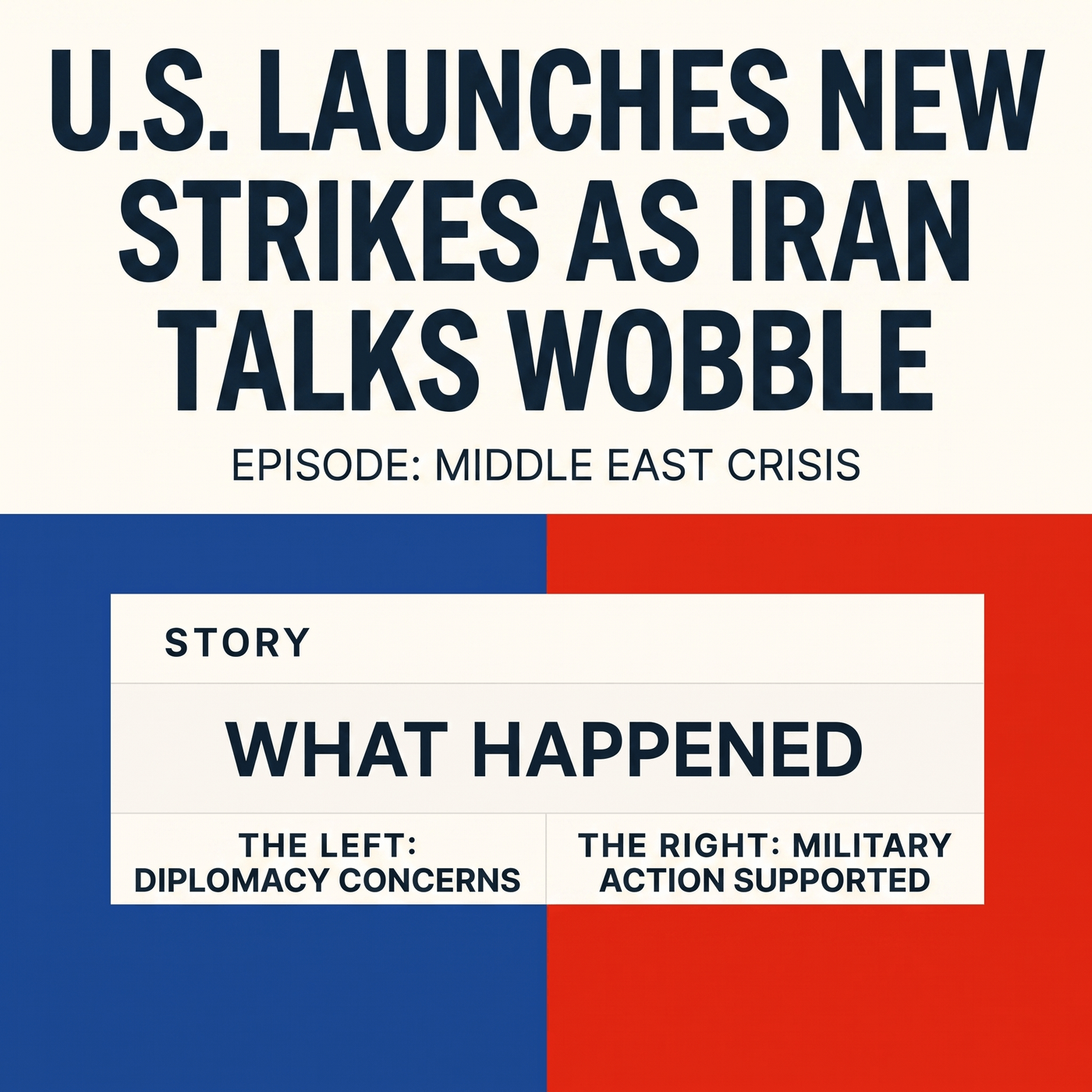
Strikes, Standoffs, and the Crypto Rulebook
Fresh U.S. strikes amid Iran ceasefire talks, a South China Sea standoff with a Dutch frigate, a moringa-linked Salmonella alert, a bipartisan college sports plan, and a White House push for crypto rules — all in one clear, balanced briefing. We break down the facts and how the right and left see them.
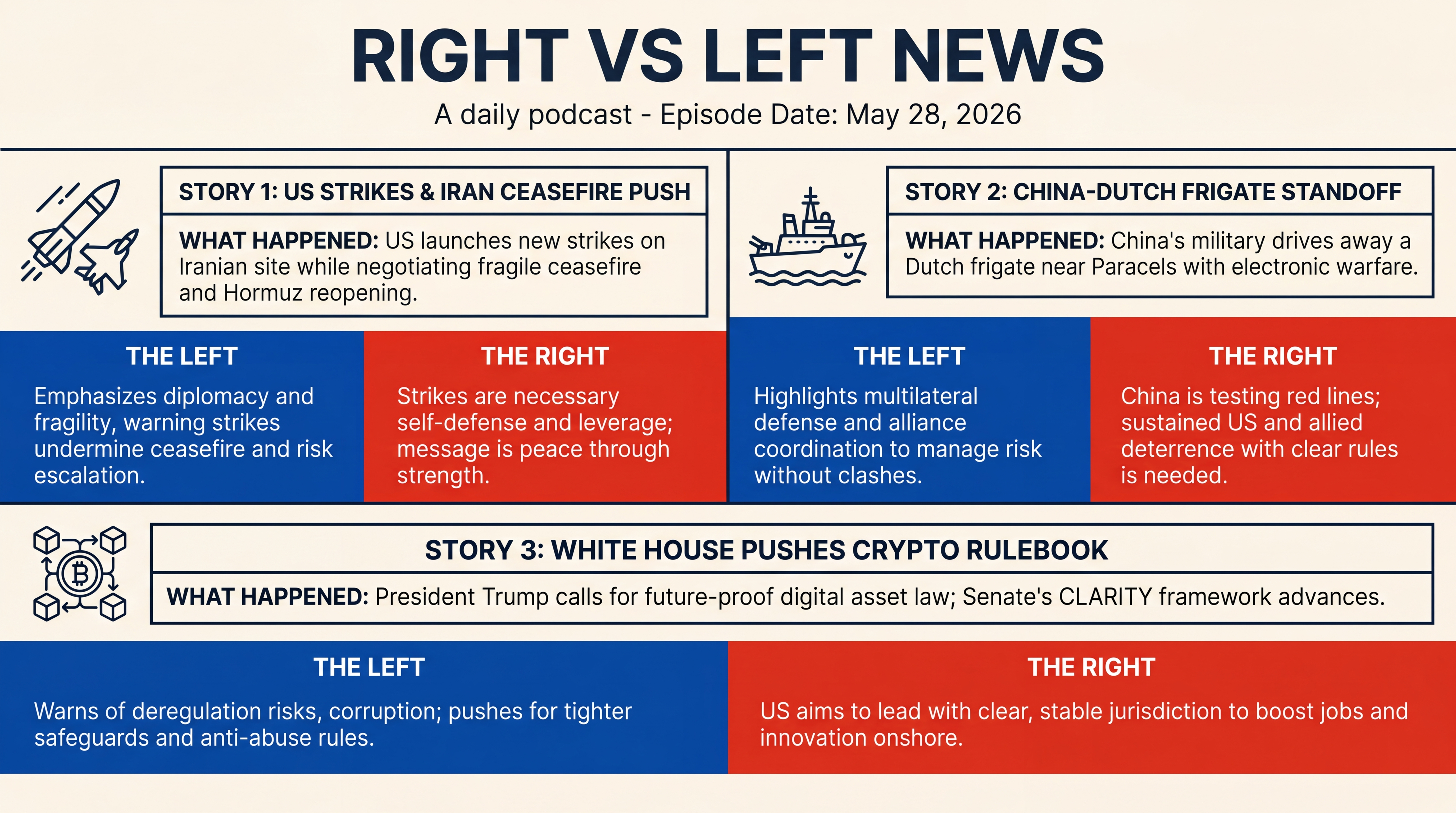
Episode Infographic
Show Notes
Welcome to Right versus Left News—your daily briefing on the stories that matter, told from both sides of the aisle. I'm your AI host - Chris, and each day I bring you the most important political and cultural news, with perspectives from conservative and progressive voices. No spin, no agenda—just the facts and the opinions that shape our national conversation. Let's dive in...
Quick heads up on what’s breaking over the last 24 hours.
The United States carried out fresh strikes connected to the Iran conflict, even as Washington pushes to extend a fragile ceasefire and reopen the Strait of Hormuz. In Asia, China says it drove away a Dutch frigate near the Paracels — another sign of rising tension on the water. Back home, the CDC issued a new health alert about growing Salmonella outbreaks tied to moringa supplements, and the FDA posted recall details. On Capitol Hill, a bipartisan bill from Senators Ted Cruz and Maria Cantwell aims to stabilize college sports by mixing revenue sharing with athlete protections. And at the White House, President Trump says he wants a future‑proof digital asset market law as the Senate’s CLARITY framework inches forward. That’s the landscape this morning.
[BEGINNING_SPONSORS]
Here’s what happened in the Middle East...
U.S. forces launched renewed strikes on an Iranian military site — the second in under a week — while negotiators worked to extend a U.S.-mediated ceasefire and to clear mines and reopen the Strait of Hormuz. Despite the diplomacy, fighting flared around Lebanon and Gaza, underscoring how fragile this truce window is. Timing matters... these updates landed overnight, Wednesday into Thursday, May 27th to 28th.
On the right, coverage frames the strikes as necessary self‑defense — pressure that is degrading Iran’s capabilities and nudging talks forward — while warning Tehran that the U.S. can finish the job if negotiations stall. The message is peace through strength, with firm terms on nuclear and proxy activity.
On the left, reporting emphasizes ceasefire fragility and humanitarian risks. Allies favor a negotiated off ramp and a secure reopening of Hormuz. Critics point to attacks by both sides during the truce as evidence that military moves are undermining diplomacy... and raising the risk of escalation.
In the South China Sea, here’s what happened...
China’s military says it organized naval and air forces to drive away a Dutch frigate near the Paracel Islands, and it reportedly used electronic warfare measures against the ship’s helicopter. Taiwan, meanwhile, logged concurrent PLA air and sea activity around the island. All of it unfolded Wednesday, May 27th, in disputed waters.
On the right, analysts argue Beijing is testing red lines — dismissing international rulings — and that only sustained U.S. and allied deterrence... more ships, stronger basing, clearer rules of engagement... will prevent coercion at sea.
On the left, coverage highlights Japan’s deepening defense ties with the Philippines and broader regional balancing — multilateral, diplomatic ways to check China without stumbling into a clash. The emphasis is on careful risk management and close alliance coordination over headline‑grabbing standoffs.
Public health update — here’s what happened...
The CDC issued a media alert Wednesday, May 27th, warning of a growing number of Salmonella illnesses tied to moringa leaf products and urging consumers to check for recalled items. The FDA, working with CDC and state partners, posted an outbreak page and a company recall for specific lots of Mogo brand moringa capsules sold online. No deaths reported... hospitalizations noted... investigation ongoing.
On the libertarian right, the argument is for targeted recalls and better consumer information rather than sweeping new supplement mandates — warning that FDA overreach can stifle innovation and limit choice, even while supporting prompt, transparent safety actions.
On the left, public health voices push for tighter standards and stronger enforcement. Repeat outbreaks are seen as evidence that the supplement market’s patchwork oversight leaves gaps — so the system needs more rigorous, proactive checks, not just after‑the‑fact responses.
[MIDPOINT_SPONSORS]
On Capitol Hill — here’s what happened...
Senators Ted Cruz and Maria Cantwell unveiled the bipartisan Protect College Sports Act on Wednesday, May 27th. The bill aims to stabilize college athletics by pairing athlete protections — health insurance, scholarship guarantees, and NIL guardrails — with limits on transfers and a mechanism for revenue sharing. It would grant limited antitrust protection to the NCAA and create a new College Sports Commission. Sponsors pitch it as a fix for chaos, while skeptics question the scope.
On the center right, the focus is on finally imposing uniform rules after years of litigation and state‑by‑state patchwork — keeping college sports from sliding fully into professionalization while preserving women’s and Olympic programs. Supporters argue modest antitrust protection is the price of restoring competitive balance.
On the left, progressives warn the draft tilts toward institutions — granting exemptions that could cap athlete pay and weaken leverage — while leaving open questions around employee status. They want stronger labor and revenue guarantees baked into any federal framework.
At the White House — here’s what happened...
President Trump said Wednesday evening, May 27th, that he will push to codify a future‑proof digital asset market structure, faulting former SEC Chair Gary Gensler for driving innovation offshore. The comments land as the Senate’s CLARITY Act advances in committee and the industry looks for consolidated rules.
On the right, pro‑crypto voices cast this as a signal that the U.S. aims to lead — standardize oversight, keep trading and tokenization onshore, and end the whipsaw of enforcement by settlement. Clear jurisdiction and stable rules, they say, will boost jobs and consumer protections alike.
On the left, Democrats warn current drafts risk deregulation, corruption, and loopholes for illicit finance. Amendments are being pushed to tighten safeguards and curb conflicts — even CLARITY backers advertise tough anti‑abuse provisions — underscoring an active fight over how permissive the final law should be.
Quick recap...
In the last day, U.S. and Iran brinkmanship mixed strikes with diplomacy. China’s run‑in with a Dutch frigate raised South China Sea stakes. The CDC and FDA flagged Salmonella risks tied to moringa supplements. A bipartisan Senate bill tried to reset college sports. And the White House vowed to lock in a national crypto rulebook while Senate talks continue.
We’ll keep tracking the facts — and the arguments from right and left — so you can decide what matters most.
That's it for today's episode of Right versus Left News. Remember, understanding both sides isn't about picking a team—it's about being informed. Subscribe wherever you get your podcasts, and join us tomorrow for another balanced look at the day's biggest stories. Until next time, stay curious and stay informed.
