
White House Gunfire, Hormuz Hopes, Kyiv Barrage
A fast, balanced briefing on a shooting near the White House, late-stage Iran ceasefire talks to reopen the Strait of Hormuz, and Russia’s punishing strikes on Kyiv. We also cover flotilla fallout and why Memorial Day gas prices are spiking.
Episode Infographic
Show Notes
Welcome to Right versus Left News—your daily briefing on the stories that matter, told from both sides of the aisle. I'm your AI host - Chris, and each day I bring you the most important political and cultural news, with perspectives from conservative and progressive voices. No spin, no agenda—just the facts and the opinions that shape our national conversation. Let's dive in...
Here’s the quick rundown for Sunday, May 24, 2026: a shooting steps from the White House leaves the suspect dead and a bystander wounded... the president says a deal to extend the Iran ceasefire and reopen the Strait of Hormuz is largely negotiated... Russia hammers Kyiv with one of its biggest air barrages of the war... a diplomatic dust-up follows Israel’s flotilla interceptions as France bars a hard-right Israeli minister... and Memorial Day gas prices hit a four-year high. Let’s dive in.
[BEGINNING_SPONSORS]
First, just outside the White House.
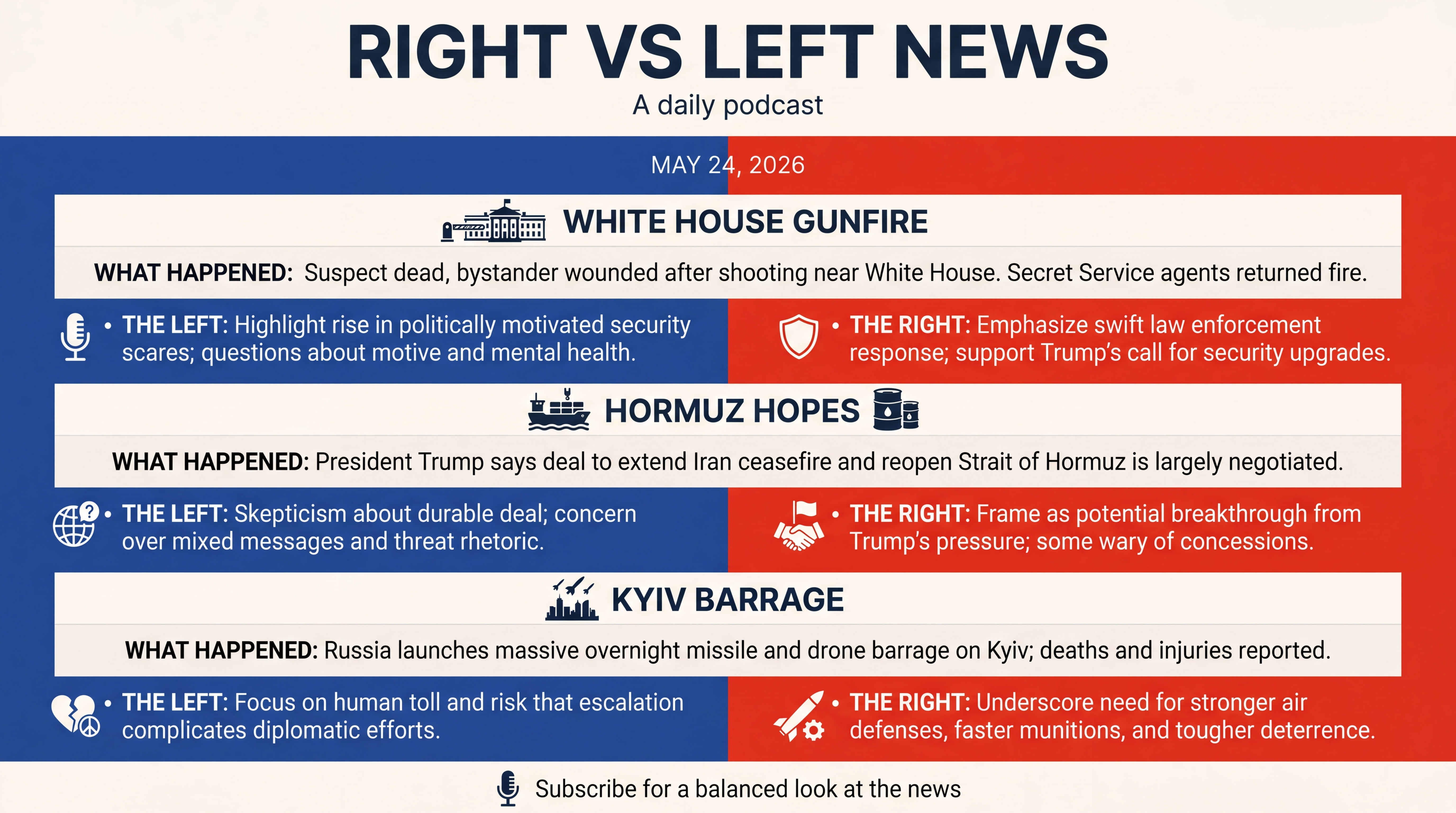
The Secret Service says a man opened fire near 17th Street and Pennsylvania Avenue Northwest on Saturday evening. Agents returned fire — the suspect later died at a hospital. A bystander was wounded. President Trump, who was inside the White House, thanked agents on social media. Reporters were briefly moved into the briefing room as a precaution. The Washington Post reports the suspect had a prior unlawful-entry case involving the White House complex. No Secret Service personnel were injured. The FBI is assisting the investigation.
On the right, Fox News emphasizes the swift law-enforcement response and a broader push to strengthen White House security — echoing Trump’s argument that new upgrades are warranted after recent threats.
On the left, the Washington Post highlights a rise in politically tinged security scares over the past year, and flags unanswered questions about motive and mental health.
Second, the Iran file.
President Trump says the United States is in the final stages of a deal to extend the ceasefire with Iran and reopen the Strait of Hormuz, with details to be announced shortly. Reporting points to parallel mediation by Pakistan and calls with regional leaders. Axios describes a draft envisioning a 60-day extension while oil flows resume and nuclear talks continue. Secretary of State Marco Rubio says there’s been progress — while warning strikes could resume if talks fail.
On the right, Fox News frames this as a potential breakthrough driven by Trump’s pressure campaign, citing supportive readouts from Arab partners. Some conservative hawks remain wary of concessions that would give Tehran access to cash or let it retain enriched uranium. At National Review, writers argue the United States still holds leverage and should lock in terms that keep Hormuz open without tolls and curb Iran’s nuclear advances.
On the left, the Washington Post spotlights conservative critics like Lindsey Graham and Mike Pompeo who call the rumored terms too lenient. The Guardian stresses mixed messages, threat-laden rhetoric, and skepticism that a durable deal is truly at hand.
Third, Kyiv under fire.
Russia launched a massive overnight barrage against the Ukrainian capital — officials say hypersonic Oreshnik missiles were used alongside drones and other munitions. At least two people were killed and dozens injured, according to the Associated Press. Images showed residents sheltering in metro stations, and live broadcasts captured the scale and timing of the strikes after Moscow vowed retaliation.
On the right, conservative national security voices say the attack underscores the need for stronger air defenses, faster munitions resupply, and tougher deterrence — casting Ukraine as a test of modern warfare where quantity and technology matter as much as strategy.
On the left, outlets like CBS News and the Associated Press focus on the human toll and the risk that each escalation complicates diplomacy — warning that tit-for-tat strikes can harden positions on both sides.
[MIDPOINT_SPONSORS]
Fourth, fallout from the flotilla interceptions.
After Israel stopped a Gaza-bound flotilla in international waters this week, deportations of activists began — and new allegations surfaced. The Associated Press reports some detainees from South Africa say they were shocked with electricity while in custody. France, in an unusually sharp rebuke of a close ally, barred Israel’s national security minister, Itamar Ben-Gvir, from entering the country after he posted what Paris called unspeakable taunts of detainees.
On the right, Fox News highlights U.S. sanctions on flotilla organizers and Israeli claims that the mission aided Hamas narratives — portraying the interceptions as lawful enforcement of a security blockade, and the sanctions as necessary to curb extremist networks.
On the left, Al Jazeera and others center activists’ accounts of mistreatment, the scale of the interdictions, and the legality of high-seas stops — casting France’s move against Ben-Gvir as part of wider alarm over human rights abuses linked to the Gaza war. The Washington Post has similarly documented the breadth of the flotilla stops.
Fifth, the price at the pump.
Memorial Day travelers are paying steep prices. Triple-A’s national average sits around four dollars and fifty-one cents today, and all fifty states are above four dollars as ripple effects from the Iran war lift fuel costs. Analysts say reopening Hormuz in a durable deal could lower oil benchmarks — but retail gas usually lags, so relief would be gradual even if talks succeed.
On the right, Fox News frames the spike as a geopolitical shock that strengthens the case for more domestic production, more pipeline capacity, and long-term energy independence. Some conservative commentators argue hard-nosed diplomacy that secures Hormuz is worth short-term pain. National Review notes how war-driven energy costs are squeezing household budgets.
On the left, The Guardian and CBS News emphasize that even with a ceasefire extension, prices may not quickly return to early 2026 levels — pointing to risk premiums, refinery constraints, profit margins, and the need for targeted consumer relief.
Before we go, a quick recap... In Washington, a shooting just outside the White House left a suspect dead as security tensions persist. On Iran, the administration says a ceasefire extension and a reopening of Hormuz are close. In Ukraine, Kyiv endures another punishing barrage. Flotilla fallout sparks a rare French ban on an Israeli minister. And holiday fuel costs stay high as markets watch the ceasefire news. We’ll keep tracking all five as the week begins.
That's it for today's episode of Right versus Left News. Remember, understanding both sides isn't about picking a team—it's about being informed. Subscribe wherever you get your podcasts, and join us tomorrow for another balanced look at the day's biggest stories. Until next time, stay curious and stay informed.
