
Troops to Poland, Capitol Clash, Airport Standoff
Trump sends troops to Poland as Senate Republicans revolt over the anti-weaponization fund, House leaders shelve an Iran war powers vote, DHS pressures sanctuary-city airports, and oil climbs amid stalled talks. A concise, balanced rundown to keep you current.
Episode Infographic
Show Notes
Welcome to Right versus Left News—your daily briefing on the stories that matter, told from both sides of the aisle. I'm your AI host - Chris, and each day I bring you the most important political and cultural news, with perspectives from conservative and progressive voices. No spin, no agenda—just the facts and the opinions that shape our national conversation. Let's dive in...
Here's the quick rundown for Friday, May 22, 2026. The White House says five thousand more U.S. troops are heading to Poland... Senate Republicans just iced their own immigration funding bill in a fight over President Trump's new anti-weaponization fund... House GOP leaders abruptly canceled a vote to limit the Iran war... Homeland Security is floating a dramatic move to squeeze sanctuary-city airports... and oil prices are climbing again as investors doubt a quick peace between the U.S. and Iran. Let's unpack it.
[BEGINNING_SPONSORS]
First up — here's what happened...
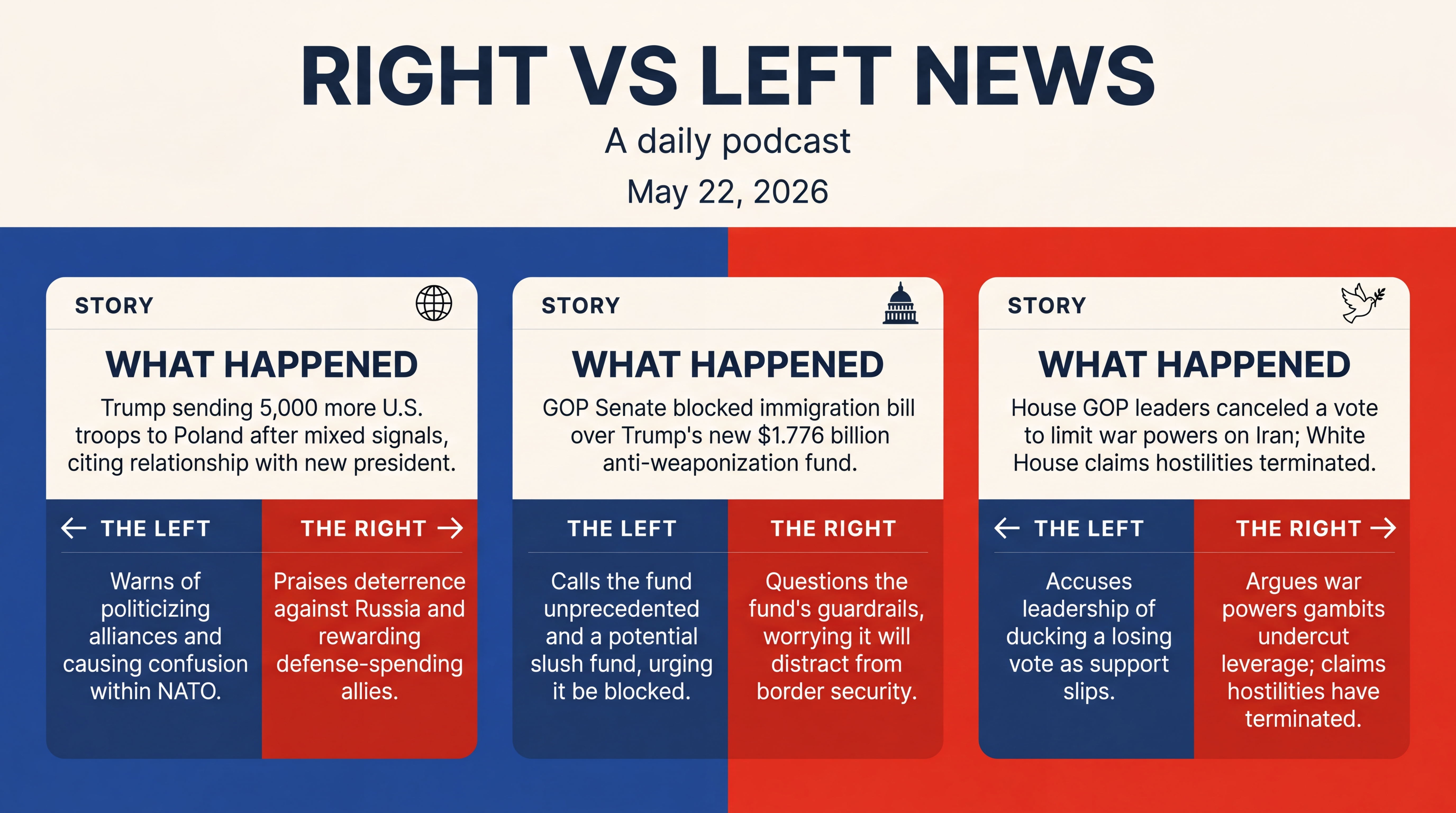
President Trump announced late Thursday that the U.S. will send an additional five thousand troops to Poland, citing his relationship with Poland's new president, Karol Nawrocki. The move follows days of confusion after a planned rotation of roughly four thousand troops was paused — and it comes amid broader posture shifts across Europe. Allies have expressed unease over the whipsawing signals, and many say the announcement appears to reverse talk of reductions elsewhere on the continent. The message went up on Truth Social and was quickly echoed by Polish officials.
How's the right framing it? On Fox News, coverage emphasizes moving assets toward frontline allies and rewarding partners who spend heavily on defense — and Poland clears NATO's benchmark. They cast the surge as deterrence against Russia and a reset toward reliable allies. Some conservatives add that repositioning inside Europe isn't a retreat — it's a reprioritization.
How's the left framing it? The Washington Post and The Guardian highlight confusion for NATO governments and warn that the personal, political framing — Trump explicitly crediting an endorsed Polish leader — risks politicizing deployments. The Associated Press reports diplomats are working overtime to reassure allies unnerved by rapid shifts. Progressive commentators say policy set by social media post invites miscalculation in Europe.
Next — here's what happened...
A Republican revolt in the Senate stalled a GOP immigration-enforcement funding push after members balked at the administration's new one point seven seven six billion dollar anti-weaponization fund — part of a Justice Department settlement tied to Trump's IRS leak lawsuit. The fight broke open Thursday night, with detailed reporting on how the fund works and why it's dividing Republicans. Fox News noted that Majority Leader John Thune signaled unease, while Democrats rolled out legislation to shut the fund down.
From the right: Several Republicans are calling the fund a potential slush fund, questioning whether January 6 convicts could benefit and arguing that if compensation is warranted, Congress — not the Justice Department — should set the guardrails. Some conservatives add that the fight is drowning out border-security messaging and jeopardizing ICE and CBP funding.
From the left: Editorial boards and legal analysts urge Congress to block the fund outright, calling it unprecedented and vulnerable to legal challenge. Democrats in both chambers are preparing oversight and prohibition bills, and progressive outlets are highlighting a new lawsuit by officers injured on January 6 arguing the fund is unlawful.
Third — here's what happened...
House Republican leaders abruptly canceled a vote on a war powers resolution to rein in the conflict with Iran — after signs the measure could pass. Leadership pulled the plug as absences mounted and support wavered. It would have been Congress's first successful formal rebuke of Trump's Iran campaign. Earlier this month, Trump told Congress that hostilities... have terminated — a move the White House sees as resetting the War Powers clock.
From the right: Republicans argue repeated war powers gambits risk undercutting leverage on Tehran and that military action has already been narrowed. Some also say the President's terminated notice changes the legal calculus.
From the left: Reporting emphasizes slipping congressional support for the war and accuses leadership of ducking a losing vote. Progressive commentators say declaring hostilities terminated while sustaining a blockade and intermittent strikes is legal wordplay that defies the spirit of the War Powers Resolution.
[MIDPOINT_SPONSORS]
Fourth — here's what happened...
Homeland Security Secretary Markwayne Mullin privately warned airline and travel executives that DHS could halt immigration and customs processing at major airports in sanctuary cities that won't cooperate with the administration's enforcement push — cities like New York, Los Angeles, Chicago, Seattle, and San Francisco. Mullin floated the idea publicly in April. Analysts warn of huge disruptions if Customs and Border Protection officers are pulled, and Fox News previously aired his remarks signaling closer scrutiny of customs in those jurisdictions.
From the right: Supporters frame the threat as long-overdue leverage — if local officials refuse to honor detainers or share information, Washington shouldn't make international arrivals easy for them. Using federal processing as pressure, they argue, could force cooperation and enhance public safety.
From the left: Critics warn this would be chaotic collective punishment — risking flight cancellations, stranded travelers, and economic harm to entire metro regions. Civil-liberties advocates also question the legality of selectively withholding federal processing to coerce local policy changes.
Finally — here's what happened...
Oil prices ticked higher Friday in Asia as investors lost faith in a swift breakthrough between the U.S. and Iran. Crude gained more than a dollar as talks remained stuck over uranium stockpiles and access through the Strait of Hormuz. Stocks were mixed as energy jitters persisted. Americans face a pricey Memorial Day at the pump, with analysts tying most of the surge to the war's supply shock.
From the right: Prolonged disruptions in the Strait feed inflation — the answer, they say, is more U.S. production, faster permits, and new pipelines. Some conservative writers add that blue state regulations magnify price pain.
From the left: Coverage emphasizes consumer impacts and the political risk of high gas prices, arguing the quickest relief is diplomatic — reopening tanker traffic — plus coordinated releases from strategic reserves. Longer term, they push for efficiency and clean-energy investment. The International Energy Agency's May report flags record inventory draws and warns of more volatility into summer.
Before we go, a quick recap: five thousand more U.S. troops to Poland... a GOP family feud stalls immigration enforcement funding over the anti-weaponization fund... House leaders shelve a vote that could have clipped Iran war powers... DHS is rattling sanctuary-city airports... and oil's up again as talks sputter. We'll keep watching through the weekend... stay informed, stay balanced, and we'll be back with more tomorrow.
That's it for today's episode of Right versus Left News. Remember, understanding both sides isn't about picking a team—it's about being informed. Subscribe wherever you get your podcasts, and join us tomorrow for another balanced look at the day's biggest stories. Until next time, stay curious and stay informed.
