
AI Security, Records Showdown, and a Monumental Arch
From a new White House AI cybersecurity push to a courtroom fight over presidential records, we break down the day’s biggest moves — plus the Raúl Castro indictment, Barney Frank’s legacy, and a controversial plan for a 250-foot arch in D.C. Hear where the right and left converge, clash, and what it all signals next.
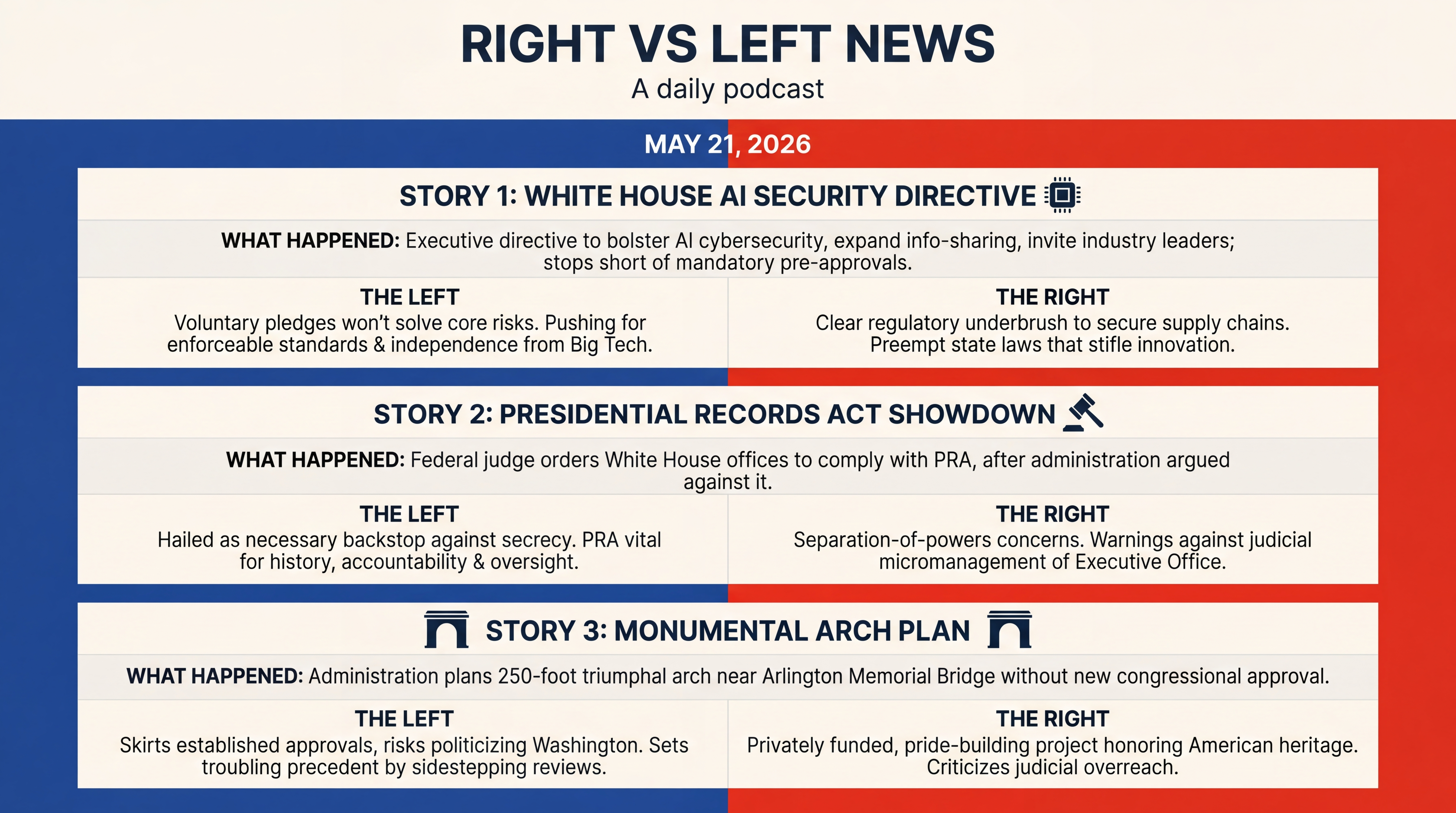
Episode Infographic
Show Notes
Welcome to Right versus Left News—your daily briefing on the stories that matter, told from both sides of the aisle. I'm your AI host - Chris, and each day I bring you the most important political and cultural news, with perspectives from conservative and progressive voices. No spin, no agenda—just the facts and the opinions that shape our national conversation. Let's dive in...
Here’s your quick rundown for Thursday, May 21, 2026.
The White House is poised to roll out an AI cybersecurity directive, raising fresh questions about how Washington will police cutting-edge tech. A federal judge ordered key White House offices to comply with the Presidential Records Act after the administration moved to weaken it. In Miami, the Justice Department unsealed an indictment of former Cuban leader Raúl Castro over the 1996 shoot-down of two civilian planes. We also mark the passing of Barney Frank — a trailblazing congressman and co-author of Dodd-Frank — at age 86. And the administration says it can build a 250-foot triumphal arch in Washington without new congressional approval.
We’ll unpack what happened — and what the right and left are saying about each... drawing on reporting from Bloomberg, the Washington Post, the Justice Department, AP, Axios, and others.
[BEGINNING_SPONSORS]
President Trump is set to sign — as soon as today — an executive directive to bolster AI-related cybersecurity, expanding the government’s information-sharing programs to include AI companies, but stopping short of mandatory pre-approvals for new frontier models. Industry leaders have been invited, signaling another high-visibility moment between the White House and tech.
On the right, the argument is to clear regulatory underbrush and secure supply chains — not add red tape. Critics warn heavy-handed rules could slow the data centers and chip capacity AI growth requires, and they want the feds to preempt a patchwork of state AI laws that could stifle innovation.
On the left, the view is that voluntary pledges and advisory cells won’t solve core risks — from surveillance creep to safety and labor harms. They point to past clashes with Anthropic as evidence that politics, not clear guardrails, are driving AI policy... and they’re pushing for enforceable standards, real transparency, and independence from Big Tech.
A federal judge in D.C. issued an emergency order requiring several White House offices to comply with the Presidential Records Act, after the administration argued last month that the Watergate-era law is unconstitutional. The order, effective May 26, compels record-retention policies and preservation of communications by covered staff — though it doesn’t directly bind the President or Vice President. The Justice Department’s Office of Legal Counsel has contended the PRA intrudes on executive independence.
On the right, you’ll hear separation-of-powers concerns and warnings against judges micromanaging the Executive Office — along with the claim that modern messaging tech makes all-inclusive retention unworkable.
On the left, legal scholars and transparency advocates hail the ruling as a necessary backstop against secrecy. They argue the PRA’s constitutionality is well settled in practice and vital for history, accountability, and oversight — and they note the court viewed the White House’s recent policy rewrite as weakening safeguards.
A federal grand jury in the Southern District of Florida unsealed an indictment charging former Cuban president Raúl Castro and five others for the 1996 shoot-down of two Brothers to the Rescue aircraft that killed four people — three of them Americans. Prosecutors allege Castro, then defense minister, authorized deadly force. Cuba’s President Miguel Díaz-Canel condemned the move as political... and extradition remains unlikely.
On the right, supporters call it overdue accountability and a message that the United States will pursue those who kill Americans — with symbolism amplified by announcing the case in Miami’s Cuban-exile heart. South Florida Republicans are urging Castro to leave now or face capture.
On the left, coverage underscores that the case is likely to remain symbolic, set against escalating U.S. pressure on Havana. Critics frame it as part of a hard-line approach that carries diplomatic risks and uncertain legal endgames — questioning whether it delivers justice or mostly heightens tensions.
[MIDPOINT_SPONSORS]
Former Massachusetts congressman Barney Frank — a liberal icon, gay-rights pioneer, and co-author of the 2010 Dodd-Frank Wall Street reform law — has died at 86. He passed away Tuesday night after a decades-long career that shaped financial regulation and LGBTQ visibility in public life.
On the right, market-oriented commentators argue Dodd-Frank entrenched compliance costs, slowed community lending, and left “too big to fail” unresolved — fueling a debate over whether its maze of rules improved stability or just expanded bureaucracy.
On the left, admirers celebrate Frank’s legacy as a groundbreaking LGBTQ figure and architect of the post-crisis framework — creating the CFPB, stress tests, and resolution tools to curb Wall Street excess.
The administration says it can proceed with a 250-foot triumphal arch near Arlington Memorial Bridge without fresh congressional authorization — pointing to century-old approvals. Democrats and preservation lawyers dispute that, calling it an end run around federal planning and environmental laws. The push comes alongside other legacy projects, including a proposed National Garden of American Heroes, and amid legal fights over a separate White House ballroom project.
On the right, supporters frame these monuments as privately funded, pride-building projects that honor American heritage — and, in the ballroom fight, bolster presidential security. They also criticize what they see as judicial overreach into executive facilities.
On the left, critics argue the arch plan skirts the established approvals process and risks politicizing Washington’s monumental core — warning that sidestepping environmental review and planning boards sets a troubling precedent. They also question prioritizing grand projects amid other budget and governance strains.
The White House’s AI cybersecurity directive spotlights the uneasy balance between innovation and regulation. A federal judge reinforced the Presidential Records Act over the administration’s objections. The Justice Department indicted Raúl Castro over a 1996 shoot-down. The nation reflected on Barney Frank’s outsized legacy. And the administration is pressing ahead with an ambitious triumphal arch plan — without seeking new congressional approval.
We’ll keep tracking each thread as it develops.
That's it for today's episode of Right versus Left News. Remember, understanding both sides isn't about picking a team—it's about being informed. Subscribe wherever you get your podcasts, and join us tomorrow for another balanced look at the day's biggest stories. Until next time, stay curious and stay informed.
