
Fund Fights, Mega-Utility, Voting Maps, and Putin
A fast, clear briefing on Washington’s new Anti-Weaponization fund, a $67 billion NextEra–Dominion power merger, the Supreme Court’s Voting Rights Act pivot, six-state primaries, and Putin’s Beijing visit. We break down what happened, why it matters, and how the left and right are framing it.
Episode Infographic
Show Notes
Welcome to Right versus Left News—your daily briefing on the stories that matter, told from both sides of the aisle. I'm your AI host - Chris, and each day I bring you the most important political and cultural news, with perspectives from conservative and progressive voices. No spin, no agenda—just the facts and the opinions that shape our national conversation. Let's dive in...
Here’s today’s rundown... In Washington, the Justice Department unveiled a nearly $1.8 billion Anti-Weaponization fund tied to President Trump dropping his $10 billion IRS lawsuit. In the energy world, NextEra and Dominion announced a $67 billion all-stock tie-up — potentially the biggest regulated utility on Earth, fueled by AI’s hunger for electricity. At the Supreme Court, justices sent a closely watched Native American voting-rights case back to a lower court after last month’s ruling that narrowed the Voting Rights Act. At the ballot box, it’s primary day for Alabama, Georgia, Idaho, Kentucky, Oregon, and Pennsylvania — with Kentucky’s Thomas Massie facing a Trump-backed challenge. And overseas, Vladimir Putin touches down in Beijing for talks with Xi Jinping — just days after Trump’s state visit there. These stories are moving fast... so let’s dig in.
[BEGINNING_SPONSORS]
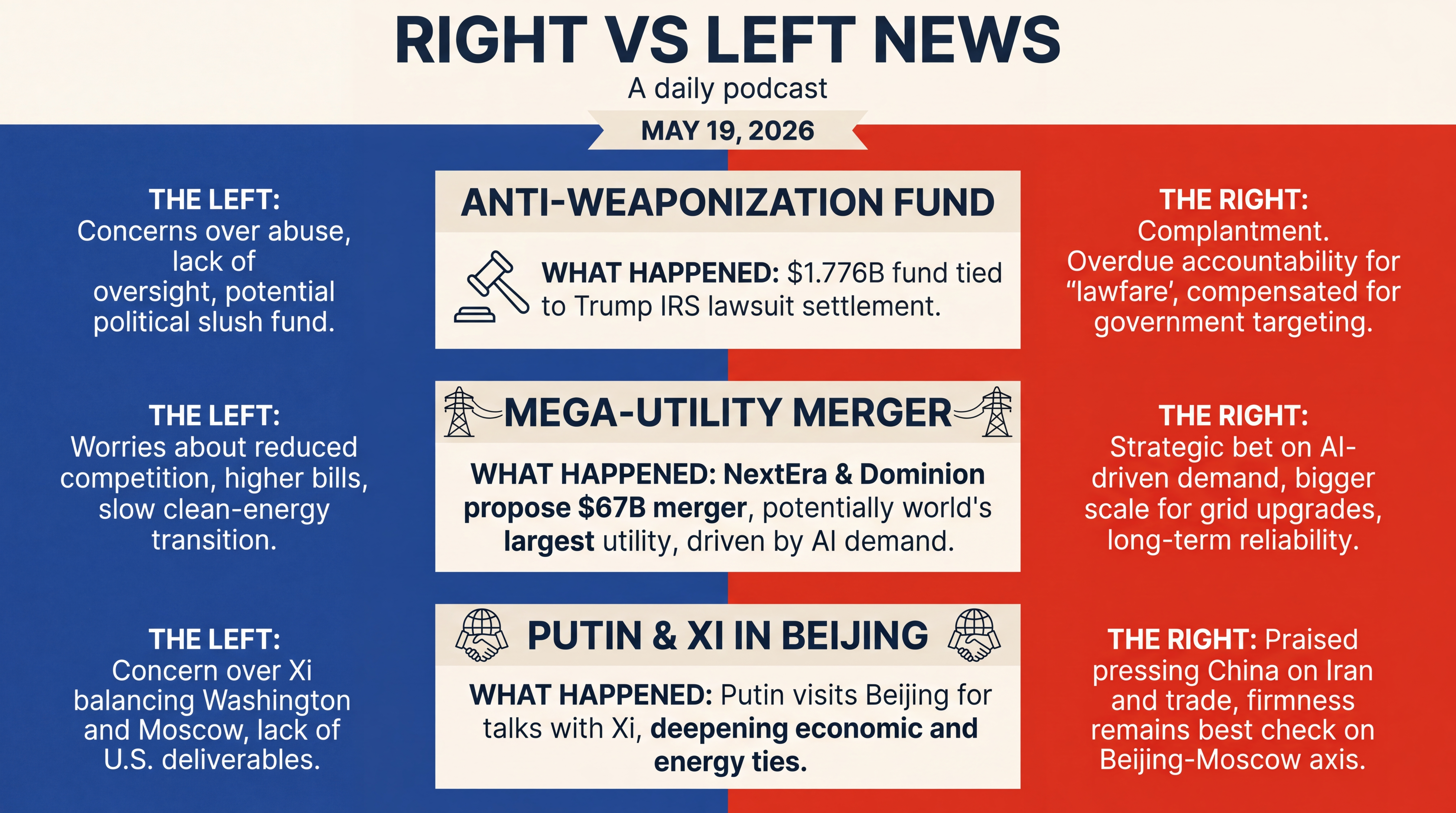
The Justice Department announced a $1.776 billion Anti-Weaponization Fund, part of a settlement that ends President Trump’s lawsuit against the IRS over the leak of his tax returns.
Acting Attorney General Todd Blanche says the fund creates a path for people who believe they were unfairly targeted to seek compensation. Critics call the move unprecedented and ripe for abuse, while the DOJ insists any American can apply. That’s where things stand as of May 18.
On the right, many frame the fund as overdue accountability for so-called lawfare — a way to compensate people who say the government was used against them, while closing out a costly, distracting lawsuit.
On the left, skeptics focus on the risks of a large compensation pool outside normal channels — warning it could operate like a political slush fund, blur lines between the White House and the Justice Department, and raise tough questions about who qualifies as a victim and what oversight looks like.
NextEra Energy and Dominion Energy unveiled a roughly $67 billion all-stock merger to create what could be the world’s largest regulated electric utility by market value.
With data centers and AI driving power demand sharply higher, the companies say scale will help ensure reliability and — over time — lower costs. The deal still needs shareholder approval and sign-offs from the Federal Energy Regulatory Commission, the Nuclear Regulatory Commission, antitrust regulators, and multiple state utility commissions.
On the right, the move is seen as a strategic bet on AI-driven demand — a bigger balance sheet and unified planning that could speed grid upgrades, new generation, and overall energy security. Market-friendly voices argue consolidation can lower long-run costs if regulators keep rates honest.
On the left, consumer advocates warn that more concentration could reduce competition and push bills higher — especially in data-center hubs like Virginia. Environmental groups worry a mega-utility could slow-walk the clean-energy transition if profits favor fossil fuels or costly mega-builds. Approvals may hinge on bill credits, enforceable reliability guarantees, and concrete climate targets.
The Supreme Court sent a Native American voting-rights case back to the lower courts, following last month’s Louisiana versus Callais decision that narrowed how Section 2 of the Voting Rights Act can be used.
The new standard shifts focus away from discriminatory effects and more toward proving intentional discrimination. In North Dakota, tribes challenging maps they say dilute Native voting power will now face that higher bar as the case is reconsidered.
On the right, legal commentators say the Court is reining in race-forward map-making and restoring the Voting Rights Act to target intentional discrimination — not partisan line-drawing that happens to correlate with race. They see the remand as consistent with Callais — protect equal treatment without mandating racial quotas in redistricting.
On the left, civil-rights groups call Callais a severe blow to the Voting Rights Act. Requiring proof of intent, they argue, will let many discriminatory maps stand — and Monday’s remand signals that communities of color, including Native voters, now face steeper odds when they challenge dilution.
[MIDPOINT_SPONSORS]
It’s primary day — Tuesday, May 19 — in Alabama, Georgia, Idaho, Kentucky, Oregon, and Pennsylvania.
The marquee fight is in Kentucky, where Republican incumbent Thomas Massie — a frequent Trump critic — faces Trump-endorsed Navy SEAL veteran Ed Gallrein in what many are calling the most expensive congressional primary in U.S. history. Defense Secretary Pete Hegseth appeared in Kentucky on Monday — saying he was there in a personal capacity — to boost Gallrein, an unusual Cabinet-level foray into a House race.
On the right, the race is cast as a test of party unity and the president’s agenda — with national-security hawks signaling they want reliable votes in Congress at a fraught moment globally.
On the left, commentators highlight how rare it is for a defense secretary to wade into a primary, raising Hatch Act concerns and the normalization of hardball tactics against intra-party dissenters. Win or lose, the Massie contest is a live measure of Trump’s grip on the GOP.
Russian President Vladimir Putin arrives in Beijing for a two-day visit with China’s Xi Jinping — just days after Trump’s own summit there.
Moscow and Beijing say they’ll deepen economic and energy ties and issue a joint statement. Analysts note the optics — Beijing positioning itself between Washington and Moscow.
On the right, many praised pressing China on Iran and trade while keeping communication channels open — and argue that firmness on tariffs, tech controls, and defense buildup remains the best check on a tightening Beijing–Moscow axis.
On the left, analysts point to the lack of concrete deliverables from Trump’s Beijing swing and say Putin’s visit lets Xi show he can talk to both Washington and Moscow without changing his stance on Ukraine, Taiwan, or tech. The concern is that the U.S. could be outmaneuvered if it mistakes photo-ops for leverage.
Big picture... Washington’s new compensation fund is igniting a rule-of-law fight. Utilities want to merge big to power the AI era. The Court’s Voting Rights Act shift is reshaping Native voting cases. Six-state primaries will test Trump’s sway. And Putin’s Beijing stop underscores China’s careful triangulation.
We’ll keep an eye on what changes by tomorrow.
That's it for today's episode of Right versus Left News. Remember, understanding both sides isn't about picking a team—it's about being informed. Subscribe wherever you get your podcasts, and join us tomorrow for another balanced look at the day's biggest stories. Until next time, stay curious and stay informed.
