
Security Fights, Sanctions Shifts, and Southern Showdowns
From a derailed White House security package to Louisiana’s political shakeups, we break down the day’s biggest stories with arguments from the right and the left. Plus, the latest on Russian oil sanctions and China’s stance on reopening the Strait of Hormuz.
Episode Infographic
Show Notes
Welcome to Right versus Left News—your daily briefing on the stories that matter, told from both sides of the aisle. I'm your AI host - Chris, and each day I bring you the most important political and cultural news, with perspectives from conservative and progressive voices. No spin, no agenda—just the facts and the opinions that shape our national conversation. Let's dive in...
Here’s the quick rundown for Sunday, May 17, 2026.
The Senate parliamentarian derailed a one billion dollar plan to upgrade White House security — including funding tied to President Trump’s new East Wing ballroom. Louisiana’s Republican primary ousted incumbent Senator Bill Cassidy, with two challengers headed to a runoff. The United States let a sanctions waiver on Russian seaborne oil lapse, stirring energy watchers at home and abroad. Trump says China’s Xi agrees Iran must reopen the Strait of Hormuz — though Beijing hasn’t promised action. And Louisiana voters rejected five state constitutional amendments in one sweep.
We’ll unpack the facts... and the arguments from the right and the left on each.
[BEGINNING_SPONSORS]
First, the parliamentarian’s ruling.
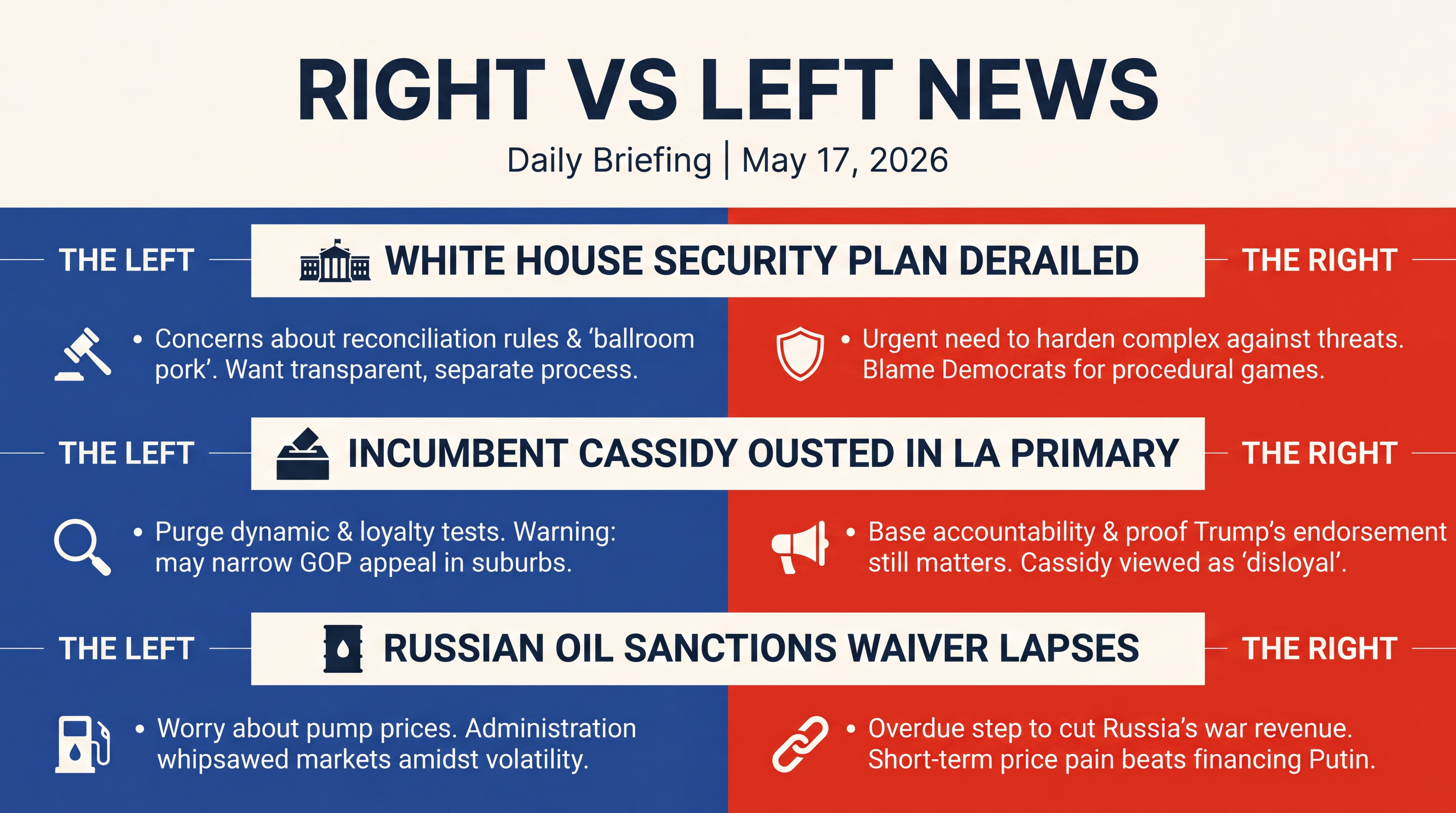
Republicans can’t tuck as much as one billion dollars in Secret Service and White House security upgrades — about two hundred twenty million linked to the new East Wing ballroom — into a filibuster-proof budget bill. The decision, disclosed late Saturday, says the package is too broad for reconciliation rules. It’s a blow to GOP leaders who framed it as urgent after the April twenty-fifth D.C. gala shooting scare. Details were reported by the Associated Press and the Washington Post.
On the right, Republicans argue this wasn’t a ballroom slush fund — it was a complex-wide hardening plan: ballistic glass, drone detection, training — amid rising threats to public officials. Homeland Security and the Secret Service, they note, say most of the money supports core protective missions beyond the ballroom. Expect conservatives to argue Democrats are playing procedural games with presidential security.
On the left, coverage in the Guardian, PBS, and the Post highlights concerns about trying to funnel security money through reconciliation while a separate lawsuit challenges parts of the project. Progressives call the ruling a needed check on “ballroom pork,” and want Congress to handle any upgrades transparently — and separate from immigration enforcement fights.
In Louisiana’s Republican primary, a surprise.
Senator Bill Cassidy — one of seven GOP senators who voted to convict Trump in 2021 — failed to make the runoff. Representative Julia Letlow led, and Treasurer John Fleming placed second. They’ll face off June twenty-seventh under the state’s new closed primary system. The Washington Post, the Associated Press, and Axios confirm the timeline and results.
On the right, Fox News leans into Trump’s influence. Labeling Cassidy “disloyal” became a rallying cry, and the outcome is framed as base accountability — proof endorsements still matter. Some conservatives add that Cassidy’s votes on infrastructure and health policy left him out of step with the party’s populist turn.
On the left, the Post and the Guardian describe a purge dynamic — loyalty tests over independence — and warn it could narrow the GOP’s appeal in the suburbs even as it energizes core voters. Confusion under the new rules is a subplot, but the center-left bottom line is simple: it’s Trump’s party.
On energy and Russia.
The United States allowed a temporary sanctions waiver to expire. That waiver had let countries buy certain Russian oil cargoes already at sea — a stopgap first extended in April during the Hormuz crisis. Letting it lapse could squeeze India’s imports, even as supplies remain tight. Reuters, Bloomberg, and Fortune reported the move, and two Senate Democrats had urged ending the waiver, arguing it wasn’t lowering U.S. gas prices and was aiding Russia’s war revenue.
On the right, conservative outlets like the Washington Examiner call the lapse overdue — tightening the screws on the Kremlin and restoring consistency after mixed signals in April. The argument is simple: short-term price pain beats financing Putin.
On the left, many progressives back hitting Russia — but worry about pump prices, and say the administration whipsawed markets by extending, then ending, a carve-out while Iran-war volatility persists. The message there: pair tougher sanctions with relief at home.
[MIDPOINT_SPONSORS]
Now to China and the Strait of Hormuz.
Returning from Beijing, President Trump said China’s Xi agreed the strait must be reopened and indicated willingness to help... but Beijing hasn’t promised concrete steps. Fox News highlighted Trump’s comments. The Associated Press tracked anxieties over Trump suggesting Taiwan arms sales are a negotiating chip, while other outlets noted modest deliverables.
On the right, conservative commentators frame the ask as smart leverage — pressuring Tehran through its biggest oil customer and keeping military options on the table if talks stall. Use China’s clout to end Iran’s blockade and avoid a wider war — while being ready to act if diplomacy fails.
On the left, outlets stress the risks. Treating Taiwan as a bargaining chip alarms a U.S. partner, and China’s rhetorical alignment doesn’t equal enforcement on Iran. The progressive consensus: the summit stabilized optics more than outcomes — no clear pathway yet to reopen Hormuz or de-escalate the region.
Finally, Louisiana’s constitutional amendments.
Nearly eight hundred thousand voters rejected all five proposals — covering civil-service changes, a new school district, and a plan to fund teacher raises from specific reserves. Public radio tallies show each measure failed, some by lopsided margins.
On the right, many conservatives see a blanket no as taxpayer skepticism — resistance to constitutional tinkering, a preference for legislative fixes over permanent changes, and pushback on inventory-tax and judiciary-retirement tweaks viewed as carve-outs.
On the left, progressives emphasize missed chances: teacher pay raises lost a funding path, and education-focused measures — though controversial — won’t advance. Local coverage also noted that confusion around the new primary and ballot language colored the night.
That’s our twenty-four hour snapshot. The Senate’s rules clipped a White House security push... a Trump-era purge reshaped a Senate race... Washington tightened Russian oil sanctions... Beijing talks soothed optics more than substance... and Louisiana voters hit the brakes on constitutional change.
We’ll be back tomorrow with what moves next — and who moves the votes.
That's it for today's episode of Right versus Left News. Remember, understanding both sides isn't about picking a team—it's about being informed. Subscribe wherever you get your podcasts, and join us tomorrow for another balanced look at the day's biggest stories. Until next time, stay curious and stay informed.
