Five Flashpoints: Clemency, Maps, Ceasefire, Data, Trades
Five big stories, clear facts, and the competing narratives: Colorado’s clemency for Tina Peters, Virginia’s frozen map, an extended Israel–Lebanon ceasefire, the EEOC’s reporting shift, and Trump’s trading disclosures. We break down what happened — and how the right and the left are framing each.
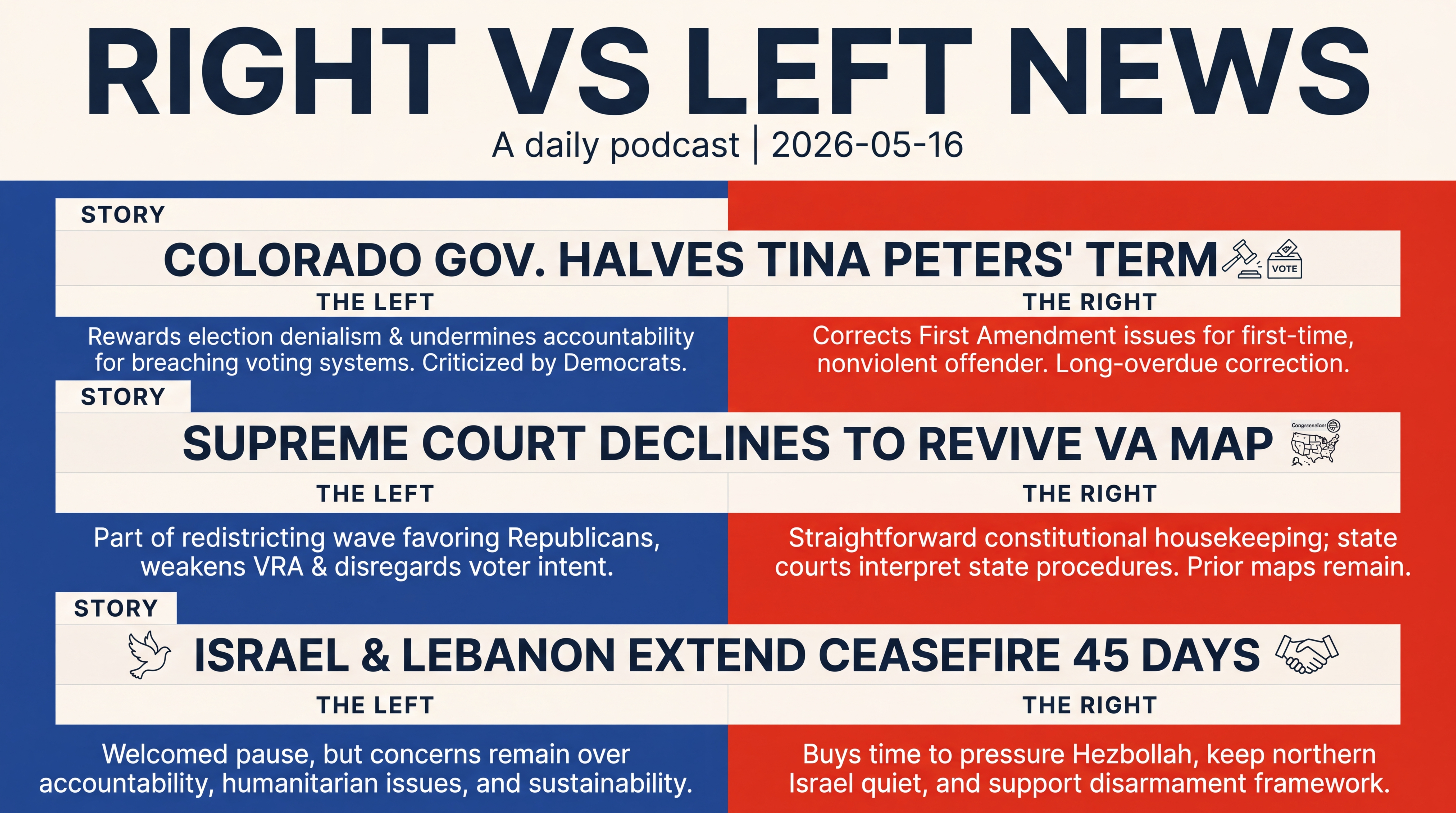
Episode Infographic
Show Notes
Welcome to Right versus Left News—your daily briefing on the stories that matter, told from both sides of the aisle. I'm your AI host - Chris, and each day I bring you the most important political and cultural news, with perspectives from conservative and progressive voices. No spin, no agenda—just the facts and the opinions that shape our national conversation. Let's dive in...
Here’s a quick overview of the five stories we’re watching today.
Colorado’s governor halves the prison term of former county clerk Tina Peters — a lightning rod in the 2020 election fights.
The Supreme Court declines to revive Virginia’s voter-approved congressional map.
Israel and Lebanon extend their ceasefire after two days of talks in Washington.
The federal EEOC moves to scrap the long-standing requirement that big employers report workforce data by race and sex.
And President Trump is fined for filing late stock-trade disclosures that show heavy first-quarter activity.
We’ll lay out the facts — and how the right and the left are framing each one.
[BEGINNING_SPONSORS]
First up — here’s what happened.
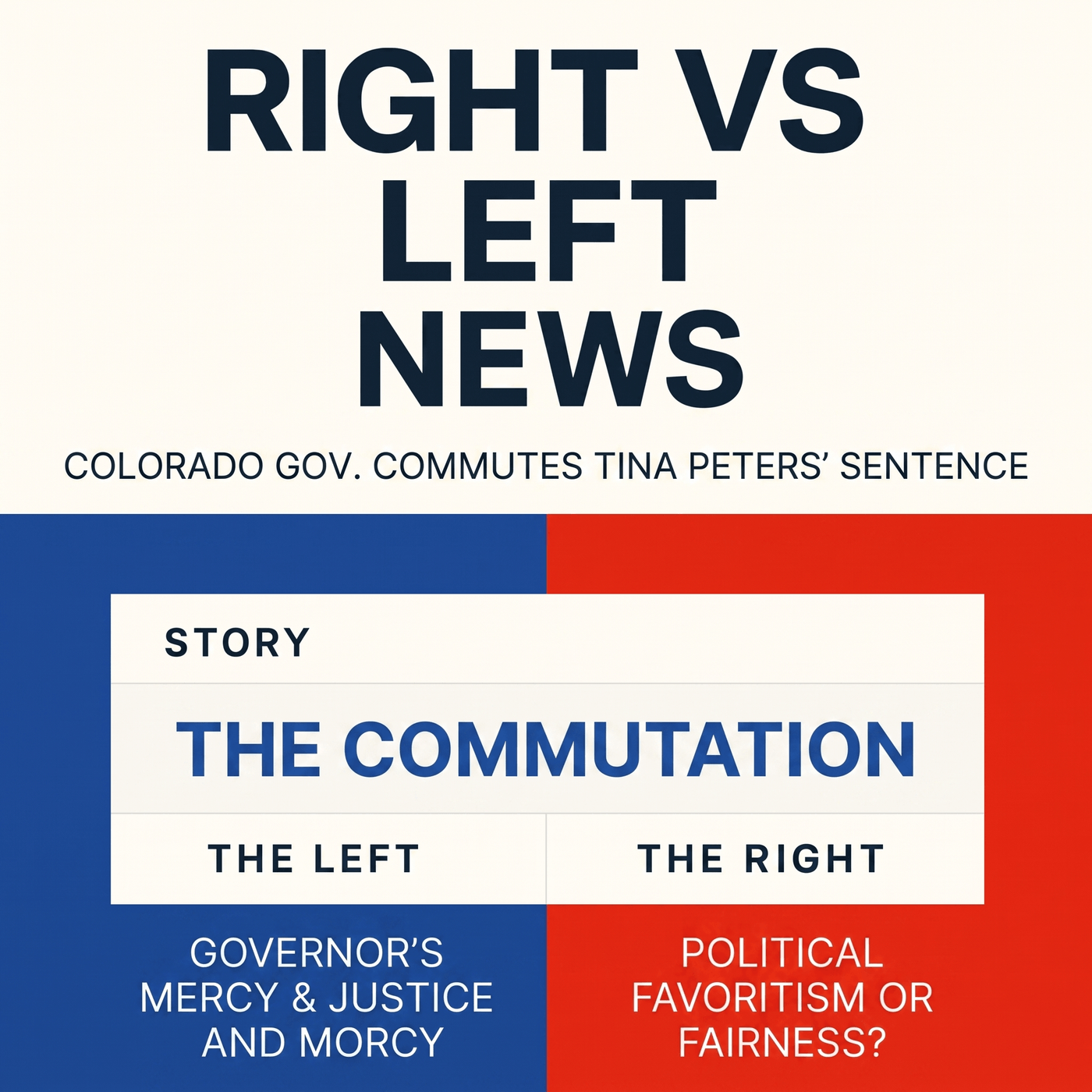
Colorado Governor Jared Polis commuted the nine-year sentence of former Mesa County clerk Tina Peters, convicted of breaching election equipment after the 2020 race. He cut it in half, making her eligible for release on June 1. The move followed sustained pressure from President Trump — and drew immediate criticism from some Colorado Democrats, including the secretary of state. Peters was one of 44 people granted clemency that day.
How the right is framing it: Conservatives say an appeals court had already flagged First Amendment issues with the original sentence, and that Peters is a first-time, nonviolent offender — so the commutation is a long-overdue correction. They add that presidents can’t pardon state crimes, so a governor’s action was the only avenue.
How the left is framing it: Progressives argue the move rewards election denialism and undermines accountability for breaching voting systems. Critics inside Colorado’s Democratic ranks called it an affront to election workers — and pointed to the visible pressure campaign from Trump.
Next — here’s what happened.
The U.S. Supreme Court declined to revive Virginia Democrats’ voter-approved congressional map, which analysts said could have flipped up to four GOP-held seats. The Virginia Supreme Court had struck down the referendum — and the map — on procedural grounds. By letting that ruling stand, the justices keep the 2021 map in place for 2026.
How the right is framing it: Conservatives call this straightforward constitutional housekeeping — state courts interpret state procedures, and the high court doesn’t step in without a clear federal question. Bottom line: the prior maps remain in effect.
How the left is framing it: Progressives say this is part of a broader redistricting wave favoring Republicans, accelerated by rulings that have weakened the Voting Rights Act. They note Democrats saw the new map as a pathway to retake the House — and argue the decision disregards voter intent.
Then — here’s what happened.
After two days of direct talks in Washington, Israel and Lebanon agreed to extend their ceasefire by 45 days. Negotiations will now split into political and security tracks, with the United States facilitating. Another round is set for June 2 and 3, according to the State Department.
How the right is framing it: Many conservatives see the extension as a hard-nosed step that buys time to pressure Hezbollah, keep northern Israel quiet, and support an eventual disarmament framework — while complicating calls to widen the war.
How the left is framing it: Progressive voices welcome the pause but warn that ceasefires without accountability can fray. They point to humanitarian concerns in southern Lebanon, ongoing skirmishes despite earlier truces, and skepticism inside Lebanon — including from Hezbollah — about the Washington process.
[MIDPOINT_SPONSORS]
On the workplace front — here’s what happened.
The Equal Employment Opportunity Commission moved to end EEO-1 Component 1 reporting, the decades-old requirement that large employers and certain federal contractors submit annual workforce data by job category, race, and sex. The agency sent its proposal to the White House’s Office of Information and Regulatory Affairs for review — publication would follow that step.
How the right is framing it: Conservatives argue enforcement should center on intentional discrimination, not statistical disparities, and say mandatory racial categorization is outdated and divisive. Supporters link the shift to a broader move toward intent-based enforcement, echoing long-standing business critiques of expanded reporting.
How the left is framing it: Progressives warn that scrapping EEO-1 would cripple civil-rights enforcement by removing the data that reveals discriminatory patterns. Former officials say the information is incredibly valuable — and caution that the change could weaken anti-bias laws in practice and sow confusion for employers.
Finally — here’s what happened.
New ethics filings show President Trump or his advisers made thousands of securities trades in the first quarter — at least $220 million in transactions. He was fined $200 for filing late notices on some trades, including positions in Microsoft and Amazon. The disclosures use broad value ranges and don’t specify precise profits, or whether trades were made through managed accounts.
How the right is framing it: Conservative-leaning commentary describes a technical compliance lapse with a nominal fine, noting that presidents are allowed to hold and trade assets, often via advisers — and that the ranges don’t show wrongdoing.
How the left is framing it: Progressives call it an ethics alarm, arguing that active trading in companies tied to federal policy invites conflicts and undermines trust. They point to the missed 45-day reporting window — and the concentration in market-moving tech stocks.
Quick recap...
Colorado’s commutation of Tina Peters has ignited a new fight over accountability and clemency.
The Supreme Court’s move in Virginia keeps the current House maps in place — for now.
Talks in Washington bought Israel and Lebanon a 45-day window.
The EEOC’s data shift could rewire how civil-rights laws are enforced.
And Trump’s stock-disclosure fine has reopened the debate over whether top officials should trade at all.
We’ll keep tracking how these evolve over the weekend — and into next week.
That's it for today's episode of Right versus Left News. Remember, understanding both sides isn't about picking a team—it's about being informed. Subscribe wherever you get your podcasts, and join us tomorrow for another balanced look at the day's biggest stories. Until next time, stay curious and stay informed.
