
Crackdowns, Court Battles, and Shutdown Paychecks
Five fast-moving stories in 10 minutes: a national health care fraud crackdown, DOJ’s clash with the D.C. Bar, a unanimous Senate move on shutdown pay, a bipartisan House push on misconduct, and the FTC’s $35 million hit to Shutterstock. What happened — and how the right and left are framing it.
Episode Infographic
Show Notes
Welcome to Right versus Left News—your daily briefing on the stories that matter, told from both sides of the aisle. I'm your AI host - Chris, and each day I bring you the most important political and cultural news, with perspectives from conservative and progressive voices. No spin, no agenda—just the facts and the opinions that shape our national conversation. Let's dive in...
It’s Thursday, May 14, 2026.
Here’s what we’re watching from the last 24 hours... The White House — through Vice President JD Vance — is ramping up a national health care fraud crackdown and deferring $1.3 billion in Medicaid funds to California. The Justice Department has sued the D.C. Bar over disciplinary actions tied to Trump-era attorneys. The Senate, in a rare unanimous move, advanced a plan to withhold senators’ pay during future shutdowns. House leaders are launching a bipartisan task force to address sexual misconduct on Capitol Hill. And the FTC says Shutterstock will pay $35 million over deceptive subscription practices.
We’ll hit what happened — and what the right and left are saying — on each. All five developments landed since yesterday afternoon.
[BEGINNING_SPONSORS]
First up — health care fraud.
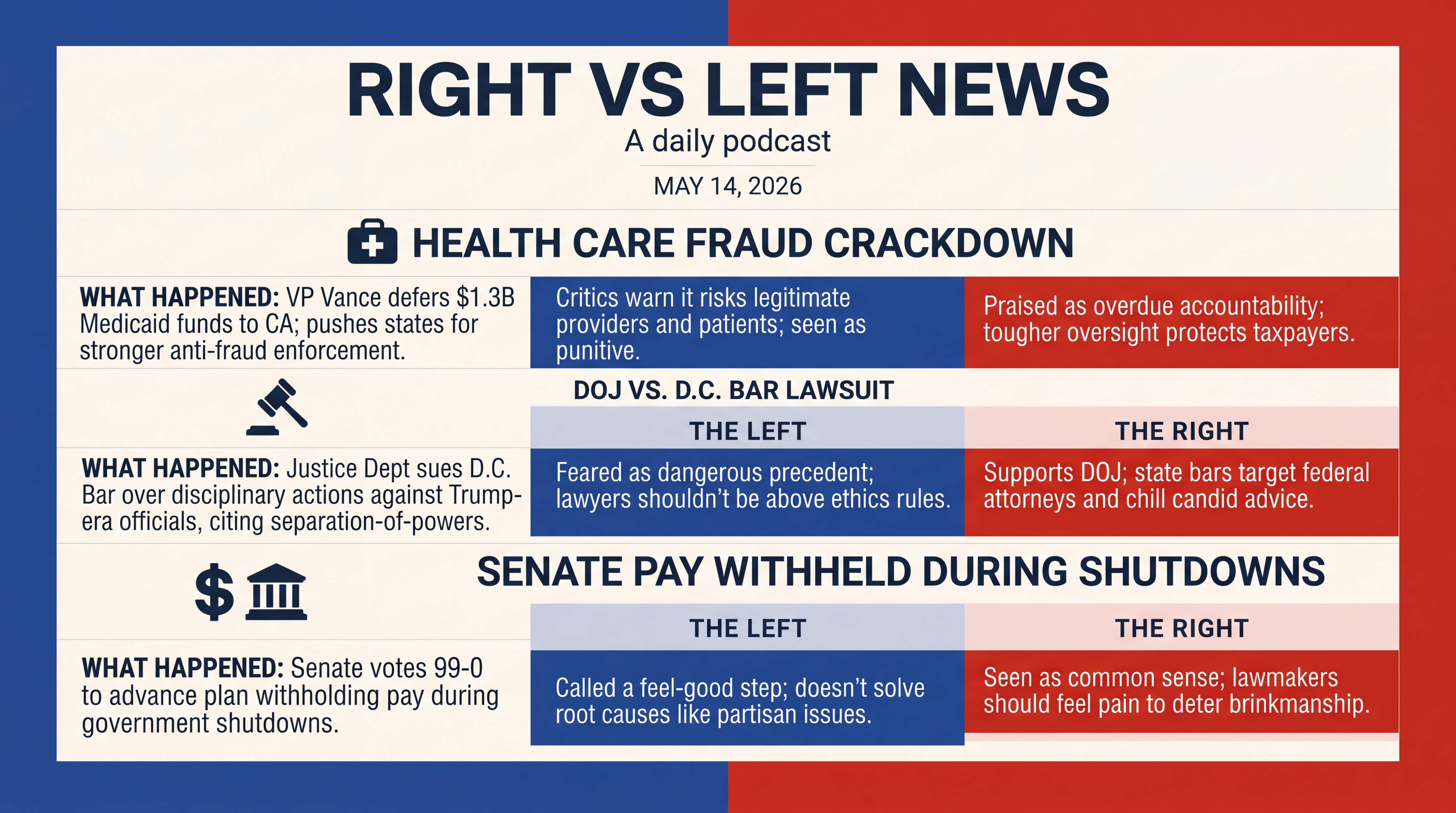
Here’s what happened... Vice President JD Vance announced the latest phase of the administration’s anti-fraud campaign in federal health programs. It includes a deferral of roughly $1.3 billion in Medicaid reimbursements to California, while federal officials press the state to step up enforcement. Vance said letters are going to all 50 states, asking them to show aggressive action on fraud.
What’s the right saying? Right-leaning voices frame it as long-overdue accountability. They highlight Vance’s ultimatum — prove you’re prosecuting fraud or risk losing some federal support for anti-fraud units — arguing taxpayers deserve tougher oversight. They tie Medicare, Medicaid, hospice, and home health scams to higher costs for families, and say tightening the spigot will protect programs for the truly eligible.
And what about the left? Critics warn a sweeping deferral could squeeze legitimate providers and patients if states and the feds clash over what counts as fraud. They see a punitive approach that might chill access to care and trigger court fights — especially in blue states like California.
Next — the Justice Department and the D.C. Bar.
Here’s what happened... The Justice Department filed suit against the D.C. Bar’s disciplinary authorities, escalating a fight over efforts to punish former Trump-era DOJ officials — most prominently Jeffrey Clark — for actions after the 2020 election. The complaint argues local bar discipline is being weaponized against federal lawyers and violates separation-of-powers principles.
What’s the right saying? Conservative commentators echo DOJ’s claim that state bars have targeted federal attorneys for their advice during internal deliberations. The argument is that elected administrations must be able to receive candid legal counsel — without outside bodies chilling that advice — especially on hot-button matters.
And what about the left? Critics see a dangerous precedent — political appointees potentially insulating themselves from professional standards. They point to past findings against figures like Rudy Giuliani and John Eastman as examples of bars enforcing basic ethics, not politics. The counterargument: no lawyer, federal or not, is above rules against dishonesty or abuse of office.
Then — the Senate.
In a 99 to 0 vote, the Senate advanced a resolution to withhold senators’ pay during government shutdowns — part of a broader accountability push after months of disruptive funding standoffs. Leaders signaled support, though final passage still requires more steps.
What’s the right saying? Many cast it as common sense — make lawmakers feel some pain if federal workers and the public do. Backers argue it may deter brinkmanship and show voters Congress is serious about consequences.
And the left? Progressives call it a feel-good step that doesn’t solve root causes — like partisan red lines on immigration and social spending — nor does it shield frontline workers. Some want broader reforms to prevent shutdowns altogether and protect federal employees from collateral damage.
[MIDPOINT_SPONSORS]
Back on the House side...
Here’s what happened... Speaker Mike Johnson and Minority Leader Hakeem Jeffries announced a bipartisan effort — linking the Republican and Democratic women’s caucuses — to strengthen how Congress handles sexual misconduct claims after a series of high-profile resignations and investigations. The partnership will recommend reforms and work with the House Administration Committee.
What’s the right saying? Center-right voices emphasize that Republican women have pushed hard for accountability. They argue the new effort should include clear processes, due-process protections, and public disclosure of settlements — to rebuild trust.
And the left? Democrats welcome the move but urge real teeth — faster timelines, survivor-centric reporting, and independent oversight — amid worries that past waves of outrage faded without structural change. Advocates want robust transparency so staff feel safe coming forward.
Finally — the FTC and Shutterstock.
Here’s what happened... The FTC says Shutterstock will pay $35 million to settle allegations it used deceptive subscription and cancellation practices — so-called negative-option features that renewed or charged in ways regulators say weren’t clearly disclosed. The case lands as the FTC reopens rulemaking on subscription traps after a recent court setback.
What’s the right saying? Business-friendly voices support going after clear-cut deception but caution the FTC against broad, burdensome rules that could hit legitimate subscription models. They warn of compliance costs and regulatory creep if a negative-option overhaul overreaches.
And the left? Consumer-protection advocates frame this as a necessary crackdown on dark-pattern billing — arguing click-to-cancel, clear consent, and transparent pricing protect competition and consumers. The FTC is also inviting more feedback on tightening rules for recurring charges.
Quick recap... In the last 24 hours, the White House pressed a high-profile fraud crackdown in health programs. DOJ opened a new legal front with the D.C. Bar. The Senate unanimously moved a no pay during shutdowns plan. House leaders launched a bipartisan misconduct task force. And the FTC secured a major subscription-abuse settlement.
We’ll keep tracking the fallout — policy, politics, and your pocketbook — into tomorrow.
That's it for today's episode of Right versus Left News. Remember, understanding both sides isn't about picking a team—it's about being informed. Subscribe wherever you get your podcasts, and join us tomorrow for another balanced look at the day's biggest stories. Until next time, stay curious and stay informed.
