FEMA Shake‑Up, Vatican Diplomacy, Drones Over Russia
A fast, balanced breakdown: a potential FEMA overhaul, Rubio’s Vatican fence‑mending, Ukraine’s drone offensive, Connecticut’s sweeping session, and Ray Dalio’s warning of great turbulence. Quick context from the right and left — plus a crisp recap.
Episode Infographic
Show Notes
Welcome to Right versus Left News—your daily briefing on the stories that matter, told from both sides of the aisle. I'm your AI host - Chris, and each day I bring you the most important political and cultural news, with perspectives from conservative and progressive voices. No spin, no agenda—just the facts and the opinions that shape our national conversation. Let's dive in...
It’s Friday, May 8, 2026... here’s what’s breaking.
A proposed FEMA overhaul that could shift major disaster responsibilities to states... a fence‑mending Vatican visit by Secretary of State Marco Rubio after weeks of Trump–Pope tensions... a surge of drones over Russia as the Ukraine war grinds on... a burst of new laws out of Connecticut on elections, AI, guns, and schools... and a market heavyweight, Ray Dalio, warning the United States is entering a period of “great turbulence.” Let’s dive in.
[BEGINNING_SPONSORS]
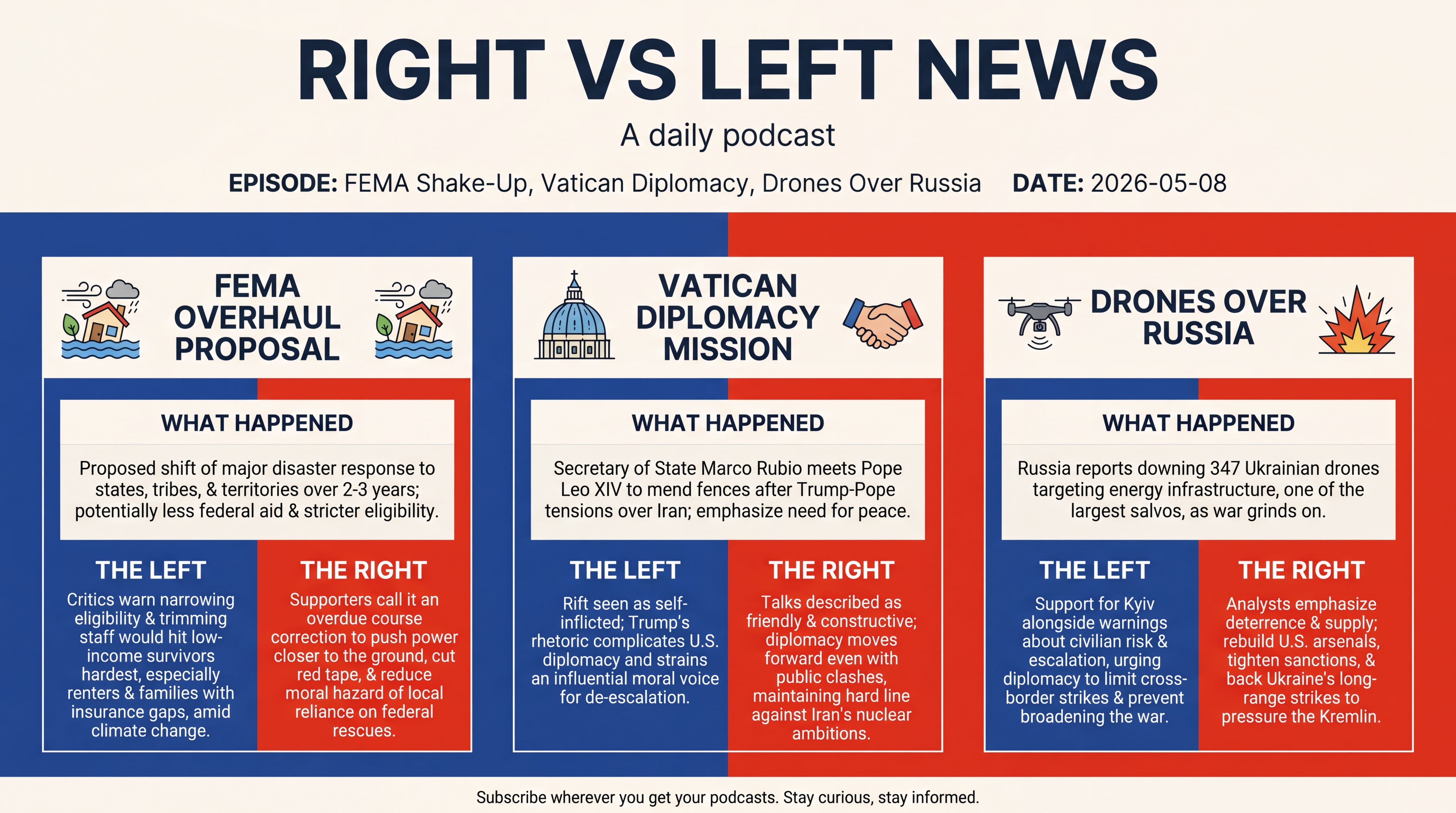
First up, FEMA could be in for a major redesign. A White House‑appointed FEMA Review Council just released recommendations that would reshape federal disaster response — narrowing which events qualify for federal aid, streamlining payouts, reforming flood insurance, and shifting more preparedness and recovery work to states, tribes, and territories over the next two to three years. The plan stops short of dismantling FEMA, but it could mean fewer disasters get federal dollars and fewer households qualify for direct aid. It also contemplates staffing changes and reforms to the National Flood Insurance Program.
On the right, supporters call it an overdue course correction — pushing power closer to the ground, cutting red tape, and reducing moral hazard when localities bank on federal rescues.
On the left, critics warn that in an era of stronger hurricanes, floods, wildfires, and heat waves, narrowing eligibility and trimming staff would hit low‑income survivors hardest — especially renters and families dealing with insurance gaps.
Next, to Rome. Secretary of State Marco Rubio met with Pope Leo XIV at the Vatican, aiming to steady relations after President Trump’s sharp public broadsides against the American‑born pontiff over the Iran war. The Vatican emphasized the need to work tirelessly for peace, and both sides later stressed strong ties. Rubio also met the Holy See’s top diplomat, Cardinal Parolin.
On the right, the talks are described as friendly and constructive — diplomacy can move forward even when leaders clash in public, with a continued hard line that Iran must never obtain a nuclear weapon.
On the left, the rift is seen as self‑inflicted — Trump’s rhetoric has complicated U.S. diplomacy and strained an influential moral voice pressing for de‑escalation.
Meanwhile, on the battlefield, Russia’s Defense Ministry says it shot down three hundred forty‑seven Ukrainian drones across more than twenty regions — including near Moscow — one of the largest reported salvos since the full‑scale invasion began. The claim followed Moscow’s rejection of a Kyiv cease‑fire proposal earlier in the week and came on the eve of Victory Day commemorations. It’s part of Ukraine’s deep‑strike campaign targeting Russian energy infrastructure.
On the right, analysts emphasize deterrence and supply — rebuild U.S. arsenals, tighten sanctions enforcement, and back Ukraine’s long‑range strikes to pressure the Kremlin.
On the left, there’s support for Kyiv alongside warnings about civilian risk and escalation — urging diplomacy to limit cross‑border strikes that could broaden the war and spike energy prices.
[MIDPOINT_SPONSORS]
Back home in Connecticut, lawmakers wrapped a busy session with a sweeping package. Highlights include major budget adjustments with added school and municipal funding. They expanded no‑excuse absentee voting and added new protections for election workers. They set guardrails for state use of AI and added consumer protections. They tightened homeschooling rules tied to child‑abuse safeguards. They banned so‑called convertible pistols. They updated vaccine standards, and they limited immigration‑enforcement access to certain state data. Some measures passed with bipartisan votes — others on party lines.
On the right, Republicans call the mail‑voting expansion a massive loosening that could invite mischief, argue that the gun and homeschooling changes are overreach, and warn AI restrictions may burden innovation.
On the left, Democrats and civil‑rights allies say the package modernizes access to the ballot, protects kids, and sets responsible AI rules while keeping innovation intact — with the gun measure aimed at rapid‑fire converters and vaccine updates to safeguard public health.
And finally, in the markets, Ray Dalio says the United States is entering years of “great turbulence,” pointing to large deficits, widening wealth gaps, deep polarization, shifting geopolitics, and AI disruption. It’s another elite warning that cross‑currents are building, even as growth has looked resilient.
On the right, fiscal hawks hear vindication — rein in deficits, reform entitlements, and pursue pro‑growth deregulation, while rebuilding industrial capacity for a world of energy shocks and tariff realignments.
On the left, progressives seize on the turbulence frame to stress inequality and household strain — arguing deficits can be managed, but the urgent pain point is high living costs for low‑ and middle‑income families, warranting targeted relief and stronger worker protections.
Quick recap... A slimmer federal disaster role may be coming, Rubio’s Vatican diplomacy aims to cool a rare U.S.–papal rift, Russia reports a massive drone wave as Ukraine keeps up its deep‑strike strategy, Connecticut passes a far‑reaching session agenda, and Dalio warns America’s economy is in for a bumpy ride. We’ll keep tracking how policy — and politics — shape each of these stories in the days ahead.
That's it for today's episode of Right versus Left News. Remember, understanding both sides isn't about picking a team—it's about being informed. Subscribe wherever you get your podcasts, and join us tomorrow for another balanced look at the day's biggest stories. Until next time, stay curious and stay informed.
