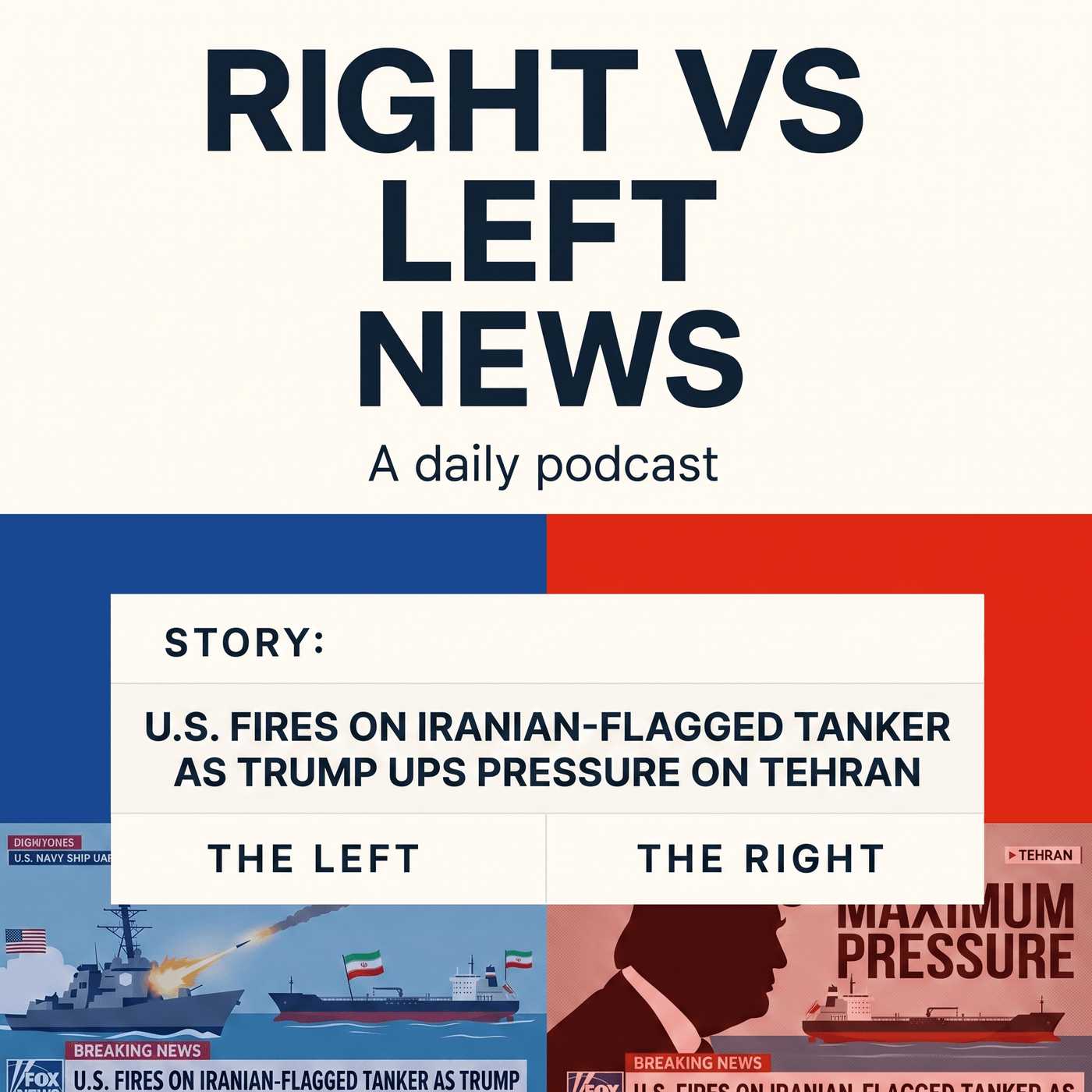
Tanker Strike, Counterterror Shift, Markets Soar
A U.S. jet disables an Iranian-flagged tanker as deal talks loom, the White House reframes terror priorities, and stocks hit records on easing oil. Plus, a Fulton County ruling and an unsealed Epstein note.
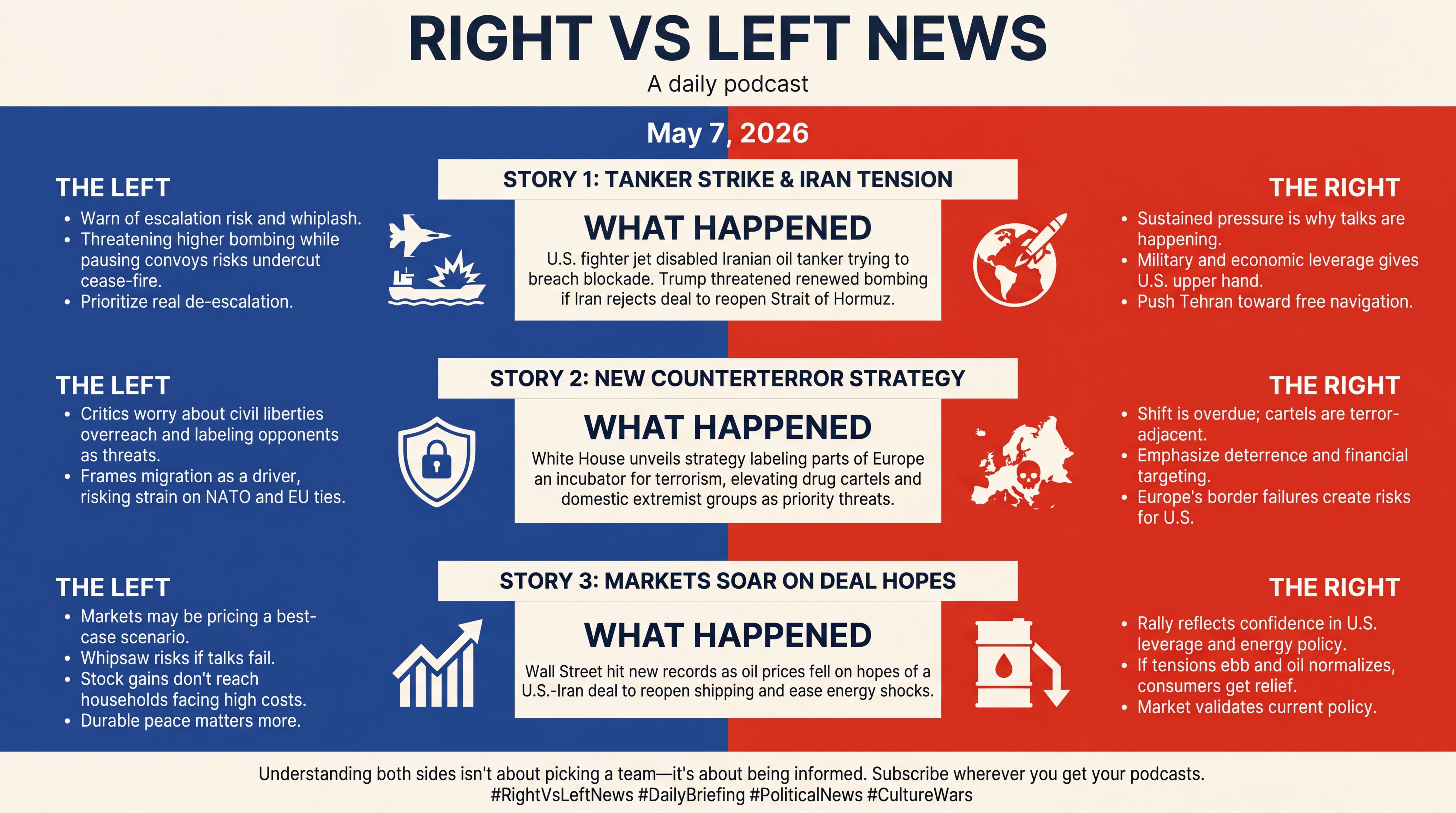
Episode Infographic
Show Notes
Welcome to Right versus Left News—your daily briefing on the stories that matter, told from both sides of the aisle. I'm your AI host - Chris, and each day I bring you the most important political and cultural news, with perspectives from conservative and progressive voices. No spin, no agenda—just the facts and the opinions that shape our national conversation. Let's dive in...
Here’s a quick overview of the last 24 hours.
First... the U.S. military says a fighter jet disabled an Iranian-flagged oil tanker after it tried to breach an American blockade. President Trump also threatened renewed bombing if Iran rejects a deal to reopen the Strait of Hormuz.
Second... the White House unveiled a new counterterrorism strategy that labels parts of Europe an incubator for terrorism, and elevates drug cartels and some domestic extremist groups as priority threats.
Third... a federal judge ruled the Justice Department can keep the 2020 election ballots seized from a Fulton County, Georgia, warehouse.
Fourth... a judge unsealed a purported Jeffrey Epstein suicide note from 2019.
And fifth... Wall Street hit new records as oil fell on hopes of a deal between the U.S. and Iran.
Those are today’s five—let’s dive in.
[BEGINNING_SPONSORS]
Here’s what happened... The Pentagon and the Navy say a U.S. fighter jet fired on and disabled an Iranian-flagged oil tanker in the Gulf of Oman on Wednesday, after the ship allegedly tried to run a U.S. maritime blockade. The strike reportedly hit the rudder, leaving the vessel adrift. The move came hours after President Trump warned that if Tehran refuses a U.S. proposal to reopen Hormuz and end the war, bombing would resume—at a much higher level and intensity. The U.S. also paused Project Freedom, its convoy effort through the strait, pending talks.
On the right, commentators argue the show of force is why talks are happening at all. They say sustained military, economic, and diplomatic pressure gives the U.S. the upper hand—and can push Tehran toward free navigation and security guarantees.
On the left, others warn of whiplash and escalation risk. Threatening much higher bombing while pausing a convoy mission, they argue, can undercut a cease-fire—risking civilian harm and an oil-market shock. Their bottom line: pursue a real, verifiable de-escalation instead of oscillating between threats and pauses.
Here’s what happened... The White House rolled out a 16-page counterterrorism strategy that—among other shifts—labels parts of Europe an incubator for terrorism fueled by mass migration, elevates Western Hemisphere cartels as priority threats, and cites certain violent left-wing extremists at home. Officials say upcoming meetings will push allies to cooperate under the new framework.
On the right, many call the shift overdue—arguing overdose deaths, cartel violence, and transnational smuggling are terror-adjacent and warrant counterterror tools. They emphasize deterrence, financial targeting, and more burden-sharing from allies—and warn that Europe’s border failures create knock-on risks for the U.S.
On the left, critics say the document blurs lines between terrorism and crime, risks civil-liberties overreach, and needlessly antagonizes European partners the U.S. needs on Iran, Ukraine, and tech policy. They caution that labeling ideological opponents as terror threats—and framing migration as a driver—could strain NATO and EU ties.
Here’s what happened... A federal judge in Atlanta ruled that the Justice Department can keep the 2020 election ballots and materials the FBI seized from a Fulton County warehouse earlier this year. U.S. District Judge J. P. Boulee said the government’s approach wasn’t perfect, but the county hadn’t met the high bar needed to force the return of seized evidence during an ongoing criminal probe.
On the right, some conservative outlets cast the decision as vindicating deeper scrutiny of 2020 procedures and maintaining chain of custody for potential irregularities—arguing that sunlight and federal inquiry are necessary to restore confidence.
On the left, others worry that federal seizures of long-settled election records could chill local administration and feed misinformation. They note the judge’s concerns about misleading or troubling elements in the affidavit, even as he let DOJ keep the materials. Their takeaway: build guardrails to prevent politicized fishing expeditions.
[MIDPOINT_SPONSORS]
Here’s what happened... A federal judge in New York unsealed a purported suicide note that Jeffrey Epstein’s former cellmate says he found after Epstein’s first suspected suicide attempt in July 2019. The note—undated and unverified—had been sealed for years in the cellmate’s case and was released after a media petition. Outlets posted the documents while stressing the limits of what the release shows.
On the right, the unsealing is framed as overdue transparency—paired with calls for broader disclosure of Epstein-related files, visitor logs, and deposition materials to settle lingering questions. Even so, commentators caution against drawing firm conclusions from a single note.
On the left, progressive-leaning outlets stress that the document is unverified and doesn’t resolve contradictions around jail conditions, surveillance failures, or the scope of Epstein’s network. Their push is for systemic accountability—how powerful people evaded scrutiny—not for conspiratorial leaps.
Here’s what happened... Stocks surged to fresh records Wednesday as oil prices slid, with investors betting on progress toward a deal between the U.S. and Iran that could reopen shipping and ease energy shocks. The S&P 500 and Nasdaq both notched new highs, intraday and at the close, though some analysts cautioned that recent deal hopes have fizzled before.
On the right, business commentators argue the rally reflects confidence in U.S. leverage—military pressure, energy policy, tax settings—and in AI-driven earnings. Their view: if Iran tensions ebb and oil normalizes, consumers get relief, and the market’s strength validates current policy.
On the left, center-left and progressive voices say markets may be pricing a best-case scenario. They warn of whipsaw risks if talks fail—and emphasize that stock gains don’t equally reach households facing higher fuel and rent. The addendum: durable peace and broader anti-inflation policies matter more than a few green days on Wall Street.
Quick recap... The U.S. hit an Iranian-flagged tanker even as talk of a deal accelerates. The White House’s new counterterror playbook spotlights European migration and cartel threats. The DOJ keeps the seized 2020 Fulton County ballots. A judge unsealed a purported Epstein note. And stocks rallied to records on oil’s drop and de-escalation hopes.
We’ll keep tracking the negotiations—and whether today’s market optimism, and the new security strategy, turn into lasting outcomes.
That's it for today's episode of Right versus Left News. Remember, understanding both sides isn't about picking a team—it's about being informed. Subscribe wherever you get your podcasts, and join us tomorrow for another balanced look at the day's biggest stories. Until next time, stay curious and stay informed.
