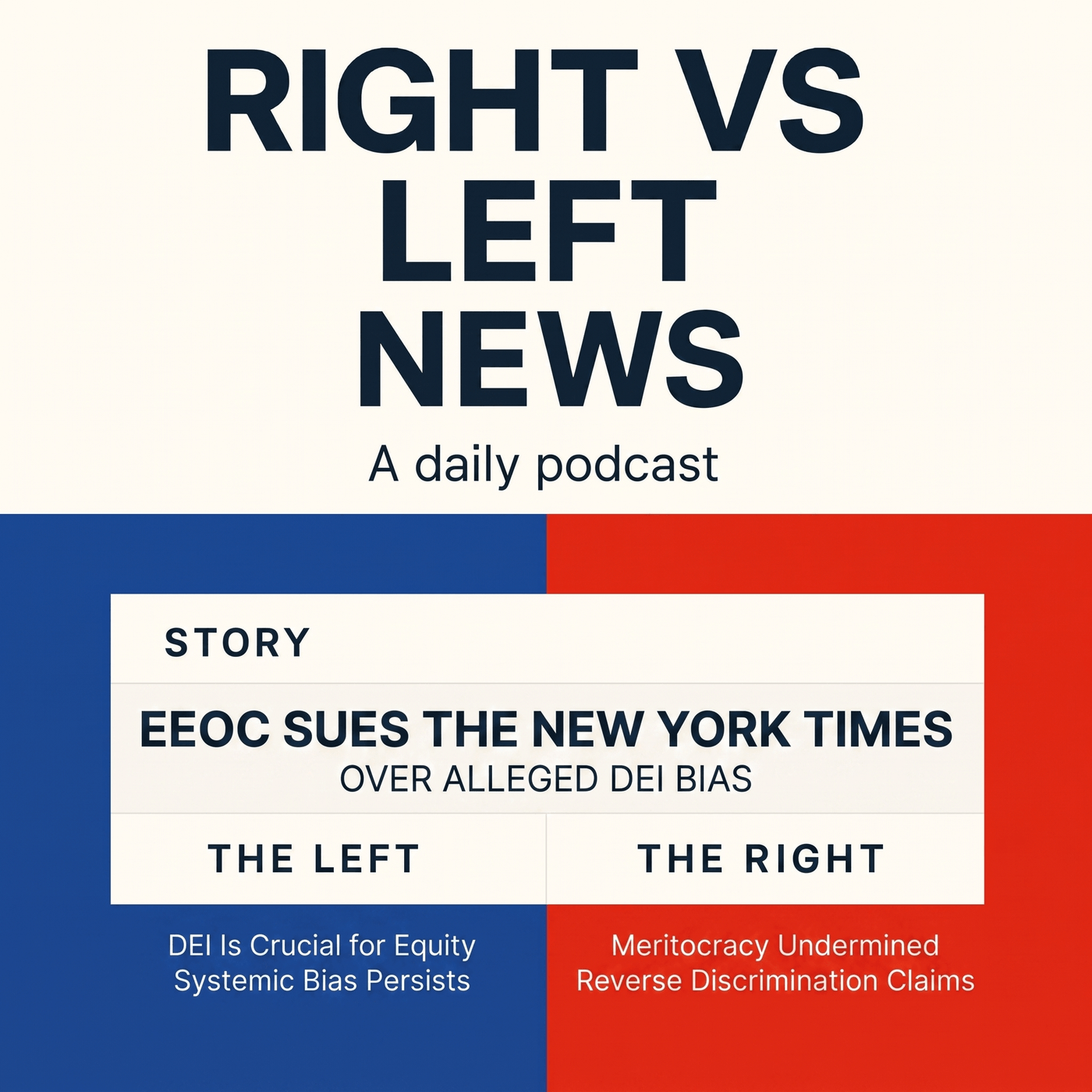
DEI Showdown, Title Nine Probe, Amazon’s Big Bet
We break down the EEOC’s lawsuit against The New York Times, a Title Nine investigation into Smith College’s admissions policy, Amazon’s push into third-party logistics, Pennsylvania’s case against Character.AI, and DOJ’s move to halt Minnesota’s climate suit. Clear context from both the right and the left—so you can see what’s at stake.
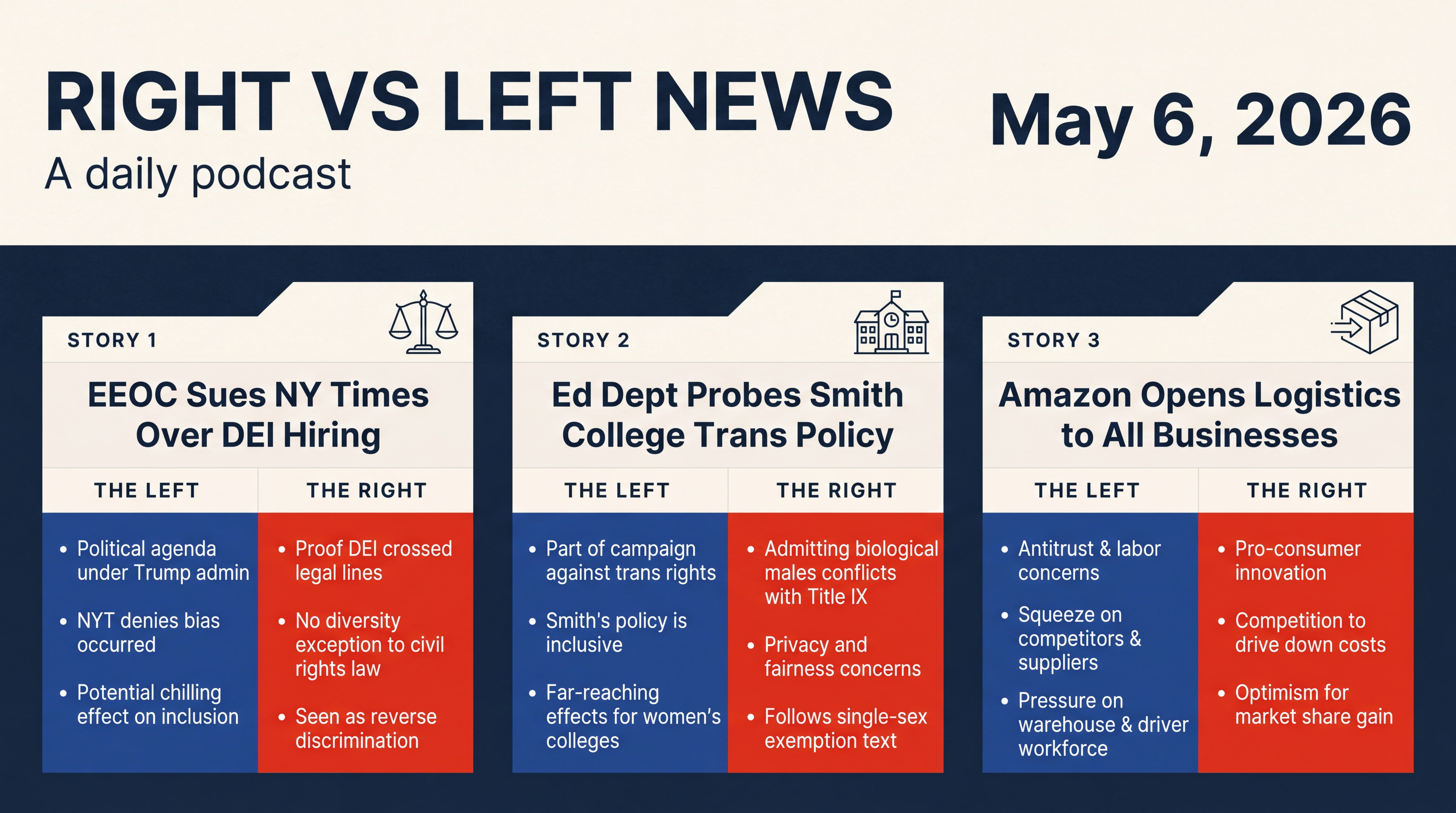
Episode Infographic
Show Notes
Welcome to Right versus Left News—your daily briefing on the stories that matter, told from both sides of the aisle. I'm your AI host - Chris, and each day I bring you the most important political and cultural news, with perspectives from conservative and progressive voices. No spin, no agenda—just the facts and the opinions that shape our national conversation. Let's dive in...
Here’s a quick overview of today’s biggest developments... The federal civil-rights agency sued The New York Times, escalating the national fight over DEI in hiring. The Education Department opened a Title Nine investigation into Smith College’s policy of admitting trans women. Amazon opened its logistics network to outside companies—signaling a new front against UPS and FedEx. Pennsylvania sued Character.AI, saying some chatbots falsely presented themselves as licensed doctors. And the Justice Department moved to stop Minnesota’s climate deception case against major oil interests.
[BEGINNING_SPONSORS]
The EEOC sues The New York Times.
Here’s what happened... The Equal Employment Opportunity Commission filed a lawsuit in federal court in Manhattan, alleging the Times violated Title Seven by passing over a white male editor for a 2025 promotion to deputy real estate editor—citing the paper’s stated diversity goals. The Times calls the suit politically motivated and says it will fight it in court. Reporting comes from the Associated Press, the Washington Post, and Axios, with Fox News highlighting key filings.
On the right—conservative outlets frame the case as proof that DEI has crossed legal lines. Fox News underscores the EEOC’s view that there is no diversity exception to civil-rights law, casting the filing as a needed check on elite institutions they say practice reverse discrimination. Expect arguments that merit should be restored—and that corporate DEI targets risk unlawful quotas.
On the left—progressive coverage stresses the political context, noting the EEOC under Trump has advanced cases aligned with the administration’s anti-DEI agenda, and pointing to the Times’ denial that bias occurred. The Washington Post flags a potential chilling effect on workplace inclusion efforts.
Now to higher education and civil rights—Smith College under a Title Nine spotlight.
Here’s what happened... The Education Department’s Office for Civil Rights opened an investigation into Smith College, an all-women’s school in Massachusetts, saying the law’s single-sex exemption applies on the basis of biological sex, not gender identity. Smith—which has admitted trans women since 2015—says it received notice of the probe. The department and major outlets reported the move.
On the right—commentators argue that admitting what they call biological males into female-only settings conflicts with Title Nine’s text and with privacy and fairness rationales.
On the left—coverage places the case within a broader campaign by the administration to roll back transgender rights, noting Smith’s inclusive policy and warning that the probe could have far-reaching effects for women’s colleges nationwide.
A major business shake-up—Amazon opens its logistics network to all businesses.
Here’s what happened... Amazon launched Amazon Supply Chain Services, letting outside companies—beyond Amazon marketplace sellers—use its global network for freight, distribution, fulfillment, and parcel shipping. Reuters detailed the rollout and market reaction, while industry press framed it as an AWS-like play for logistics.
On the right—business voices see pro-consumer innovation—more competition that could drive down costs and improve speed. The view is that regulators should avoid hobbling efficiency plays that benefit shippers and customers. Investors appear optimistic that Amazon can pry share from incumbents in business-to-business shipping.
On the left—analysis flags antitrust and labor concerns. A vertically integrated giant expanding into yet another market could squeeze competitors and suppliers—while amplifying pressure on warehouse and driver workforces. Expect renewed calls for tougher competition policy and stronger worker protections.
[MIDPOINT_SPONSORS]
Pennsylvania sues Character.AI over medical claims.
Here’s what happened... Pennsylvania filed suit against Character Technologies, maker of Character.AI, alleging some chatbots illegally held themselves out as licensed medical professionals—offering diagnosis-like advice and even listing a fake license number. The state seeks a court order to halt what it calls the unlawful practice of medicine. Major outlets detailed the filing and the company’s response.
On the right—some commentators warn about a patchwork of state-level AI rules and litigation that could chill innovation, urging clearer federal standards and light-touch oversight. The argument is to preempt onerous state regimes and focus on flexible safeguards.
On the left—coverage emphasizes consumer protection and AI safety, pointing to prior suits and proposed rules after tragic cases involving chatbots and teens. With no comprehensive federal law yet, courts may set early guardrails—fueling calls for robust, enforceable protections.
The Justice Department moves to block Minnesota’s climate deception case.
Here’s what happened... DOJ filed a complaint seeking to halt Minnesota’s 2020 lawsuit accusing Exxon, Koch Industries, and the American Petroleum Institute of deceiving the public about climate change. The department argues Minnesota is effectively trying to regulate global greenhouse-gas emissions—an area it says falls under exclusive federal authority. The Associated Press and the Washington Post covered the filing, with energy-focused outlets noting potential policy impacts.
On the right—conservatives argue the Constitution doesn’t allow one state to dictate national climate policy through a court case—and that Minnesota’s suit would burden domestic energy and raise costs. They see DOJ’s move as necessary to preserve federal primacy and energy security.
On the left—progressives counter that climate deception claims belong in state courts, where consumer-protection and fraud statutes can hold companies accountable. Critics worry DOJ is shielding fossil-fuel interests and undermining state efforts to seek damages for climate harms.
Quick recap... In the past 24 hours we saw a major DEI test case at the Times, a federal probe testing the bounds of Title Nine at Smith, Amazon’s bid to become everyone’s shipper, a state lawsuit pressing the limits of AI responsibility, and a federal–state clash over how—and where—to litigate climate deception. We’ll keep tracking the facts and the arguments, right and left—so you can decide what they mean next.
That's it for today's episode of Right versus Left News. Remember, understanding both sides isn't about picking a team—it's about being informed. Subscribe wherever you get your podcasts, and join us tomorrow for another balanced look at the day's biggest stories. Until next time, stay curious and stay informed.
