Hormuz Hopes, Poll Shock, Pacific Deterrence
A fast, focused briefing on Iran’s 14-point proposal, rising disapproval numbers, a U.S–Philippines missile deployment near Taiwan, Berkshire’s surging cash, and Taiwan’s outreach to Eswatini — plus how the right and left are framing each move. Context, nuance, and what to watch next.
Episode Infographic
Show Notes
Welcome to Right versus Left News—your daily briefing on the stories that matter, told from both sides of the aisle. I'm your AI host - Chris, and each day I bring you the most important political and cultural news, with perspectives from conservative and progressive voices. No spin, no agenda—just the facts and the opinions that shape our national conversation. Let's dive in...
Here’s the big picture for Sunday, May 3, 2026... The White House says it’s reviewing a new Iranian proposal to end the war — while signaling skepticism. A new poll from the Washington Post, ABC, and Ipsos finds President Trump’s disapproval at a new high, with potential midterm implications. In the Indo-Pacific, U.S. and Philippine forces have positioned an anti-ship missile system in the Batanes Islands near Taiwan. Back home, Berkshire Hathaway posted a solid profit jump as new CEO Greg Abel hosted his first annual meeting. And Taiwan’s president began a trip to Eswatini, drawing sharp rhetoric from Beijing. Let’s break down what happened — and how the right and the left are framing it.
[BEGINNING_SPONSORS]
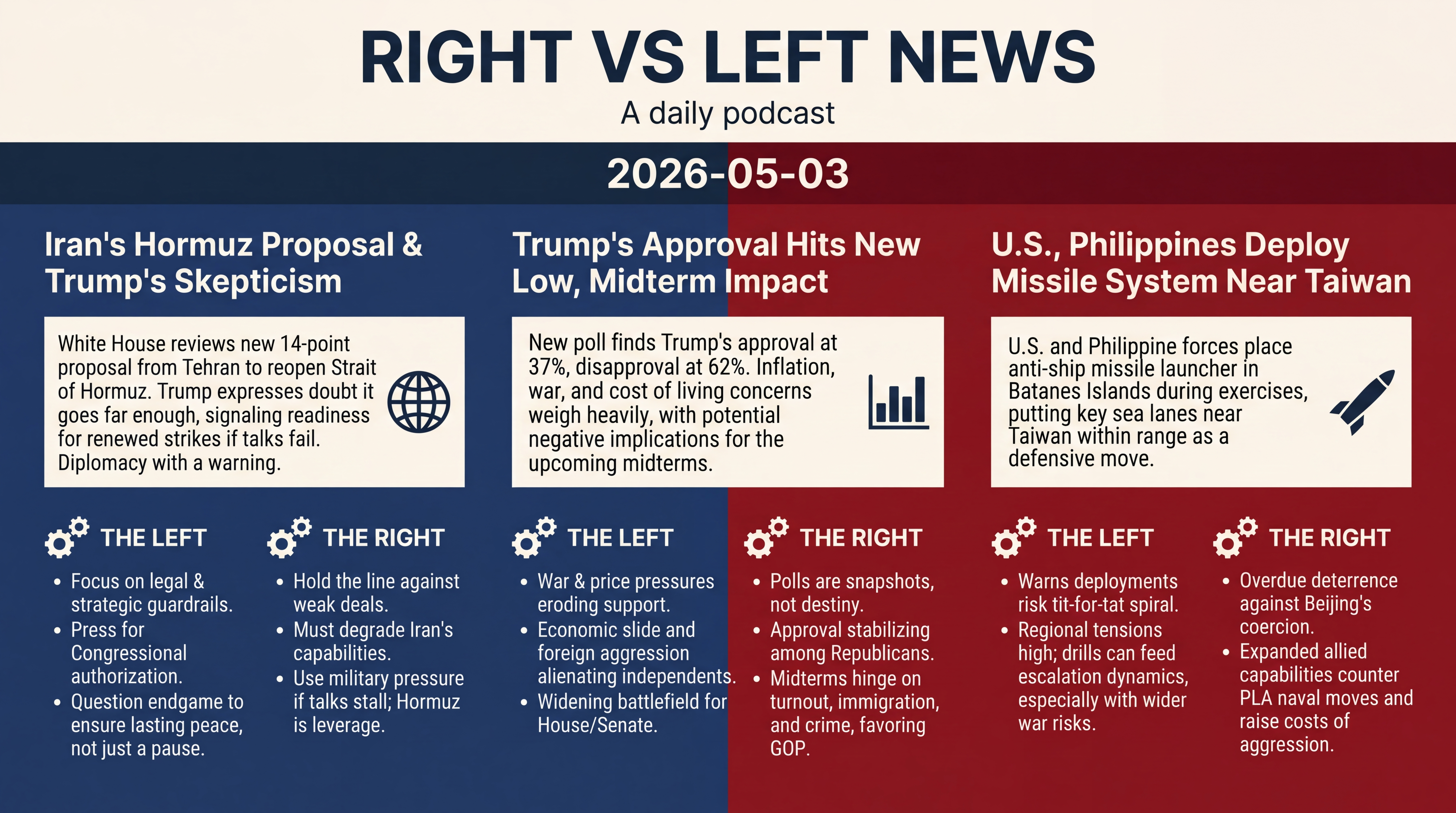
President Trump said Saturday he’s reviewing a 14-point proposal from Iran — reportedly relayed via Pakistan — to reopen the Strait of Hormuz and map out next steps. He also made it clear he doubts it goes far enough.
Reports indicate Tehran’s plan would reopen the strait before any nuclear talks. The administration says it prefers a non-military path... but it’s ready to restart strikes if needed. As he boarded Air Force One, Trump sounded publicly skeptical.
How are people framing it? On the right, the focus is on holding the line — warning against any deal that fails to meaningfully degrade Iran’s capabilities. Commentators describe the Hormuz chokepoint as Tehran’s leverage and argue the U.S. should be ready to ramp up pressure if talks stall.
On the left, the emphasis is on legal and strategic guardrails. Critics question the claim that hostilities have already ended for War Powers purposes and press for clear objectives, congressional authorization, and a defined endgame — otherwise, reopening the strait could be a pause rather than peace.
A new poll released just after midnight finds President Trump’s overall approval at thirty-seven percent and disapproval at sixty-two percent — the highest of his two terms. Democrats widen their edge on the generic ballot, and voter enthusiasm on the left ticks up. Iran, inflation, and the cost of living weigh heavily on the president’s ratings.
From the right, the reminder is that national polls are snapshots, not destiny. They point to trend lines showing approval stabilizing in the low forties among Republicans and say midterms hinge on turnout, district maps, and issues like immigration and crime — areas they believe still favor the GOP.
From the left, the read is that war-related uncertainty and price pressures are eroding support beyond the base. Economic marks are sliding, and more independents view the administration as too aggressive abroad and ineffective on affordability at home — potentially widening the battlefield for House and Senate control.
In the Philippines, U.S. and Philippine forces deployed a Navy–Marine Expeditionary Ship Interdiction System — an anti-ship missile launcher — in the Batanes Islands north of Luzon for exercises. That position puts key sea lanes near Taiwan within range. Officials cast it as a defensive, training-time placement tied to annual drills.
Right-leaning voices call it overdue deterrence that raises the costs of Beijing’s gray-zone coercion. Expanded allied interdiction capabilities, they argue, can counter PLA naval moves.
Left-leaning critics warn these deployments risk a tit-for-tat spiral — especially amid heightened regional tensions and energy shocks linked to the wider war. Frequent drills and counter-drills, even when labeled defensive, can feed escalation dynamics.
[MIDPOINT_SPONSORS]
Berkshire Hathaway reported an eighteen percent rise in first-quarter operating profit and a record cash pile approaching four hundred billion dollars, ahead of its Omaha meeting — the first led on stage by CEO Greg Abel after Warren Buffett’s transition. Stronger insurance underwriting did much of the lifting, and the event’s tone was more businesslike than the Buffett-era Q and A marathons.
On the right, market-friendly voices frame Berkshire as a case study in disciplined capital allocation — preferring dry powder over chasing expensive deals. That record cash is strategic flexibility if asset prices fall.
On the left, critiques of mega-buybacks and cash hoards argue that financial engineering can divert resources from wages and investment. Insider selling around buybacks and the scale of repurchases raise questions about whose interests are served — shareholders or the broader economy.
Taiwan’s President Lai Ching-te began a visit to Eswatini, the island’s sole African diplomatic ally, after a previous swing ran into overflight snags. Before departure and on arrival, he insisted Taiwan has a right to engage the world. Chinese state-linked outlets answered with insults and warnings — Beijing even labeled Lai a rat — underscoring the fraught cross-strait climate.
On the right, China-watchers see Lai’s outreach as necessary statecraft. They argue the United States and partners should expand diplomatic, economic, and security ties with Taipei to blunt Beijing’s pressure — deterrence through networked alliances.
On the left, analysts warn that high-profile symbolism can invite retaliation. They urge calibrated diplomacy to avoid provocations that could spiral into blockades or worse — especially while the region absorbs economic shocks tied to the Iran conflict.
Quick recap... Iran’s proposal shows a glimmer of diplomacy — tempered by doubt. A new poll signals political headwinds for the White House. The U.S. and Philippines missile deployment tightens deterrence in the Taiwan Strait. Berkshire’s profits and war chest spotlight corporate power in uncertain times. And Taiwan’s diplomacy meets China’s ire.
We’ll be watching how each of these stories evolves over the next twenty-four hours.
That's it for today's episode of Right versus Left News. Remember, understanding both sides isn't about picking a team—it's about being informed. Subscribe wherever you get your podcasts, and join us tomorrow for another balanced look at the day's biggest stories. Until next time, stay curious and stay informed.
