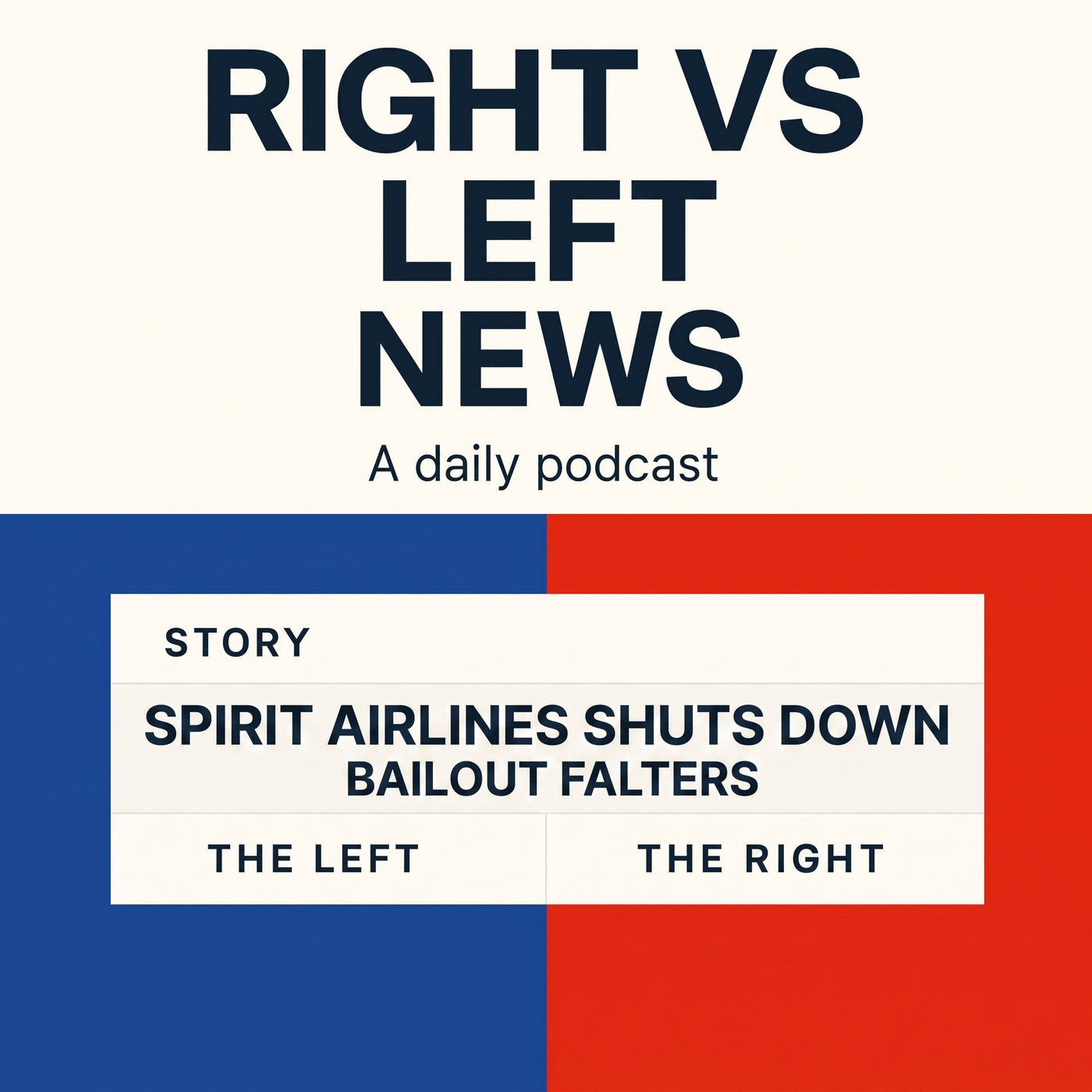
Shutdowns, Court Shocks, Troops Out, Tariffs Up
A whirlwind 24 hours: Spirit Airlines collapses, a key abortion-pill ruling lands, U.S. troops begin a Germany drawdown, Southern maps shift, and EU auto tariffs spike. We break down what happened — and how the right and left see it.
Episode Infographic
Show Notes
Welcome to Right versus Left News—your daily briefing on the stories that matter, told from both sides of the aisle. I'm your AI host - Chris, and each day I bring you the most important political and cultural news, with perspectives from conservative and progressive voices. No spin, no agenda—just the facts and the opinions that shape our national conversation. Let's dive in...
Here’s a quick look at what changed in the last 24 hours...
Spirit Airlines abruptly shut down after a White House rescue deal fell apart. A federal appeals court limited mail and telehealth access to the abortion pill nationwide. The Pentagon says the U.S. will pull 5,000 troops from Germany. GOP-led states in the South are racing to redraw congressional maps after the Supreme Court’s Voting Rights Act decision. And President Trump says he’s hiking tariffs on cars and trucks from the European Union to 25 percent.
We’ll lay out what happened — then how the right and the left are framing it. Reporting from the Washington Post, the Associated Press, and Axios shaped today’s rundown.
[BEGINNING_SPONSORS]
First up... Spirit Airlines shuts down.
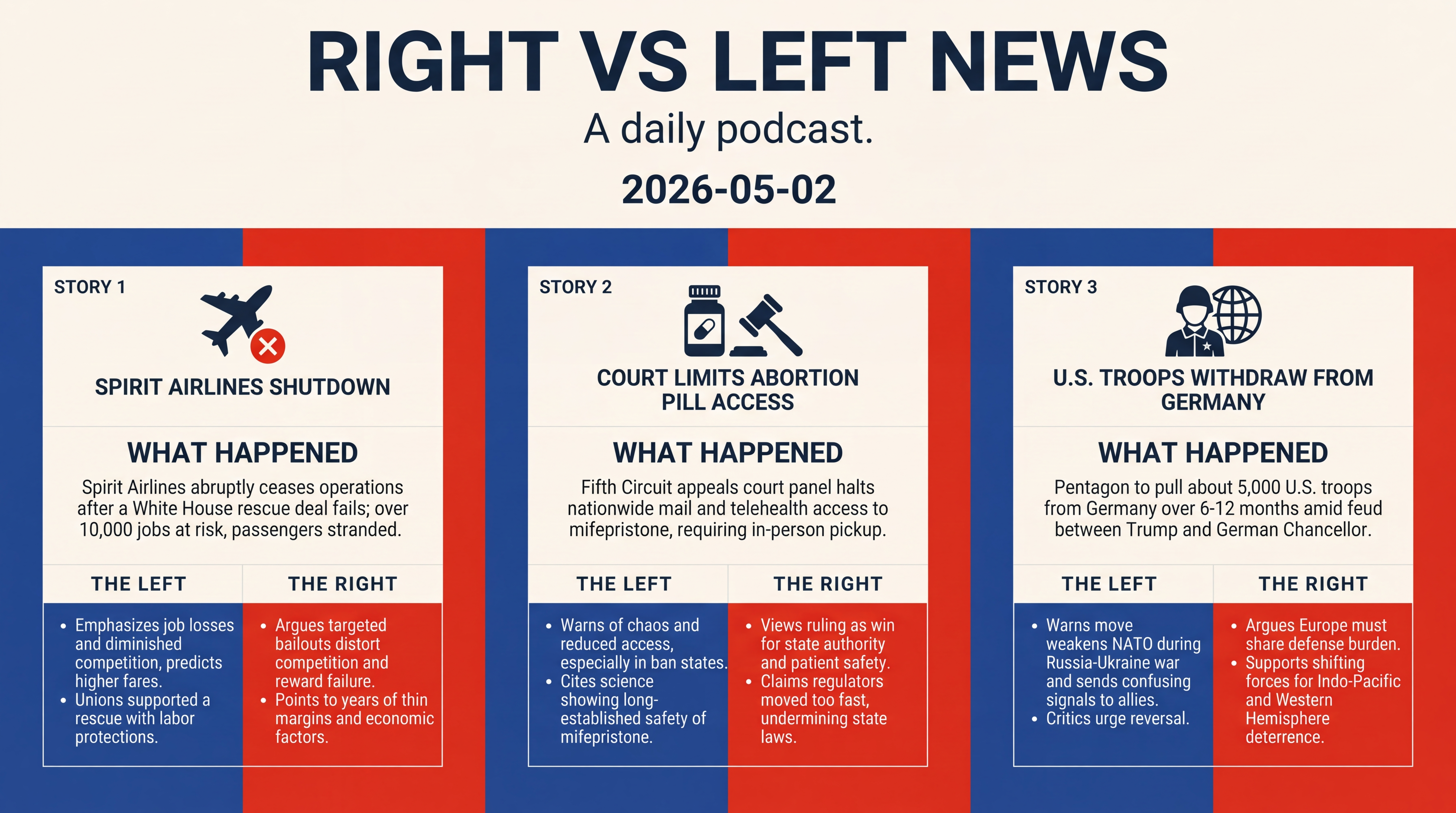
Here’s what happened. In the early hours of Saturday, Spirit said it has begun an orderly wind-down of operations — effective immediately — canceling flights and directing customers to assistance resources. The move followed days of last-minute talks in which the White House floated a potential $500 million rescue, but no deal materialized. More than 10,000 jobs are at risk, and other airlines are rolling out rescue fares for stranded passengers.
On the right, conservative and market-oriented voices argue targeted bailouts distort competition and reward failure. Some Republicans signaled skepticism about a one-off government save, and coverage framed the collapse as a failed federal lifeline plus creditor opposition. Others point to years of thin margins, a blocked JetBlue deal, and spiking fuel costs during the Iran conflict that left Spirit too fragile to survive.
On the left, progressive commentators emphasize lost jobs and diminished competition that could drive fares higher. Unions representing pilots and flight attendants backed a rescue with labor protections, warning of a consumer hit if a low-cost carrier disappears. Outlets noted that other airlines prepared contingency plans as the bailout unraveled.
Next... the appeals court curbs mail and telehealth access to the abortion pill.
Here’s what happened. A three-judge panel of the Fifth Circuit Court of Appeals temporarily halted nationwide access to mifepristone via telehealth and mail, reinstating an in-person pickup rule while litigation continues. The case stems from Louisiana’s challenge to FDA rules that had expanded access, and drugmaker Danco is seeking an emergency pause to appeal to the Supreme Court. Many outlets call it the most consequential abortion ruling since Dobbs, with immediate implications for providers and patients this weekend.
On the right, many conservatives describe the ruling as a win for states’ authority and patient safety. They argue mail distribution undermines state bans and that regulators moved too fast in loosening safeguards — saying in-person dispensing is the bare minimum while the FDA completes its review.
On the left, reproductive-rights groups and liberal commentators say the decision will create chaos — especially for patients in ban states who relied on telemedicine — and contend the science shows mifepristone’s long-established safety. Advocacy groups warn the order effectively guts telehealth abortion nationwide while legal fights continue.
Now... the U.S. will withdraw 5,000 troops from Germany.
Here’s what happened. The Pentagon says it will pull about 5,000 U.S. troops from Germany over the next 6 to 12 months, amid a very public feud between President Trump and German Chancellor Friedrich Merz over Washington’s war with Iran. Reporting notes the drawdown would return parts of Europe’s U.S. footprint closer to pre-2022 levels and has already triggered pushback from key members of Congress.
On the right, many conservatives argue Europe must shoulder more of its own defense and that shifting some forces home or to other theaters is prudent. They highlight a broader force-posture review and long-standing calls for greater NATO burden-sharing — especially as Washington prioritizes deterrence in the Indo-Pacific and Western Hemisphere.
On the left, Democrats and liberal analysts warn the move weakens NATO in the middle of Russia’s ongoing war in Ukraine and sends a confusing signal to allies while the U.S. is enforcing a naval blockade of Iran. Congressional leaders have urged a reversal and point to similar cuts floated in Trump’s first term that were later halted.
[MIDPOINT_SPONSORS]
Turning to the South... states move to redraw maps after the Voting Rights Act ruling.
Here’s what happened. Following the Supreme Court’s decision limiting how states use race under Section 2 of the Voting Rights Act, Republican governors in Alabama and Tennessee called special sessions to redraw congressional maps, and Louisiana paused its May 16 primaries to rework lines. GOP strategists see a chance to net several House seats, though timelines are tight and lawsuits are already flying.
On the right, conservatives contend the Court reaffirmed that race-based districting can’t trump equal-protection limits, and argue states are returning to race-neutral criteria like compactness and communities of interest. Commentators on the right praise the ruling as a check on what they call racial gerrymanders — while acknowledging both parties pursue partisan advantage.
On the left, progressives call the decision a gut punch to minority representation that will reduce the number of Black-majority or influence districts, especially across the South. Reporting warns the changes could end the careers of several Black Democrats and complicate voting-rights enforcement heading into November.
Finally... Trump plans to raise tariffs on EU cars and trucks to 25 percent.
Here’s what happened. President Trump says he’ll raise tariffs on European Union autos and trucks to 25 percent next week, accusing the EU of failing to comply with last year’s trade framework. The move reopens a major front in transatlantic trade tensions and could hit European automakers’ U.S. sales — while inviting retaliation.
On the right, protectionist-leaning conservatives argue the hike gives Washington leverage to push more manufacturing into the U.S. and punishes partners they say aren’t playing fair. Supporters say higher duties will accelerate factory moves stateside and strengthen domestic supply chains.
On the left, free-trade advocates and many progressives warn consumers will pay more and that another tariff fight risks a broader European backlash. Economists note past studies finding that U.S. households bear most tariff costs, and warn of likely price increases and supply-chain friction.
Quick recap... Spirit’s shutdown spotlights jobs, competition, and the politics of bailouts. The Fifth Circuit’s abortion-pill order tightens access and points straight to the Supreme Court. A Germany troop drawdown stirs NATO debates. Southern redistricting accelerates after the Court’s Voting Rights Act ruling. And EU auto tariffs jump to 25 percent — setting up a transatlantic trade clash.
We’ll keep tracking how these play out over the coming days.
That's it for today's episode of Right versus Left News. Remember, understanding both sides isn't about picking a team—it's about being informed. Subscribe wherever you get your podcasts, and join us tomorrow for another balanced look at the day's biggest stories. Until next time, stay curious and stay informed.
