DHS Reopens, Growth Rebounds, Oil Politics Shift
Congress ends the DHS shutdown as growth ticks up. We cover May Day actions, the UAE leaving OPEC, and the Supreme Court’s next moves — plus how the right and left frame each story.
Episode Infographic
Show Notes
Welcome to Right versus Left News—your daily briefing on the stories that matter, told from both sides of the aisle. I'm your AI host - Chris, and each day I bring you the most important political and cultural news, with perspectives from conservative and progressive voices. No spin, no agenda—just the facts and the opinions that shape our national conversation. Let's dive in...
Here are today’s five biggest stories...
Congress ended the record shutdown at the Department of Homeland Security, and President Trump signed the funding into law. TSA and the Coast Guard are back on steady footing.
The Commerce Department says the U.S. economy grew about two percent in the first quarter.
It’s May Day — labor and immigration rights groups are staging rallies and walkouts nationwide.
The United Arab Emirates’ departure from OPEC takes effect today — a jolt to global oil politics.
And the Supreme Court meets in private conference to decide which new cases to take up this term.
We’ll break down what happened — and how both the right and the left are reading the moment.
[BEGINNING_SPONSORS]
Let’s start with Homeland Security.
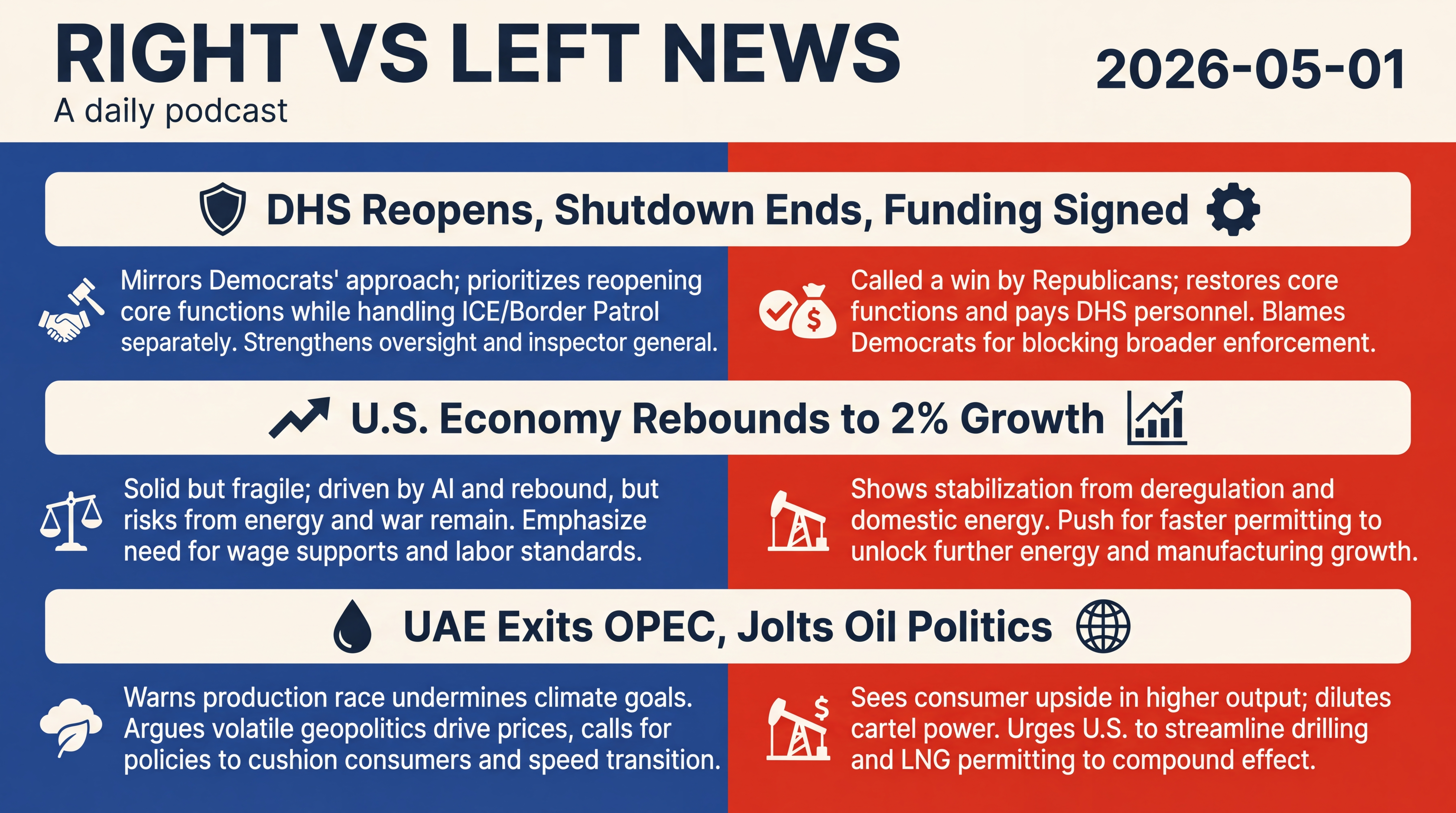
The House approved a Senate-passed bill to fund most of DHS — excluding ICE and Border Patrol — and sent it to the White House. President Trump signed it the same day, ending a shutdown that dragged on for more than seventy-five days. The standoff had begun to bite — airport security was at risk, and the Coast Guard and the Secret Service were straining under emergency payroll workarounds that were running out.
On the right, House Appropriations Republicans call this a win that pays DHS personnel and restores core functions — while blaming Senate Democrats for blocking a broader enforcement bill. Some conservatives also credit the White House for authorizing temporary payroll patches that bought time.
On the left, Democrats say this mirrors their approach — reopen most of DHS, keep negotiating reforms, and handle ICE and Border Patrol in separate votes. They argue Republicans pushed needless brinkmanship that risked airport chaos, while this package strengthens oversight and the inspector general.
Now... the economy.
The Bureau of Economic Analysis reports real GDP grew roughly two percent in the first quarter of 2026 — an acceleration from about half a percent late last year. Think rebound, helped by business investment, AI spending, and a snapback from earlier shutdown slowdowns.
On the right, many argue two percent growth amid global shocks shows deregulation, domestic energy expansion, and tighter spending plans are stabilizing the outlook. They still warn inflation risks remain — and push for faster permitting to unlock energy and manufacturing.
On the left, progressives call the number solid but fragile — pointing to energy shocks, war uncertainty, and higher rates that could squeeze consumers. They note the growth underperformed some forecasts, and say wage supports, price-fairness enforcement, and labor standards are needed so any AI gains reach workers.
May Day next.
Across the U.S., organizers planned marches, boycotts, and student walkouts — no work, no school, no shopping — tying demands to wages, immigration policy, and the cost of living. Around the world, rallies are pushing for higher pay, peace, and stability amid energy-driven price spikes.
On the right, commentators focus on disruption and public safety — warning coordinated walkouts can morph into broader anti-capitalist protests and strain already thin public services, especially on campuses and in busy downtowns.
On the left, labor advocates frame May Day as a legitimate pressure valve — arguing that strikes and boycotts have historically delivered wage gains and safer workplaces. With household budgets stretched, they see collective action as a way to flex power.
[MIDPOINT_SPONSORS]
Energy geopolitics...
The United Arab Emirates’ exit from OPEC becomes effective today, May 1 — removing the cartel’s third-largest producer and weakening its leverage. Abu Dhabi wants to set its own pace and accelerate production. Analysts call it an existential shock for OPEC’s cohesion, even if near-term prices still hinge on war-related supply risks.
On the right, some see upside for consumers if the UAE pursues higher output — arguing that more non-OPEC barrels dilute cartel power and align with a U.S. strategy built on abundant energy and friend-shoring in the Gulf. They urge Washington to streamline drilling and liquefied natural gas permitting to compound the effect.
On the left, progressives warn that a production race risks undermining climate goals — and could entrench fossil dependence just as clean-energy investment needs to accelerate. They stress that volatile geopolitics — rather than demand — may drive prices, and push policies that cushion consumers while speeding the transition.
Finally, the Supreme Court.
The justices hold their private conference today to consider which new cases to hear next term. Petitions on the list range from sanctions power, to appellate deadlines, to due-process questions — early signals of where the docket may head.
On the right, legal conservatives welcome grants that rein in expansive administrative or judicial power and clarify limits on agency actions and court-imposed sanctions — an effort to restore textual and structural guardrails.
On the left, civil-rights advocates worry the Court could narrow enforcement or limit access to the courts, and they watch for grants that might reshape due-process standards, voting, or immigration procedures. They’ll also urge lawmakers to shore up statutory protections regardless of what the Court takes.
Quick recap...
DHS is funded again. The economy grew about two percent to start the year. May Day actions are testing politics in the streets. The UAE’s OPEC exit takes effect today. And the Supreme Court is quietly shaping next term’s agenda. We’ll keep tracking each thread — the policy, the pocketbook, and the courts — as they evolve.
That's it for today's episode of Right versus Left News. Remember, understanding both sides isn't about picking a team—it's about being informed. Subscribe wherever you get your podcasts, and join us tomorrow for another balanced look at the day's biggest stories. Until next time, stay curious and stay informed.
