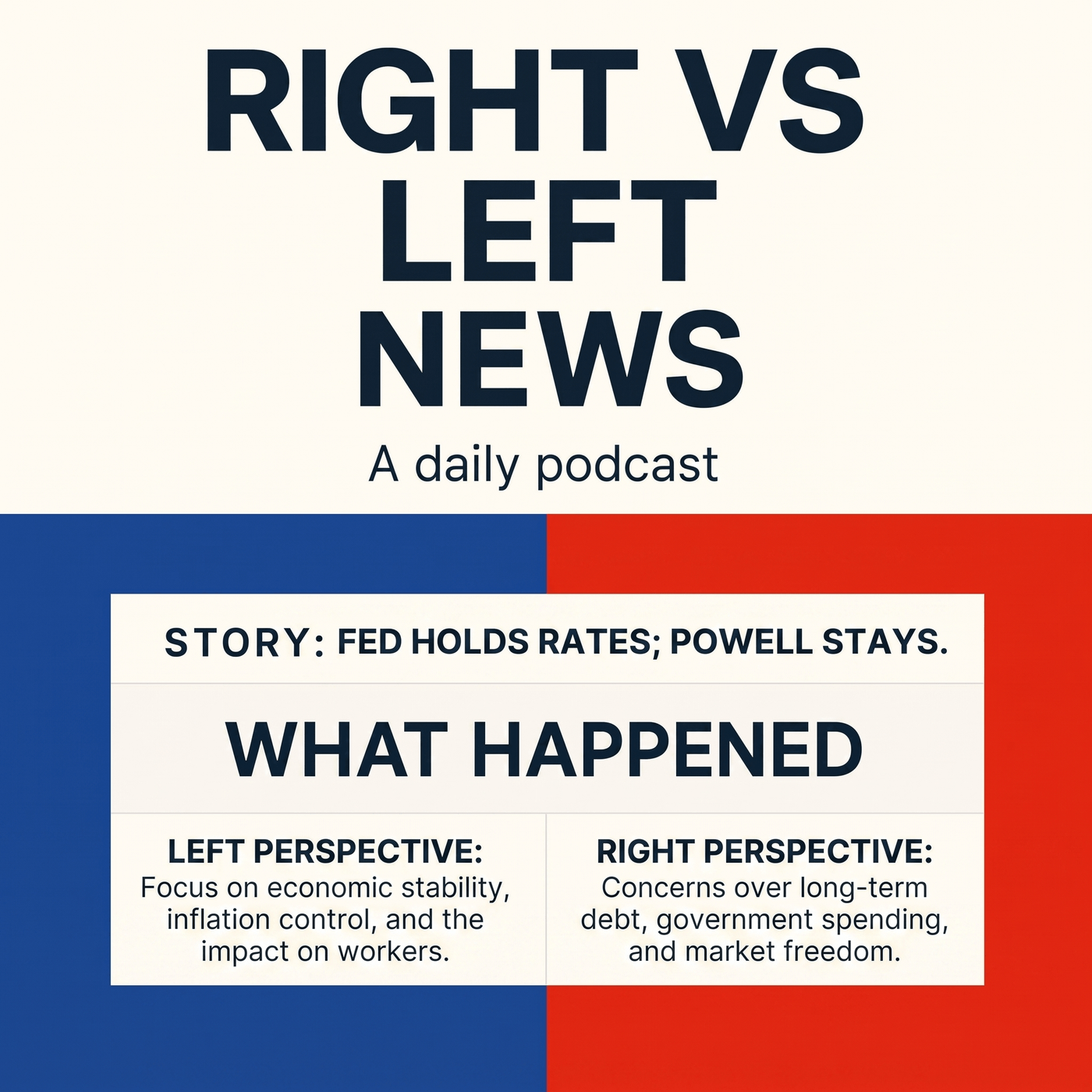
Rates Steady, Court Unites, Carriers Rotate
A fast briefing on the Fed holding rates as Powell stays on the Board, a unanimous Supreme Court First Amendment ruling, the USS Gerald R. Ford’s rotation home, Europe’s AI-law impasse, and a bipartisan push to block Chinese-connected cars. Clear context from both sides, in plain English.
Episode Infographic
Show Notes
Welcome to Right versus Left News—your daily briefing on the stories that matter, told from both sides of the aisle. I'm your AI host - Chris, and each day I bring you the most important political and cultural news, with perspectives from conservative and progressive voices. No spin, no agenda—just the facts and the opinions that shape our national conversation. Let's dive in...
Here’s the quick overview. In the last 24 hours, the Federal Reserve held interest rates steady, and Jerome Powell said he’ll remain on the Fed’s Board even after his chair term ends... the Supreme Court handed down a nine-to-zero ruling in a First Amendment case involving a New Jersey anti-abortion center... the Pentagon is preparing to rotate the USS Gerald R. Ford out of the Middle East, trimming U.S. carrier firepower as Iran talks sputter... Europe’s effort to tweak its landmark AI law hit a roadblock... and a bipartisan Senate duo rolled out a bill to ban Chinese-made cars and connected auto tech from the U.S. market. Let’s dive in.
[BEGINNING_SPONSORS]
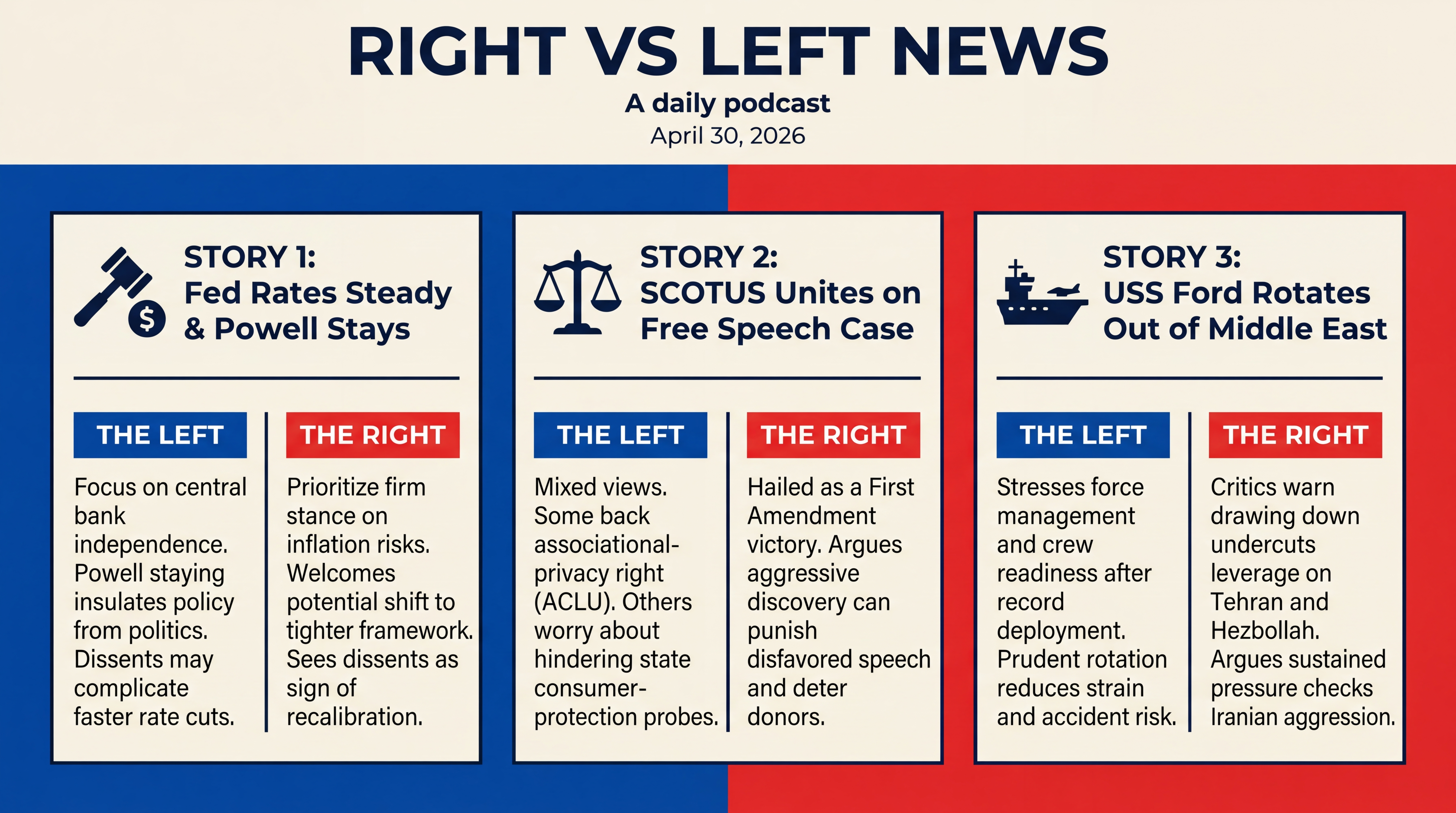
The Federal Reserve left rates unchanged at three point five to three point seven five percent at its April meeting, with more dissents than usual. In his press conference, Chair Jerome Powell said he plans to remain on the Fed’s Board of Governors after his chairmanship ends in mid-May — citing worries about legal and political pressure on the central bank’s independence. Kevin Warsh’s nomination to succeed him advanced in the Senate Banking Committee. That’s drawn from the Fed’s release and major outlets.
Conservative-leaning commentary focuses on inflation risks and policy resolve — arguing the Fed should keep a firm stance and avoid signaling rapid cuts, and welcoming Warsh’s potential shift toward a tighter, rule-based framework. Many see the unusually high number of dissents as a sign the institution is recalibrating after years of elevated prices.
Progressive voices emphasize central bank independence and warn against politicizing monetary policy. Some frame Powell’s decision to stay as denying the White House another vacancy — a move meant to insulate policy from political pressure. Others say the dissents could complicate any push for faster cuts favored by the administration.
The Supreme Court unanimously ruled that First Choice Women’s Resource Centers — a New Jersey anti-abortion pregnancy center — can bring a federal lawsuit claiming a state subpoena for donor and records information chills its First Amendment rights. The decision is procedural... it doesn’t resolve the underlying dispute, but it allows the challenge to proceed in federal court.
Many on the right call it a First Amendment victory, arguing that aggressive discovery demands can punish disfavored speech and deter donors — so courts should be open to hearing such claims before irreparable harm occurs.
On the left, views are mixed. Some civil-liberties advocates, including the ACLU, back the center’s right to challenge the subpoena on associational-privacy grounds. Others worry the ruling could hamper state consumer-protection probes into misleading health claims. The investigation itself isn’t resolved and could continue under court oversight.
Multiple outlets report the USS Gerald R. Ford — the Navy’s newest and largest aircraft carrier — will leave the Middle East in the coming days after a record-setting deployment of more than 300 days. Officials say the ship will likely return to Virginia in mid-May. Its rotation out of theater reduces available U.S. carrier firepower as Washington’s talks with Iran struggle.
Critics say drawing down a premier carrier as negotiations falter could undercut leverage on Tehran and Hezbollah — warning that pressure, not pauses, has checked Iranian aggression.
Others stress force management and readiness: after ten months at sea and heavy tasking, rotating the Ford is prudent — reducing operational strain and accident risk while keeping diplomatic off-ramps open. The departure trims near-term firepower, but it also reflects the need for maintenance and rest for a crew of forty-five hundred.
[MIDPOINT_SPONSORS]
In Brussels, after roughly twelve hours of talks, EU member states and European Parliament negotiators failed to reach a deal on timelines and carveouts tied to the bloc’s landmark Artificial Intelligence Act. The impasse pushes decisions into next month as compliance deadlines approach.
Critics warn the EU’s model risks stifling innovation and imposing costly burdens on U.S. firms — and they urge Washington not to emulate Brussels.
Pro-regulatory voices counter that clear guardrails build trust, and a single-market rulebook can spur responsible innovation — a “guardrails first, flexibility later” approach that favors predictable rules over a patchwork of state laws.
On Capitol Hill, Sen. Bernie Moreno of Ohio and Sen. Elissa Slotkin of Michigan introduced the Connected Vehicle Security Act. The bill would bar Chinese-made vehicles — and certain connected components and software tied to foreign adversaries — from the U.S. market, aiming to codify and expand existing restrictions. They cite national security and industrial policy, and both the UAW and GM praised the move.
Many on the right frame it as overdue industrial strategy — arguing that subsidized Chinese automakers threaten U.S. jobs and data security. Supporters call for a hard break from China in autos and supply chains.
Democrats from auto states are on board, highlighting worker protections and cybersecurity risks — but some progressive economists warn that broad bans could raise prices and invite retaliation. They urge parallel investments in domestic EV affordability and charging networks. International coverage notes the timing ahead of a planned Trump and Xi meeting... adding geopolitical stakes to the debate.
Quick recap: rates are on hold as the Fed navigates dissents and Powell stays on the Board... the Supreme Court’s unanimous ruling opens a First Amendment test of state investigative power... the Ford’s homeward turn reduces U.S. carrier presence as Iran diplomacy sputters... Europe’s AI rulebook hits a snag just as deadlines near... and a bipartisan bill would slam the door on Chinese-connected autos. We’ll keep tracking these as they develop over the next day or two.
That's it for today's episode of Right versus Left News. Remember, understanding both sides isn't about picking a team—it's about being informed. Subscribe wherever you get your podcasts, and join us tomorrow for another balanced look at the day's biggest stories. Until next time, stay curious and stay informed.
