Comey Indictment, TPS Showdown, Price Shock, Campus Clash
We unpack the new James Comey indictment, Supreme Court TPS arguments, soaring gas prices, U.S. leverage at the U.N., and a Capitol Hill clash over campus speech. Clear context, key perspectives, and what to watch next.
Episode Infographic
Show Notes
Welcome to Right versus Left News—your daily briefing on the stories that matter, told from both sides of the aisle. I'm your AI host - Chris, and each day I bring you the most important political and cultural news, with perspectives from conservative and progressive voices. No spin, no agenda—just the facts and the opinions that shape our national conversation. Let's dive in...
Here’s the big picture for Wednesday, April 29, 2026. The Justice Department has indicted former FBI Director James Comey again — this time over a social media post prosecutors say threatened the president. The Supreme Court is set to hear two high-stakes immigration cases that could affect hundreds of thousands of Haitians and Syrians with Temporary Protected Status. At the pump, U.S. gasoline prices have climbed to multi-year highs, even as consumer confidence ticks up — energy markets and politics are colliding. On the world stage, the U.S. is conditioning billions in back dues to the United Nations on budget cuts and curbs on China’s influence. And on Capitol Hill, House lawmakers are holding a hearing on free speech and protests on college campuses.
[BEGINNING_SPONSORS]
The Justice Department has filed a new two-count indictment against former FBI Director James Comey, alleging that a 2025 Instagram photo of seashells arranged to read "86 47" constituted a threat against President Trump. The case is in the Eastern District of North Carolina, and as of Tuesday evening an initial court appearance hadn’t been scheduled. It’s the second Comey case in recent months — an earlier indictment was tossed on appointment grounds — and this one focuses solely on the alleged threat. Multiple outlets have reported details of the filing and the controversy around it.
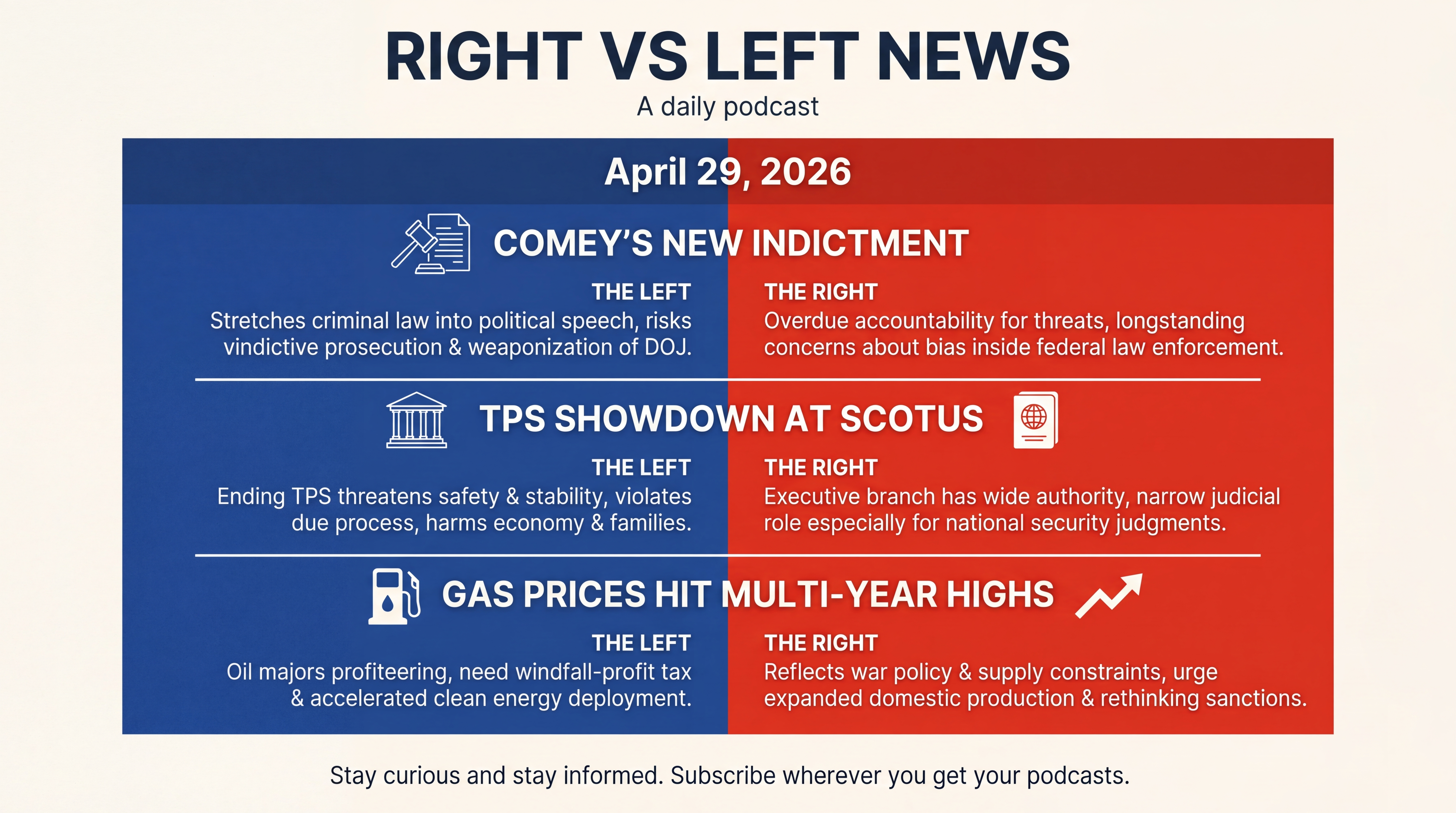
On the right... Some conservative commentary frames the indictment as overdue accountability for what they see as a pattern of anti-Trump behavior, stressing that threats — implicit or explicit — must be taken seriously. Coverage highlights the issuance of an arrest warrant and longstanding concerns about bias inside federal law enforcement.
On the left... Center-left and progressive voices argue the case stretches criminal law into protected political speech and risks weaponizing the Justice Department against a prominent critic. They flag unanswered questions about intent, and raise concerns about vindictive prosecution after the earlier case collapsed.
The Supreme Court hears arguments today on whether the administration can end Temporary Protected Status for roughly 350,000 Haitians and about 6,000 Syrians. The consolidated cases test executive authority — and whether courts can review TPS terminations at all. A decision expected by June could ripple to more than a dozen nationalities whose TPS designations were revisited in recent years. Major newsrooms and advocacy groups are mapping out the filings and the stakes.
On the right... Conservative legal commentators argue the TPS statute gives wide discretion to the executive, with a narrow — even nonexistent — role for judicial second-guessing, especially where national security and foreign policy judgments are invoked.
On the left... Progressive immigration advocates say ending TPS without robust judicial review would destabilize families and workplaces, handing the executive a blank check despite dangerous conditions on the ground. They emphasize due-process concerns and the human toll if deportations resume, noting that hundreds of thousands have built lives here and contribute to the economy.
U.S. gasoline prices have climbed to their highest levels since the outset of the Iran war, with the national average in the low $4s per gallon this week, according to AAA and other reports. BP reports profits more than doubling as crude prices hover above $100 and refining margins improve. Yet the Conference Board says consumer confidence edged higher in April — even as respondents fret about fuel costs. Polling suggests high gas prices pose political risks for the White House.
On the right... Commentators argue the price spike reflects foreseeable fallout from war policy and supply constraints. They urge expanding domestic production, easing permitting, and rethinking sanctions or blockades that tighten global supply — with some pinning blame directly on the administration’s Iran strategy.
On the left... Progressive voices counter that oil majors posting windfalls while families pay more underscores the case for windfall-profit taxes, stronger price-gouging enforcement, and accelerated clean-energy deployment to cut exposure to geopolitics. They also note consumer confidence hasn’t cratered — suggesting targeted relief and faster electrification could blunt oil-price shocks without rewriting foreign policy.
Now to diplomacy at the U.N.
[MIDPOINT_SPONSORS]
The United States is conditioning payment of billions in U.N. arrears on quick-win reforms — further cost-cutting and steps to limit Beijing’s sway in key U.N. funds — according to documents reported by Devex and echoed in global press coverage. Washington’s conditions reportedly include curbing channels China uses to route discretionary funds, and demanding broader management changes before checks go out.
On the right... Many conservatives applaud tying U.S. money to reform, arguing China has leveraged rising contributions to tilt U.N. agendas and leadership pipelines. From this view, linking funds to governance changes protects U.S. taxpayers and counters authoritarian influence in multilateral bodies.
On the left... Progressive and multilateralist voices warn that attaching sweeping conditions risks undercutting peacekeeping, humanitarian operations, and nuclear monitoring — right as global crises mount. They argue the U.S. should pay treaty-obligated dues promptly to restore credibility, pursue reforms through consensus, and avoid setting a precedent other countries could use to politicize funding. Reporting underscores budget cuts and staff reductions already underway, heightening concern about further strings.
An American culture-and-politics flashpoint heads to Capitol Hill. The House Education and the Workforce Committee holds a hearing titled "Speech or Silence? The Future of the First Amendment in Higher Education," amid disputes over campus protests, antisemitism, and university discipline policies. The notice lists witnesses from academic-freedom groups and think tanks. The broader backdrop includes recent crackdowns and arrests at campus encampments in prior protest waves.
On the right... Conservative media and lawmakers argue universities have tolerated harassment and antisemitism under the banner of protest, failed to enforce neutral time-place-manner rules, and chilled non-progressive speech — hence the push for hearings and legislation to condition federal aid on protecting free expression.
On the left... Progressive commentators and civil-liberties groups warn that congressional pressure can morph into political litmus tests, and that aggressive police actions and suspensions risk criminalizing dissent and academic freedom. Data-driven reporting on prior protest crackdowns is often cited to argue for de-escalation and content-neutral rules rather than partisan intervention.
Quick recap... Comey’s new indictment reignites a years-long feud over law, politics, and speech. The Supreme Court’s TPS arguments could reshape immigration authority — and the futures of hundreds of thousands of people. Gas prices are rising — and so are the political stakes. Washington’s U.N. funding gambit tests how far leverage can push reform. And Congress is back in the middle of the campus speech wars. We’ll keep tracking it all as it develops.
That's it for today's episode of Right versus Left News. Remember, understanding both sides isn't about picking a team—it's about being informed. Subscribe wherever you get your podcasts, and join us tomorrow for another balanced look at the day's biggest stories. Until next time, stay curious and stay informed.
