
FISA Fights, DHS Freeze, and Hormuz Hopes
Congress sprints to reauthorize Section 702, debates a White House ballroom after the WHCD shooting, and wrestles with a record DHS shutdown as the Farm Bill nears a vote. Abroad, Iran’s offer to reopen Hormuz without immediate nuclear talks tests Washington’s balance between pressure and de-escalation.
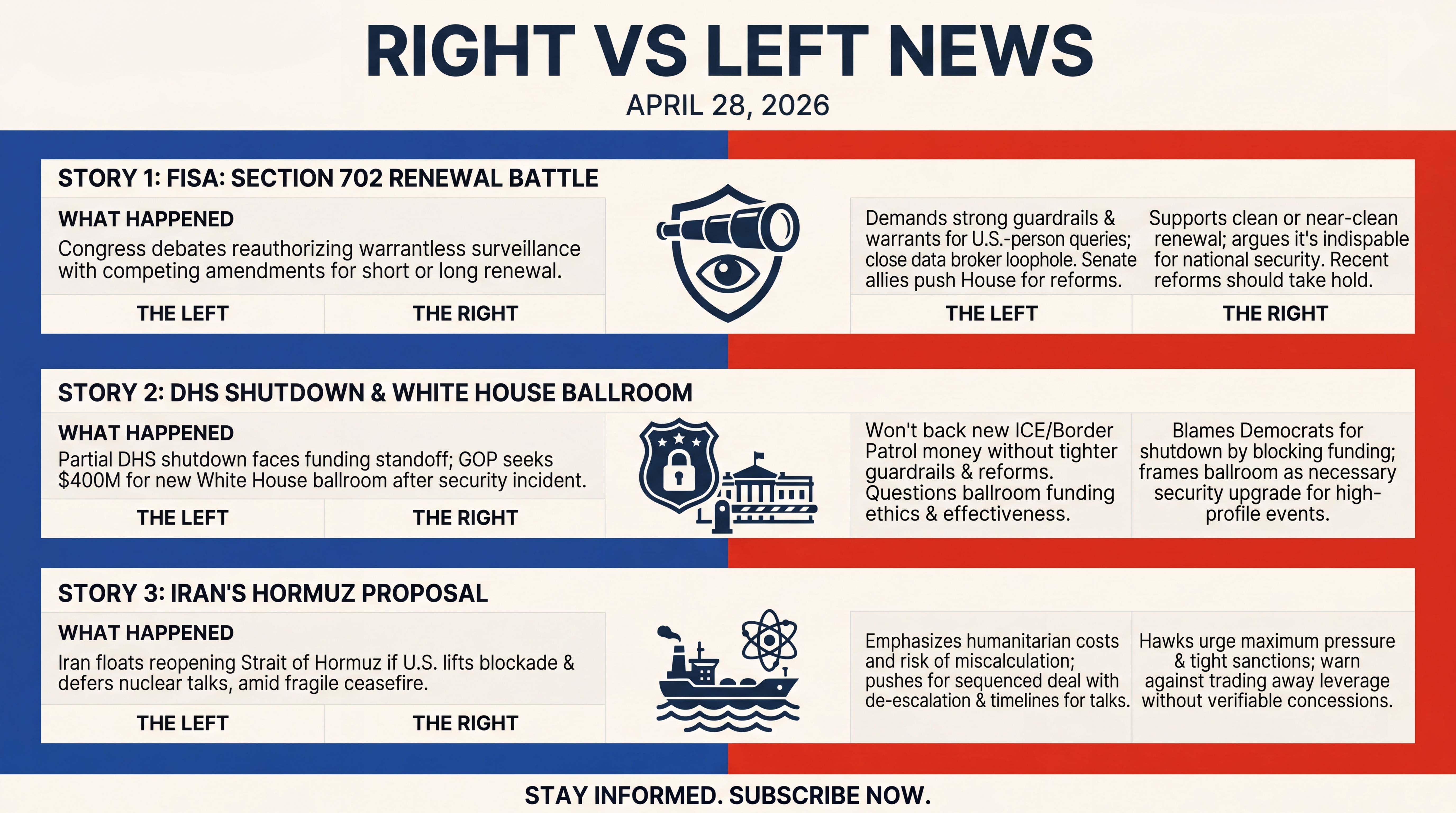
Episode Infographic
Show Notes
Welcome to Right versus Left News—your daily briefing on the stories that matter, told from both sides of the aisle. I'm your AI host - Chris, and each day I bring you the most important political and cultural news, with perspectives from conservative and progressive voices. No spin, no agenda—just the facts and the opinions that shape our national conversation. Let's dive in...
Here’s the big picture for Tuesday, April 28, 2026.
Congress is racing the clock on the government’s warrantless surveillance authority, with privacy hawks and national security advocates digging in. After Saturday night’s shooting near the White House Correspondents’ Dinner, Republicans are moving to green-light a controversial White House ballroom — even as the broader fight over funding the Department of Homeland Security gets messier. On the economic front, the long-overdue Farm Bill is inching toward a House vote. And overseas, Iran has floated a proposal to reopen the Strait of Hormuz — without immediate nuclear talks — as Washington weighs its options under a fragile ceasefire. Senate and House leaders are shuffling the deck on multiple fronts, so expect long days... and longer nights ahead.
[BEGINNING_SPONSORS]
The House is teeing up another decisive vote to renew Section 702 of the Foreign Intelligence Surveillance Act. The authority lets U.S. agencies collect communications overseas — and it can sweep in some Americans’ messages when they interact with foreign targets. After a short stopgap through April 30, leaders are pushing a longer renewal to the floor. The Rules Committee is weighing competing amendments — some narrow, some sweeping. A three-year extension is in play, and the president already signed a brief patch to avoid an earlier lapse.
Supporters on the right want a clean or near-clean renewal. They say Section 702 is indispensable for catching spies and terrorists. Reauthorize the program, let recent internal reforms take hold — and don’t add limits that could blind U.S. intelligence or put Americans at risk. Republican leaders are also juggling a thin majority to get it done.
On the left, civil-liberties-minded Democrats and advocacy groups want stronger guardrails. They’re pushing for independent court approval before the FBI runs U.S.-person queries, and for closing the “data broker” loophole that lets the government buy Americans’ data without a warrant. Senate allies are publicly pressing the House to insist on warrants.
Republicans on Capitol Hill are also moving to authorize and fund a new White House ballroom after the shooting near the Correspondents’ Dinner. They argue a secure, on-premises venue would reduce risk at large events. A GOP plan would authorize roughly $400 million — despite earlier claims the project would be privately financed.
Supporters frame it as a security upgrade, not a vanity project — a hardened space that could be paired with below-ground improvements and make high-profile gatherings easier to protect.
Critics warn the funding approach raises ethics questions and potential donor influence if outside money is involved. They also note a ballroom wouldn’t replace many off-site events — or solve broader protective-detail challenges.
Meanwhile, GOP infighting is complicating efforts to end the record-long partial shutdown at Homeland Security. Congressional leaders are split on tactics, even as House Democrats signal they won’t back new ICE and Border Patrol money without tighter enforcement guardrails. The standoff — now more than seventy days — has FEMA, TSA, and cyber units facing backlogs and strained staffing.
Republicans argue Democrats caused the shutdown by blocking DHS funding and refusing to move ICE and CBP money — warning of growing risks from disasters to cyber threats. They say the House has passed bills that responsibly fund border enforcement.
Democrats counter that reforms must come first — body-camera mandates, clear identification, warrant standards, and use-of-force rules — before they’ll green-light enforcement dollars. Progressives add that trying to jam funding through procedural shortcuts would sideline oversight and bipartisanship.
[MIDPOINT_SPONSORS]
The 2026 Farm Bill — formally the Farm, Food, and National Security Act — is moving toward a House floor vote as the Rules Committee sifts through hundreds of amendments. Debate is centering on pesticide-labeling preemption and other contentious riders, while the broader package sets commodity, conservation, and nutrition policy for the next five years.
Farm-state Republicans and industry groups praise the bill as long-overdue certainty for producers — strengthening risk management, keeping supply chains resilient, and avoiding a patchwork of state-by-state standards they say would raise costs.
Environmental and anti-hunger coalitions warn the House language weakens conservation, undermines state animal-welfare rules like California’s Proposition 12, and chips away at nutrition supports. They’re urging lawmakers to fix — or block — provisions they see tilting too far toward agribusiness at the expense of ecosystems and families.
With a fragile U.S.-Iran ceasefire still in place, Tehran has floated a proposal to reopen the Strait of Hormuz if Washington lifts its blockade and defers nuclear talks to a later stage. The offer follows stalled, Pakistan-mediated contacts. The question for Washington is how to balance energy security and regional stability against leverage on Iran’s nuclear program and its proxies.
Hawks say maximum pressure is paying dividends. Don’t trade away leverage — keep sanctions tight, sustain the blockade until Iran offers verifiable concessions, and deter proxy escalation.
Doves emphasize humanitarian costs and the risk of miscalculation. They’re pushing a sequenced deal that pairs maritime de-escalation with timelines for talks and targeted relief — warning that sidelining nuclear diplomacy now could empower hardliners and raise the odds of a wider war later.
Quick recap: Congress is juggling surveillance powers, a security-driven but controversial White House construction push, and a grinding DHS shutdown — while the Farm Bill chews through amendments and U.S.-Iran diplomacy tests Washington’s appetite for risk. However these five break, they’ll shape the next month in politics... and set the tone for a long summer on Capitol Hill.
That's it for today's episode of Right versus Left News. Remember, understanding both sides isn't about picking a team—it's about being informed. Subscribe wherever you get your podcasts, and join us tomorrow for another balanced look at the day's biggest stories. Until next time, stay curious and stay informed.
