Geofences, Royal Diplomacy, and Fed Moves
From a Supreme Court showdown over geofence warrants to King Charles’s Washington visit and a fast-moving Fed nomination, we break down what matters now. Plus, Wisconsin’s high-stakes court race and Congress’s missile-defense debate set the week’s agenda.
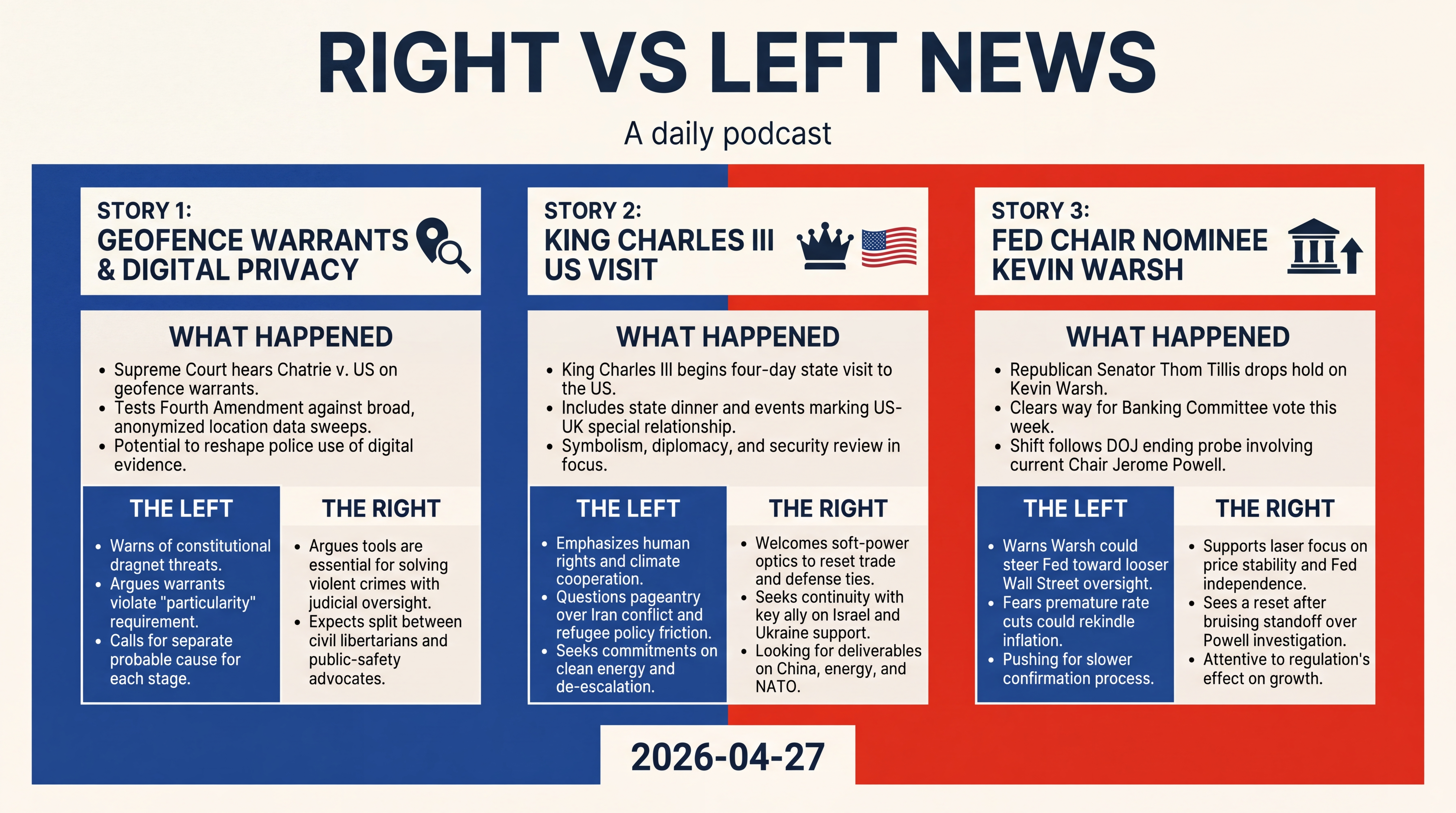
Episode Infographic
Show Notes
Welcome to Right versus Left News—your daily briefing on the stories that matter, told from both sides of the aisle. I'm your AI host - Chris, and each day I bring you the most important political and cultural news, with perspectives from conservative and progressive voices. No spin, no agenda—just the facts and the opinions that shape our national conversation. Let's dive in...
Here’s what we’re watching today.
The Supreme Court takes up a closely watched case on geofence warrants and digital privacy — a fight that could reshape how police use location data.
King Charles III lands in Washington for a four-day state visit... symbolism, diplomacy, and a fresh look at security are all in the mix.
President Trump’s pick to lead the Federal Reserve, Kevin Warsh, has a clearer path after a Republican holdout signaled support.
Wisconsin’s pivotal state supreme court race heads into its final day of campaigning before Tuesday’s vote.
And on Capitol Hill, the Senate Armed Services Committee zeroes in on missile defense as it reviews the Pentagon’s 2027 budget request.
[BEGINNING_SPONSORS]
The justices are hearing oral arguments in Chatrie v. United States — a test of whether geofence warrants, which sweep up anonymized location pings from phones near a crime scene, violate the Fourth Amendment. It’s one of the term’s major digital-privacy fights... and the Court’s 2018 Carpenter ruling on cell-site data looms large.
On the right, civil libertarians warn that broad, dragnet-style searches threaten constitutional limits, even as some law-and-order voices argue that, with judicial oversight, these tools help solve violent crimes. Expect a split — surveillance skeptics versus public-safety hawks.
On the left, groups like the ACLU argue geofence warrants invert the Fourth Amendment’s particularity requirement by starting with everyone in the area. They want the Court to treat each step of these multi-stage warrants as a separate search that requires its own probable cause.
King Charles III begins a four-day state visit to the United States, with a state dinner Tuesday and events marking America’s 250th anniversary and the U.S. and U.K. special relationship. After a weekend security review, the trip is moving forward as planned.
Conservatives welcome the soft-power optics and the chance to reset ties on trade, defense cooperation, and support for Israel and Ukraine — continuity with a key ally even as Washington presses Europe to shoulder more defense costs. They’re looking for concrete deliverables on China, energy, and NATO burden sharing.
Progressives emphasize human rights and climate cooperation, and question whether pageantry can overcome friction over the Iran conflict and refugee policy. They want commitments on clean energy, humanitarian aid, and de-escalation diplomacy.
Kevin Warsh’s path to become Federal Reserve chair brightened after Senator Thom Tillis said he would no longer block the nomination — clearing the way for a Banking Committee vote this week. The shift followed the Justice Department ending a probe involving current Chair Jerome Powell, which Tillis had cited.
Supporters on the right say Warsh will keep a laser focus on price stability and protect the Fed’s independence from short-term politics — while being attentive to how regulation affects growth. They see a reset after a bruising standoff over the Powell investigation.
On the left, progressives warn Warsh could steer the Fed toward looser Wall Street oversight and premature rate cuts that risk rekindling inflation. Banking Committee Democrats are signaling resistance and pushing for a slower confirmation process.
[MIDPOINT_SPONSORS]
Wisconsin’s state supreme court race is in the home stretch ahead of Tuesday’s vote. An open seat could either expand or narrow the court’s liberal majority. Appeals court judges Chris Taylor and Maria Lazar are facing off, and the outcome will shape decisions on abortion, maps, and voting rules in a key 2026 battleground.
Conservatives call the race a needed check on what they see as a politicized bench — warning that a larger liberal majority could entrench progressive rulings on redistricting and elections.
Progressives argue that another liberal justice would protect abortion access under the state constitution, defend voting access, and curb gerrymandering — part of a broader effort since 2023 to build durable majorities on state high courts.
On Capitol Hill, the Senate Armed Services Committee is holding a hearing on missile defense as part of the fiscal 2027 authorization review — one of several sessions scrutinizing big-ticket Pentagon requests. The broader debate centers on how much to prioritize air and missile defense, space, and cyber.
Hawks on the right see missile defense as essential given Iran’s arsenal, North Korea’s advances, and great-power competition. They argue that credible deterrence — and protection of U.S. forces and allies — requires sustained investment.
Progressives push for tighter oversight of costs and threat inflation, urging that each new layer of missile defense be tied to clear testing benchmarks and diplomacy that reduces launch risks. Budget watchers want Congress to weigh trade-offs carefully as requests for AI, cyber, and missile defense grow.
Quick recap... The Supreme Court’s geofence case could redraw the line between privacy and policing. King Charles’s visit blends ceremony with hard geopolitics. Kevin Warsh’s Fed bid moves forward after a key Senate Republican relents. Wisconsin’s court race may shape abortion, maps, and elections for years. And in the Senate, missile-defense dollars face tough questions about real-world deterrence.
We’ll keep tracking what changes next — and what it all means for you.
That's it for today's episode of Right versus Left News. Remember, understanding both sides isn't about picking a team—it's about being informed. Subscribe wherever you get your podcasts, and join us tomorrow for another balanced look at the day's biggest stories. Until next time, stay curious and stay informed.
