
Security Scare, Severe Storms, and Bitcoin Surge
We break down D.C.'s security scare, a multi-day severe weather threat, nationwide flight delays, rare Palestinian local elections, and Bitcoin's latest rally—with clear context from the right and the left. Get the facts and the arguments in minutes.
Episode Infographic
Show Notes
Welcome to Right versus Left News—your daily briefing on the stories that matter, told from both sides of the aisle. I'm your AI host - Chris, and each day I bring you the most important political and cultural news, with perspectives from conservative and progressive voices. No spin, no agenda—just the facts and the opinions that shape our national conversation. Let's dive in...
Here’s a quick look at five big stories we’re watching right now.
First, a dramatic security scare in Washington—the White House Correspondents’ Dinner was interrupted after a shooting outside the venue, and the president was evacuated.
Second, severe weather is set to intensify through Monday across the Plains and Midwest—forecasters warn of large hail, damaging winds, and tornadoes.
Third, the FAA’s weather-related ground-delay programs are already snarling travel at several major hubs.
Fourth, Palestinians voted in municipal elections across the West Bank—and, for the first time in two decades, in one city in central Gaza—with early claims of gains by Fatah.
And fifth, Bitcoin is hovering around $78,000, stirring another round of arguments about inflation, interest rates, and the administration’s economic stewardship.
[BEGINNING_SPONSORS]
Let’s start in Washington.
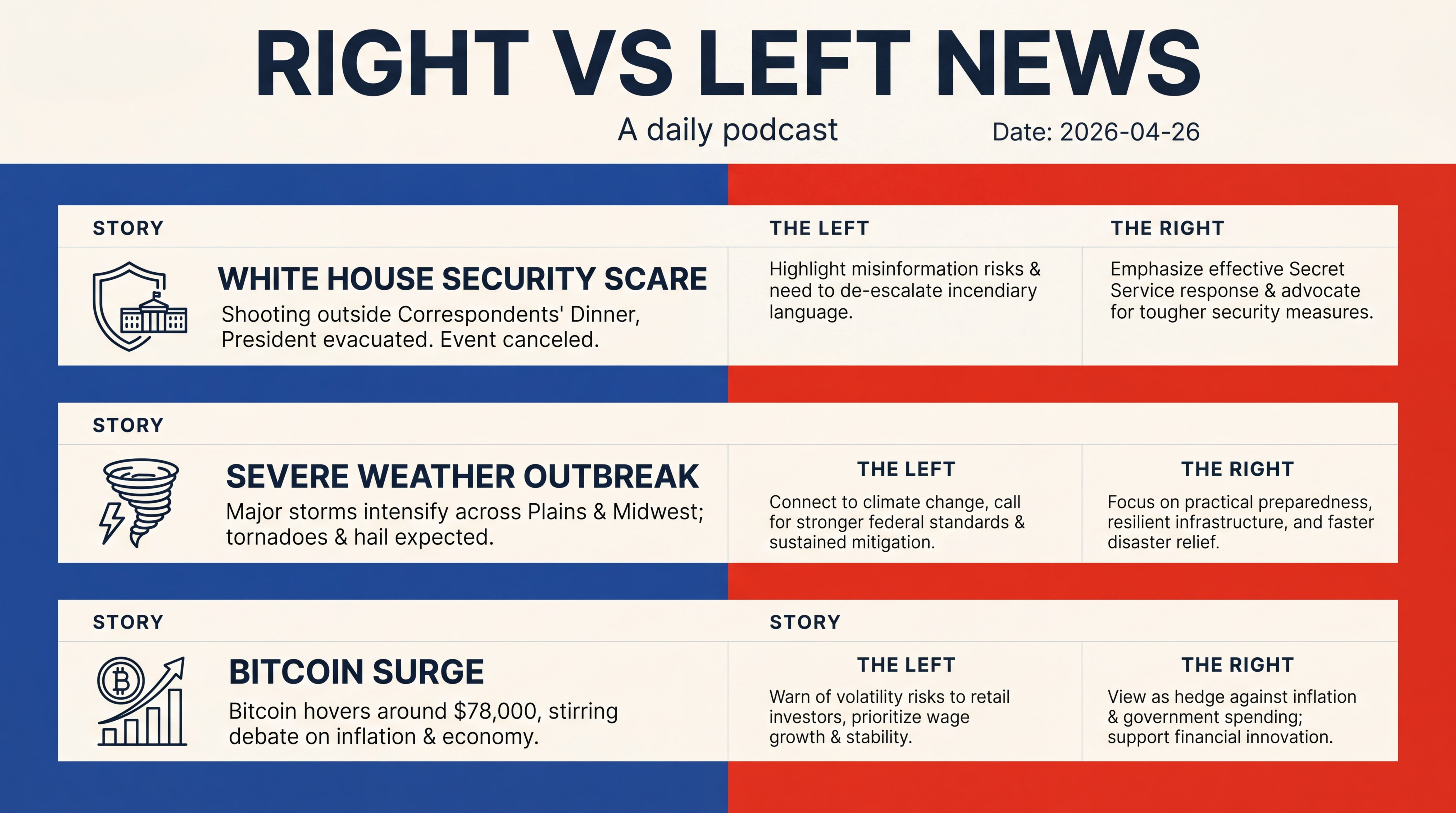
Shots were fired outside the Washington Hilton on Saturday night, April 25, during the White House Correspondents’ Dinner, prompting the Secret Service to evacuate President Trump and other officials. Law enforcement says the suspect was armed and is now in custody; no injuries inside the ballroom were reported. The event was halted and ultimately canceled at the request of law enforcement, and streets around the hotel were sealed off. On-the-ground accounts described a tense scene as guests sheltered and waited for updates.
Conservative voices emphasize the speed and effectiveness of the Secret Service response—pointing to what they see as an escalating pattern of political violence that warrants tougher sentencing and more robust security at high-profile events. Some also argue the media should reflect on rhetoric they believe contributes to a hostile environment.
Progressive voices note how quickly misinformation can spread in breaking moments and credit mainstream outlets for correcting early rumors. They highlight the danger of normalizing threats, call for a broader de-escalation of incendiary language across the spectrum, and stress that journalists themselves face growing risks while covering politics.
Now to the weather.
A major severe-weather outbreak is expected to intensify through Monday, April 27, across the Plains and Midwest—with the potential for strong tornadoes, giant hail, and destructive winds. Forecasters are urging preparedness across parts of Texas, Oklahoma, Kansas, Missouri, and the Upper Midwest. It’s a multiday threat zone… so have a plan and stay alert.
On the right, the focus is on hardening infrastructure and improving readiness—more resilient grids, better radar and siren systems, and faster disaster relief with less red tape. Some caution against attributing every severe spell to climate change, arguing the immediate priority is practical preparedness and recovery.
On the left, many connect these outbreaks to a warming climate and call for stronger federal building standards, smarter land use, and sustained investment in mitigation—alongside swift disaster aid. They emphasize long-term adaptation as well as near-term safety.
Travel is feeling the strain, too.
Weather-related air-traffic management is already affecting flyers. An FAA advisory initiated ground-delay programs at San Francisco International and warned of possible ground stops or delays at Washington National and Dulles, Atlanta, and New York JFK. Low ceilings and storms tied to this broader setup are the culprits—so expect ripple effects as the system shifts east.
Conservatives argue the network needs modernization—more runways where feasible, quicker approvals for airport upgrades, and air-traffic control reform—so bad weather doesn’t trigger nationwide meltdowns. They also push for stricter airline operational planning to reduce cancellations.
Progressives support infrastructure investment as well, paired with stronger passenger protections—automatic compensation for long delays, tighter rules on tarmac strandings, and more transparency on airline scheduling—while warning that increasingly volatile weather will keep testing the system without broader climate action.
In the Palestinian territories, there was a rare bit of electoral activity.
Palestinians voted Saturday, April 25, in municipal elections across the West Bank—and, for the first time in more than 20 years, in Deir al-Balah in central Gaza. Hamas did not field candidates; participation in Gaza was limited to that city, and turnout varied by locality. On Sunday, Fatah claimed sweeping gains, while independent monitors pointed to procedural limits and a constrained political field. Some reports also highlighted donor-driven reforms to the local election law.
Hawkish commentators say the vote changes little strategically—without Hamas in the race, they see limited legitimacy and warn that local outcomes won’t resolve security concerns or produce a credible partner for final-status talks. Some in Israel and the U.S. argue Washington should condition aid on verifiable governance reforms.
Others frame the voting—even if limited—as a fragile step toward renewing Palestinian political life and basic services under extraordinary hardship. They push for broader, freer elections, humanitarian access, and diplomatic pressure on all sides to stabilize the situation and preserve a path toward a viable two-state framework.
And finally… markets.
Bitcoin is trading near $78,000 as of today, Sunday, April 26. Crypto prices swing for many reasons, but this latest leg higher is fueling fresh debate about inflation, Federal Reserve policy, and whether risk assets are benefiting from liquidity expectations despite geopolitical shocks.
Pro-market voices often cast Bitcoin’s strength as a vote of no confidence in government spending and central-bank discretion—arguing it’s a hedge against inflation, regulatory overreach, and currency debasement. Some say a friendlier regulatory climate would keep innovative finance onshore and create high-skill jobs.
Progressives counter that crypto’s volatility and speculative manias can harm retail investors and threaten financial stability—so they call for tougher consumer protections, strict anti-fraud enforcement, and climate-minded scrutiny of mining. They also argue the real economic test is wage growth and affordability… not digital-asset charts.
That’s the rundown for today—a potential tragedy averted in D.C.; a dangerous severe-weather setup; flight delays rippling across the map; closely watched local elections for Palestinians; and markets—crypto especially—testing everyone’s economic theories. We’ll keep tracking the facts and the arguments from both right and left.
That's it for today's episode of Right versus Left News. Remember, understanding both sides isn't about picking a team—it's about being informed. Subscribe wherever you get your podcasts, and join us tomorrow for another balanced look at the day's biggest stories. Until next time, stay curious and stay informed.
