
Asylum Ruling, Iran Squeeze, Meta Layoffs
We unpack a court decision on asylum, fresh Iran sanctions and backchannel diplomacy, Trump’s Correspondents’ Dinner return, and Meta’s pivot to AI — with jobs on the line. Clear context from right and left to keep you ahead this weekend.
Episode Infographic
Show Notes
Welcome to Right versus Left News—your daily briefing on the stories that matter, told from both sides of the aisle. I'm your AI host - Chris, and each day I bring you the most important political and cultural news, with perspectives from conservative and progressive voices. No spin, no agenda—just the facts and the opinions that shape our national conversation. Let's dive in...
Today we’re tracking five fast-moving stories... a border ruling on asylum... fresh Iran sanctions... new U.S.-Iran diplomacy... the Correspondents’ Dinner... and a big round of Meta layoffs. Let’s dive in.
[BEGINNING_SPONSORS]
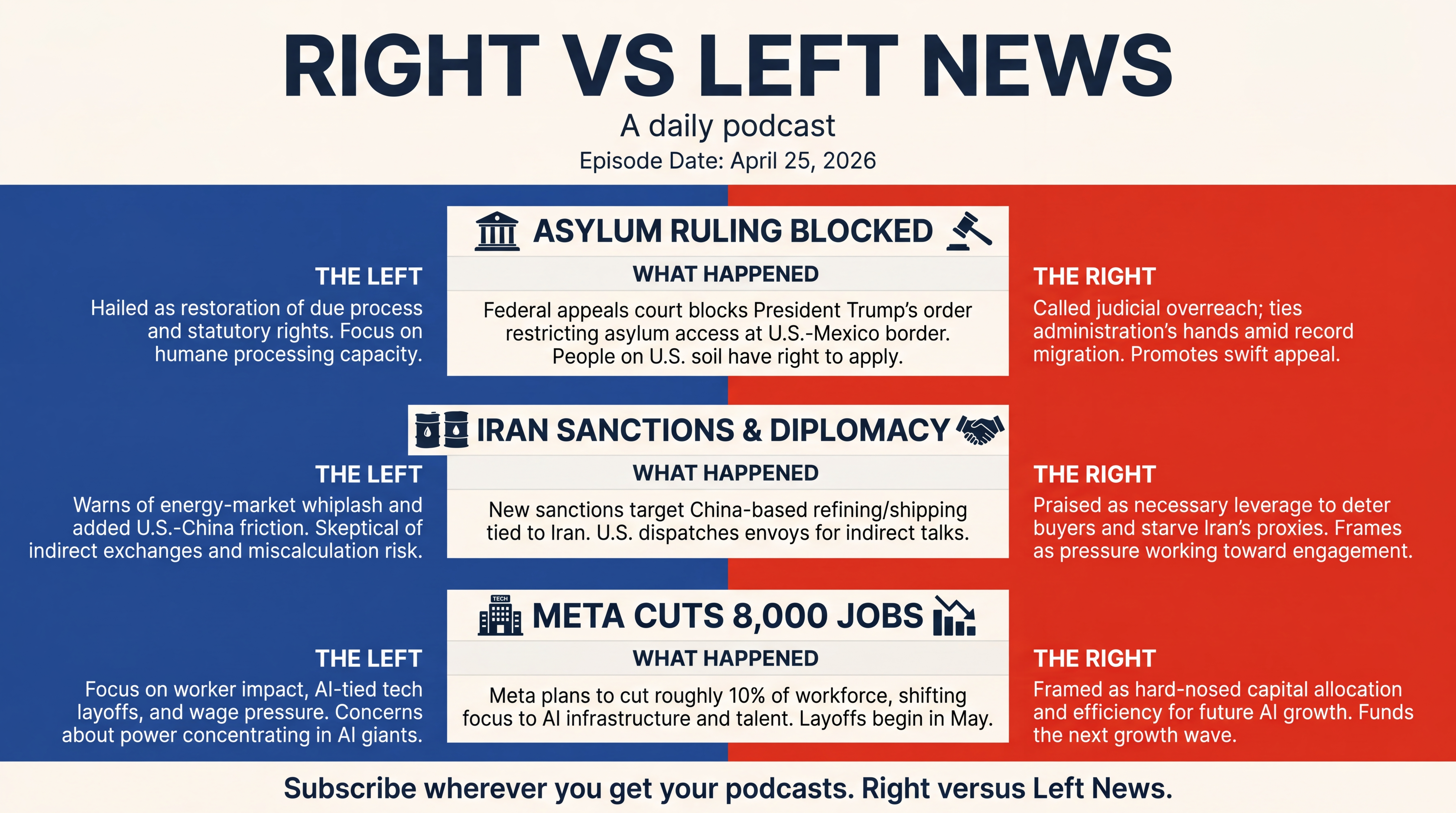
First, a federal appeals court has blocked President Trump’s order restricting access to asylum at the U.S.-Mexico border. A three-judge panel on the D.C. Circuit says people on U.S. soil have the right to apply for asylum — and a presidential proclamation can’t override that process. The Justice Department is weighing next steps, including a possible appeal.
On the right, critics call the decision judicial overreach and say it ties the administration’s hands amid record migration. Press secretary Karoline Leavitt called the judges political and promised a swift appeal.
On the left, supporters hail the ruling as a restoration of due process and statutory rights. They want the administration to focus on humane processing capacity — not deterrence by denial.
Next, the Treasury Department rolled out new Iran-related sanctions, targeting China-based refining interests — including Hengli Petrochemical — along with roughly forty shipping firms and vessels tied to Iran’s shadow fleet. These networks obscure cargo origins with ship-to-ship transfers and flags of convenience. Officials say the move escalates pressure on Tehran’s oil revenue.
On the right, the action is praised as necessary leverage while ceasefire diplomacy drags on — a way to deter Beijing-linked buyers and starve Iran’s proxies.
On the left, there are warnings about energy-market whiplash and added U.S.-China friction. Sweeping designations could ripple through already tight oil markets, and secondary sanctions could harden Beijing’s stance.
Meanwhile, Washington is dispatching special envoy Steve Witkoff and adviser Jared Kushner to Islamabad for another try at talks with Iran — even as Tehran publicly rules out direct meetings. And in a tentative sign of normalcy, Iran has resumed commercial flights from Tehran’s main international airport, with departures to Istanbul and Muscat.
Right-leaning coverage frames this as pressure working — sanctions and naval interdictions nudging Iran toward engagement, with envoys keeping options open without rewarding Tehran.
Progressive voices are more skeptical, noting Iran’s insistence on indirect exchanges and warning that mixed signals, tanker seizures, and ceasefire violations raise the risk of miscalculation.
[MIDPOINT_SPONSORS]
Tonight, the White House Correspondents’ Dinner returns — and for the first time as president, Donald Trump plans to attend. It’s a night of glitz, roasts, and awards — with the unusual twist of a mentalist as entertainment. Scrutiny is high given Trump’s long-running feud with much of the press.
Some on the right see a pragmatic thaw, arguing it’s healthy for a president to show up and face the room — while also mocking what they view as Beltway media self-regard.
On the left, many remain uneasy, saying that honoring a staunchly anti-press president risks normalizing attacks on journalists. Organizers are being urged to underscore First Amendment values — and to brace for the stage turning into a political broadside.
Finally, Meta plans to cut roughly eight thousand jobs — about ten percent of its workforce — as it shifts spending toward AI infrastructure and high-priced AI talent. Layoffs are expected to begin in May, and thousands of open roles will be left unfilled.
Center-right and business-friendly takes frame the cuts as hard-nosed capital allocation — efficiency to fund the next growth wave.
Progressives focus on worker impact and the broader trend of tech layoffs tied to AI, warning of wage pressure and calling for stronger safety nets and training. There’s also growing concern about privacy and power concentrating around a handful of AI giants.
Quick recap: a major court ruling checks executive power on asylum... sanctions tighten the squeeze on Iran’s oil trade... new U.S.-Iran diplomacy stirs as Tehran restarts flights... Trump steps into the Correspondents’ Dinner spotlight... and Big Tech’s AI pivot hits workers again. We’ll keep watching how these threads evolve over the rest of the weekend — and into next week.
That's it for today's episode of Right versus Left News. Remember, understanding both sides isn't about picking a team—it's about being informed. Subscribe wherever you get your podcasts, and join us tomorrow for another balanced look at the day's biggest stories. Until next time, stay curious and stay informed.
