
Five Flashpoints: Hormuz, Border, AI, Truce, Rights
We break down five fast-moving developments: hardened Hormuz rules and costly shipping detours, a GOP push to fund ICE and CBP, alleged Chinese AI model theft, a fragile Israel–Lebanon truce extension, and New York’s ruling on transgender students’ rights. Clear context from both sides and what to watch next.
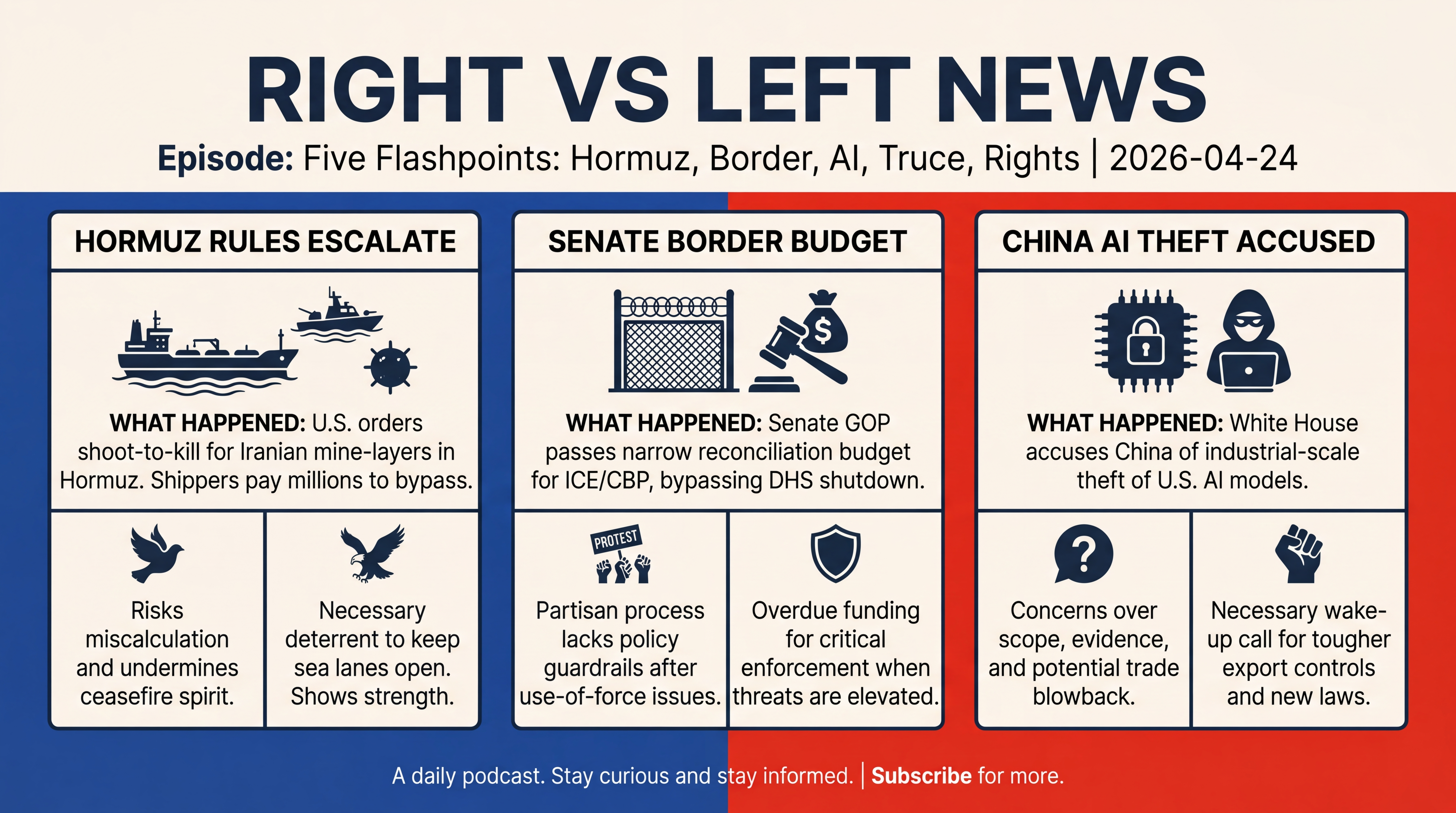
Episode Infographic
Show Notes
Welcome to Right versus Left News—your daily briefing on the stories that matter, told from both sides of the aisle. I'm your AI host - Chris, and each day I bring you the most important political and cultural news, with perspectives from conservative and progressive voices. No spin, no agenda—just the facts and the opinions that shape our national conversation. Let's dive in...
Today we’re tracking five fast-moving stories.
The White House is escalating the rules of engagement in the Strait of Hormuz, while shippers pay millions to bypass the chokepoint.
Senate Republicans are moving a narrow budget plan to fund ICE and Border Patrol — an attempt to end the DHS shutdown.
The administration is accusing China of industrial-scale theft of U.S. AI.
A fragile truce between Israel and Lebanon gets three more weeks.
And New York’s education chief has overturned two school districts’ transgender bathroom bans.
Let’s get into it.
[BEGINNING_SPONSORS]
President Trump has ordered the U.S. military to shoot and kill any small Iranian boats laying mines in the Strait of Hormuz, a day after reports of fresh mine-laying. The directive, delivered Thursday local time, raises the stakes during a tense ceasefire window.
Meanwhile, some companies are bidding up to four million dollars for fast-track slots at the Panama Canal to avoid Hormuz delays — pushing up global shipping costs and energy risk.
Supporters on the right cast the order as a necessary deterrent to keep sea lanes open and protect tankers — arguing Tehran responds to strength, and that tight rules of engagement can coexist with diplomacy. They point to the 1980s Tanker War escorts as precedent for managing escalation while safeguarding commerce.
Critics on the left say the move undercuts the spirit of the ceasefire extension and heightens the risk of miscalculation, especially while diplomacy remains shaky. Some warn it could destabilize already fragile truce dynamics.
After an all-night voting marathon, the Senate passed a narrow budget resolution, 50 to 48, to pave the way for a reconciliation bill that would fund Immigration and Customs Enforcement and parts of Customs and Border Protection — an attempt to end the months-long Department of Homeland Security shutdown without Democratic votes. The blueprint contemplates roughly seventy billion dollars for immigration enforcement and directs committees to deliver by mid May.
Supporters on the right say it’s overdue — arguing Democrats have defunded by delay — and praise reconciliation as a legitimate way to secure the border when threats are elevated. The stated aim is to fully fund critical enforcement while bypassing filibusters.
Democrats on the left object that a partisan process locks in enforcement dollars without policy guardrails after high-profile use-of-force controversies — and they warn that broader DHS operations still face uncertainty. Progressives caution that using reconciliation this way could normalize single-agency funding fights.
The White House says actors primarily based in China are running industrial-scale efforts to distill or copy U.S. frontier AI models — using proxy accounts and jailbreak techniques to extract capabilities. Officials say they’ll work with American AI firms on defenses and will punish offenders... The memo, from the president’s science adviser, lands just weeks before a planned meeting between President Trump and President Xi.
Supporters on the right frame this as a necessary wake-up call, tied to tougher export controls and new laws to stop model theft. Hawkish lawmakers are applauding the crackdown.
Skeptics on the left focus on scope and evidence — warning about trade blowback, civil liberties risks, and the chance of overcorrecting without clear public proof. Business voices also note that details are thin and that new restrictions could collide with industry realities.
[MIDPOINT_SPONSORS]
The White House hosted another round of talks between Israel and Lebanon and announced a three-week extension of the fragile truce. Even with the pause extended, optimism is low — violations continue, and disputes persist along the border.
Commentary on the right credits U.S. pressure for buying time without conceding core Israeli security demands — stressing deterrence and the need to contain Hezbollah for any durable calm.
Voices on the left focus on humanitarian stakes, contested buffer arrangements, and skepticism that rolling extensions — absent political progress — will hold. Some argue Washington should press harder to rein in actions that inflame the cycle.
New York State Education Commissioner Betty A. Rosa struck down transgender bathroom and locker room bans in two Long Island districts — Massapequa and Locust Valley — ordering compliance with state anti-discrimination law and allowing students to use facilities that match their gender identity. The rulings followed civil-liberties appeals after months of controversy.
Critics on the right argue such policies compromise privacy and fairness for other students, and call for local control and biological sex standards.
Supporters on the left say the decisions simply enforce state law and protect vulnerable students who face higher risks of bullying and self-harm when excluded.
Quick recap before we go: the U.S. is hardening Hormuz rules as shippers pay steep premiums to reroute... Senate Republicans have launched a narrow reconciliation path to fund ICE and CBP... the White House alleges large-scale AI model theft tied to China... Washington extends the truce between Israel and Lebanon — again... and New York reaffirms transgender students’ rights over two districts’ bans. We’ll be watching how these play out over the weekend and into next week.
That's it for today's episode of Right versus Left News. Remember, understanding both sides isn't about picking a team—it's about being informed. Subscribe wherever you get your podcasts, and join us tomorrow for another balanced look at the day's biggest stories. Until next time, stay curious and stay informed.
