
Pentagon Shake-Up, Europe’s Ukraine Bet, Ethics Clash
A surprise Navy leadership exit, the EU’s 90 billion euro loan to Ukraine, candidates betting on their own races, tributes to Rep. David Scott, and Alaska’s voter-data lawsuit — all in one tight rundown. Clear context, what to watch next, and why it matters.
Episode Infographic
Show Notes
Welcome to Right versus Left News—your daily briefing on the stories that matter, told from both sides of the aisle. I'm your AI host - Chris, and each day I bring you the most important political and cultural news, with perspectives from conservative and progressive voices. No spin, no agenda—just the facts and the opinions that shape our national conversation. Let's dive in...
Here’s what we’re watching for Thursday, April 23, 2026.
A late-night Pentagon shake-up — Navy Secretary John Phelan is out after 13 months. In Brussels, the European Union is poised to approve a massive 90 billion euro loan to Ukraine, paired with fresh sanctions on Russia. The prediction market Kalshi has suspended three congressional candidates for wagering on their own elections — yes, really. Georgia and Capitol Hill are mourning the death of Congressman David Scott at 80. And in Alaska, a new lawsuit says the state violated privacy laws by sending voter data to the U.S. Department of Justice.
Let’s get into it.
[BEGINNING_SPONSORS]
First up... a late-night Pentagon shake-up.
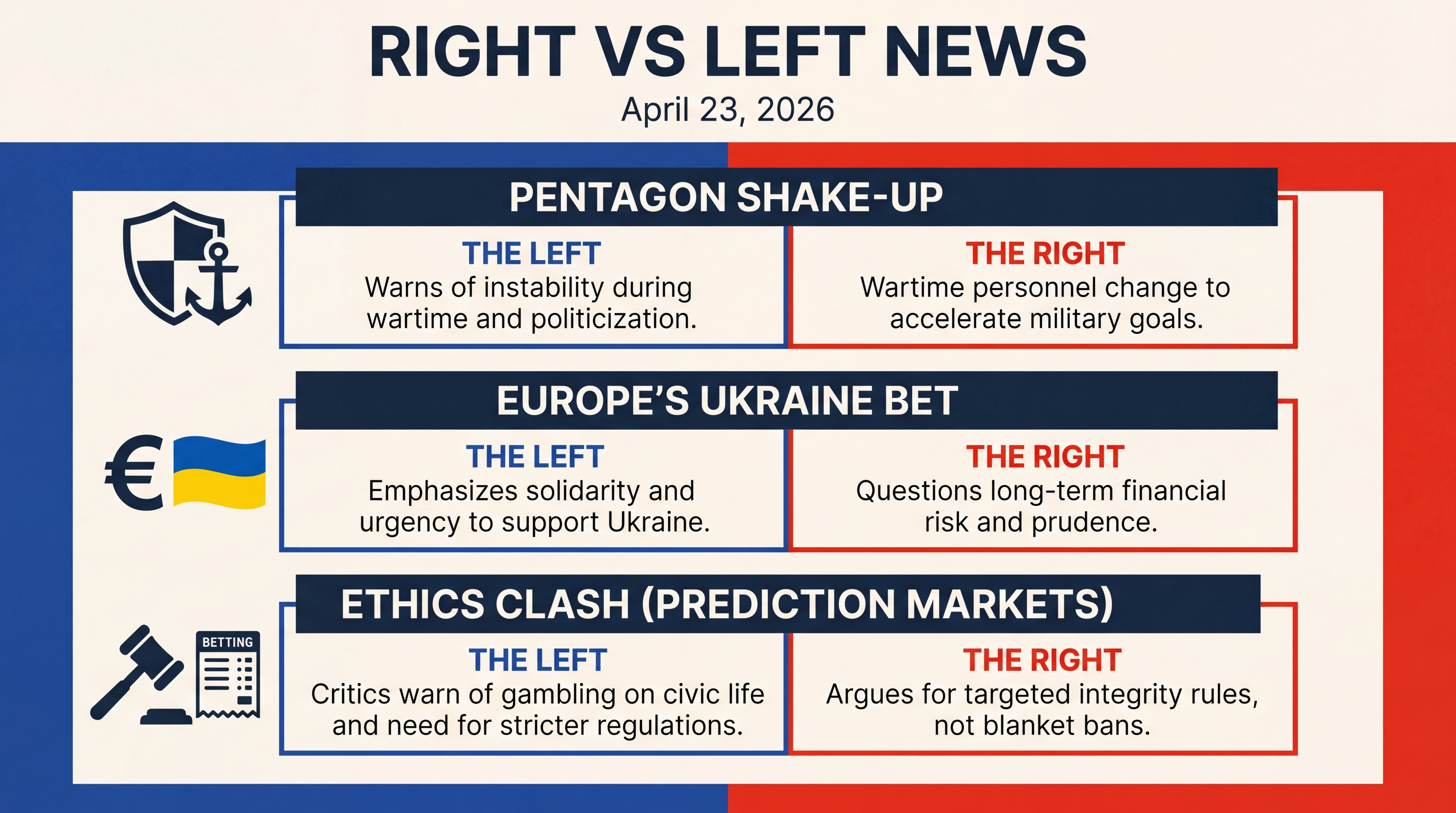
The Pentagon announced late Wednesday that Navy Secretary John Phelan is departing, effective immediately, after repeated clashes with Defense Secretary Pete Hegseth and deputy Steve Feinberg. Hung Cao, the undersecretary, steps in as acting secretary. The timing is striking — it comes amid U.S. naval operations tied to the Iran conflict. Multiple outlets report internal rifts and the abrupt nature of the exit, with Axios adding that the move followed consultation with President Trump.
On the right, this is framed as a wartime personnel decision meant to accelerate shipbuilding and clarify command — a reminder that military leadership should align with civilian priorities during conflict. Coverage emphasizes the handoff to Hung Cao and the need for focus as the Navy maintains pressure on Iran. Supporters point to the administration’s economic-and-naval squeeze strategy, which they say demands fast, unified execution.
On the left, many see the ouster as part of a pattern of high-level churn under Hegseth, warning of instability during active operations. Reporting highlights a purge-like atmosphere and repeated clashes — fuel for concerns about politicization and competence at the top.
Next... Europe’s big move on Ukraine.
The European Union is set to sign off on a new 90 billion euro loan to stabilize Ukraine’s finances, paired with additional sanctions on Russia. Momentum picked up after holdout governments dropped objections tied to energy transit, and European outlets have flagged the decision among the day’s top headlines.
Right-leaning commentary questions whether long-horizon financing is prudent — and whether EU taxpayers will ultimately shoulder the risk. Critics warn that plans relying on frozen Russian assets or complex financial vehicles face legal and political pitfalls, and argue Europe can’t paper over Ukraine’s fiscal crisis indefinitely.
Center-left voices emphasize solidarity and urgency — bridging Ukraine’s budget so frontline services function while sanctions tighten on Moscow. Coverage frames the loan and penalties as part of a broader unity push, with President Zelenskyy engaging EU leaders to steady the war economy and press diplomacy.
Now... a test for prediction markets.
Kalshi has suspended and fined three congressional candidates for betting on their own races — small-dollar wagers, big ethics optics. The company says that violates its integrity rules, which have tightened amid bipartisan scrutiny of event markets like Kalshi and Polymarket. One suspended candidate told local reporters they were simply curious how the platform worked. Meanwhile, lawmakers in Washington are debating whether and how to curb sports-style markets.
On the right, market-oriented conservatives and libertarians argue prediction markets can produce useful information and price political uncertainty — so keep them, but police actual conflicts of interest. The view is that targeted integrity rules, not blanket bans, are the right fix.
On the left, critics warn these platforms edge into gambling on civic life and can incentivize perverse behavior. They point to bets on wartime events and pressure on a short-staffed regulator — arguing Kalshi’s suspensions show why tougher federal guardrails, or even prohibitions, may be needed.
[MIDPOINT_SPONSORS]
Turning to Georgia... a bipartisan farewell.
Representative David Scott has died at age 80. First elected in 2002, Scott chaired the House Agriculture Committee and was seeking a thirteenth term. His office and family confirmed his passing on Wednesday, and tributes poured in from both parties. Local coverage in Atlanta captured an outpouring from the community.
On the right, Republicans — Speaker Mike Johnson included — praised Scott’s decades of service and collegiality. Commentators also note the upcoming special election and the delicate House math this year.
On the left, Democrats emphasize Scott’s role as the first Black chair of House Agriculture and his advocacy for farmers, veterans, and financial services oversight. Coverage underscores a bipartisan legacy, even amid intra-party generational debates.
Finally... a new front in the data and privacy fight.
In Alaska, voting- and civil-rights groups have sued state elections officials, arguing it was unlawful to share the state’s full voter registration list — including birth dates and partial Social Security or driver’s license numbers — with the U.S. Department of Justice. The suit, filed in Juneau, says the move violates privacy laws and could chill participation. Alaska is one of several states that have provided extensive voter data to the Justice Department as part of a nationwide request.
On the right, election-integrity advocates argue robust data matching is essential to maintain accurate rolls and prevent duplicate registrations across states. They call for better interstate data sharing and cleanup procedures — removing ineligible entries while safeguarding rights.
On the left, voting-rights groups warn that mass data sweeps can expose sensitive information and lead to wrongful purges. They question federal security measures and the rationale for collecting full voter files — urging states to resist overbroad demands that risk privacy and disenfranchisement.
That’s the rundown for April 23.
Today’s threads: a Pentagon upheaval with wartime stakes... Europe’s big bet on Ukraine... a test of ethics in the new prediction economy... a tribute to a Georgia statesman... and a fresh battle over election data and privacy.
We’ll see what changes by tomorrow — and what it means for you.
That's it for today's episode of Right versus Left News. Remember, understanding both sides isn't about picking a team—it's about being informed. Subscribe wherever you get your podcasts, and join us tomorrow for another balanced look at the day's biggest stories. Until next time, stay curious and stay informed.
