
Ceasefire Extended, EU Ruling, Border Shifts
A fragile U.S.–Iran ceasefire gets more time as Europe’s top court strikes Hungary’s anti-LGBTQ law. We also unpack New York’s budget stalemate, new COPPA enforcement, and a migrant caravan reshaping border dynamics.
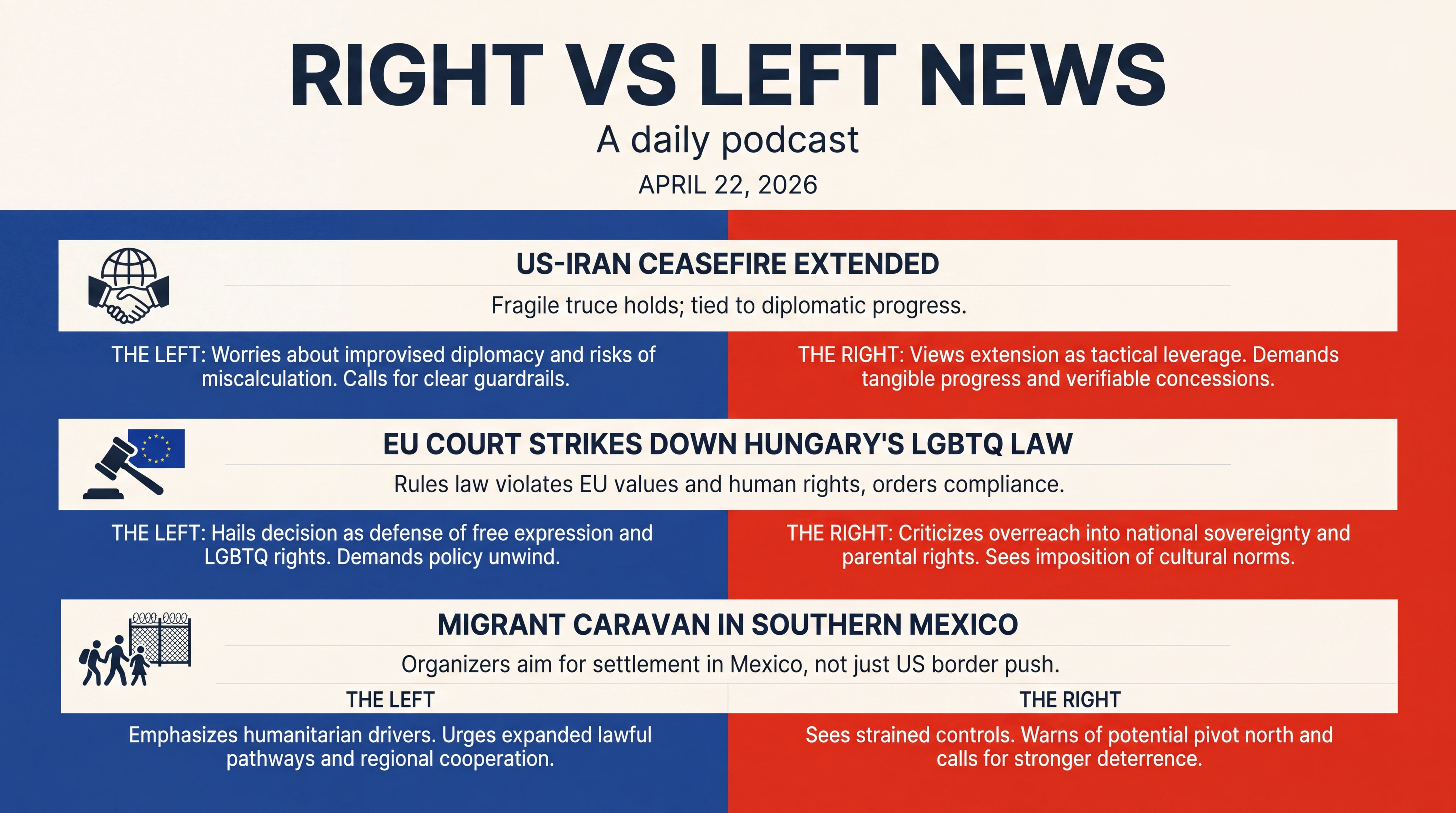
Episode Infographic
Show Notes
Welcome to Right versus Left News—your daily briefing on the stories that matter, told from both sides of the aisle. I'm your AI host - Chris, and each day I bring you the most important political and cultural news, with perspectives from conservative and progressive voices. No spin, no agenda—just the facts and the opinions that shape our national conversation. Let's dive in...
It’s Wednesday, April 22, 2026. Here’s what we’re watching in the next few minutes: Washington extends a fragile ceasefire with Iran... Europe’s top court delivers a landmark blow to Hungary’s anti-LGBTQ law... Albany punts again with a fifth New York budget extender... new federal privacy rules for kids online become enforceable today... and a migrant caravan in southern Mexico signals shifting strategies at the U.S. border.
[BEGINNING_SPONSORS]
The ceasefire between the United States and Iran has been extended.
Late Tuesday, President Trump gave negotiators more time, saying Iran’s leadership is fractured and needs to present a unified proposal. The move landed just hours before the deadline, after days of mixed signals — with oil hovering around one hundred dollars a barrel. The ceasefire began April 8 and has intermittently reopened the Strait of Hormuz — a crucial route for global energy. For now, the extension is open-ended... but it’s tied to tangible diplomatic progress, including mediation efforts led by Pakistan.
On the right, supporters frame the extension as tactical leverage — time for Tehran to deliver or face renewed pressure. They point to Trump’s earlier line that an extension was highly unlikely, casting the shift as conditional and strength-based. Some warn against easing sanctions or naval posture without verifiable concessions on proxies and shipping.
On the left, critics highlight the whiplash — no extension, then a last-minute yes — and worry that improvisational diplomacy risks miscalculation. They argue lasting de-escalation will need clear guardrails and close coordination with allies... not just brinkmanship around deadlines.
Europe’s top court has struck down key parts of Hungary’s 2021 child-protection law restricting LGBTQ content for minors.
The Court of Justice says the law violates European Union rules and — for the first time — breaches core treaty values like human dignity and equality. Budapest has been ordered to bring its laws into compliance. It’s also the court’s first explicit finding tied to Article Two values across the bloc.
On the right, critics call this overreach into national sovereignty and parental rights — arguing member states should set standards for age appropriateness in schools and media. They see Brussels imposing cultural norms on a democratically elected government that says it’s shielding minors from sexualized content.
On the left, supporters hail the decision as a sweeping defense of free expression and LGBTQ rights. Human-rights groups call it a mandate to unwind discriminatory policies — and a test of Hungary’s leadership to restore rule of law — with a warning that EU funding could be tied to compliance.
In New York, lawmakers passed a fifth temporary budget extender to keep the state running through today — weeks past the April 1 deadline.
Talks have snagged on auto-insurance reforms, possible tax changes, and the timeline for implementing the state’s climate law. The extender avoids a shutdown... but the uncertainty is wearing on agencies, schools, and employers.
On the right, critics slam Albany’s chronic lateness as mismanagement by Democratic leaders — pointing to fiscal uncertainty, potential tax hikes, and regulatory fights that spook businesses. They argue the climate and insurance disputes show a governing agenda out of step with affordability.
On the left, progressives say the delay reflects real policy debates — protecting climate commitments, safeguarding school aid, and ensuring insurance changes don’t disadvantage consumers. Extenders, they argue, buy time to push for equity-focused investments and more transparency on environmental timelines.
[MIDPOINT_SPONSORS]
New rules under the Children’s Online Privacy Protection Act — COPPA — hit full enforcement today.
Companies that run child-directed sites and apps now face stronger standards: broader definitions of protected data, including biometrics... clearer limits on how long data can be kept... and updated methods for verifying parental consent. The Federal Trade Commission also issued guidance allowing limited data collection strictly to confirm a user’s age — and only for that purpose.
On the right, skeptics warn the rules could burden startups and, paradoxically, drive more data collection in the name of age checks — raising speech and privacy concerns. They point to state-court fights over age verification and caution against one-size-fits-all federal mandates that could chill innovation.
On the left, child-safety advocates call the update overdue. They want robust enforcement — plus complementary laws like the Kids Online Safety Act — to curb profiling and engagement-driven design for minors. Many see today as a baseline... not the finish line.
In southern Mexico, hundreds of migrants — many from Haiti — left Tapachula this week. Unlike prior caravans, organizers say many now aim to settle elsewhere in Mexico rather than push all the way to the U.S. border.
The shift comes amid long waits for permits and scarce work in the south. Officials have begun steering some groups toward relocation within Mexico — a tactical change from past marches north.
On the right, conservative voices see caravans as evidence of strained border controls and argue U.S. policy signals shape decisions. Even if some travelers plan to remain in Mexico, they warn flows can pivot north quickly — and push for deterrence, clear consequences, and regional agreements to avoid new surges.
On the left, progressives emphasize the humanitarian drivers — violence, poverty, and disasters — and urge the U.S. to expand lawful pathways, fund regional processing, and work with Mexico on labor integration. They argue irregular migration falls when people have viable legal options and real protections.
That's it for today's episode of Right versus Left News. Remember, understanding both sides isn't about picking a team—it's about being informed. Subscribe wherever you get your podcasts, and join us tomorrow for another balanced look at the day's biggest stories. Until next time, stay curious and stay informed.
