Seized Ship, City Clashes, Cannabis Reset, AI Money, Andean Rift
Markets jolt after a U.S. seizure near Hormuz, Houston tangles with Texas over I-C-E cooperation, and Massachusetts rewrites its cannabis rules on the eve of four-twenty. We also break down today’s F-E-C money snapshot — including new A-I cash — and the deepening Colombia and Ecuador tariff showdown.
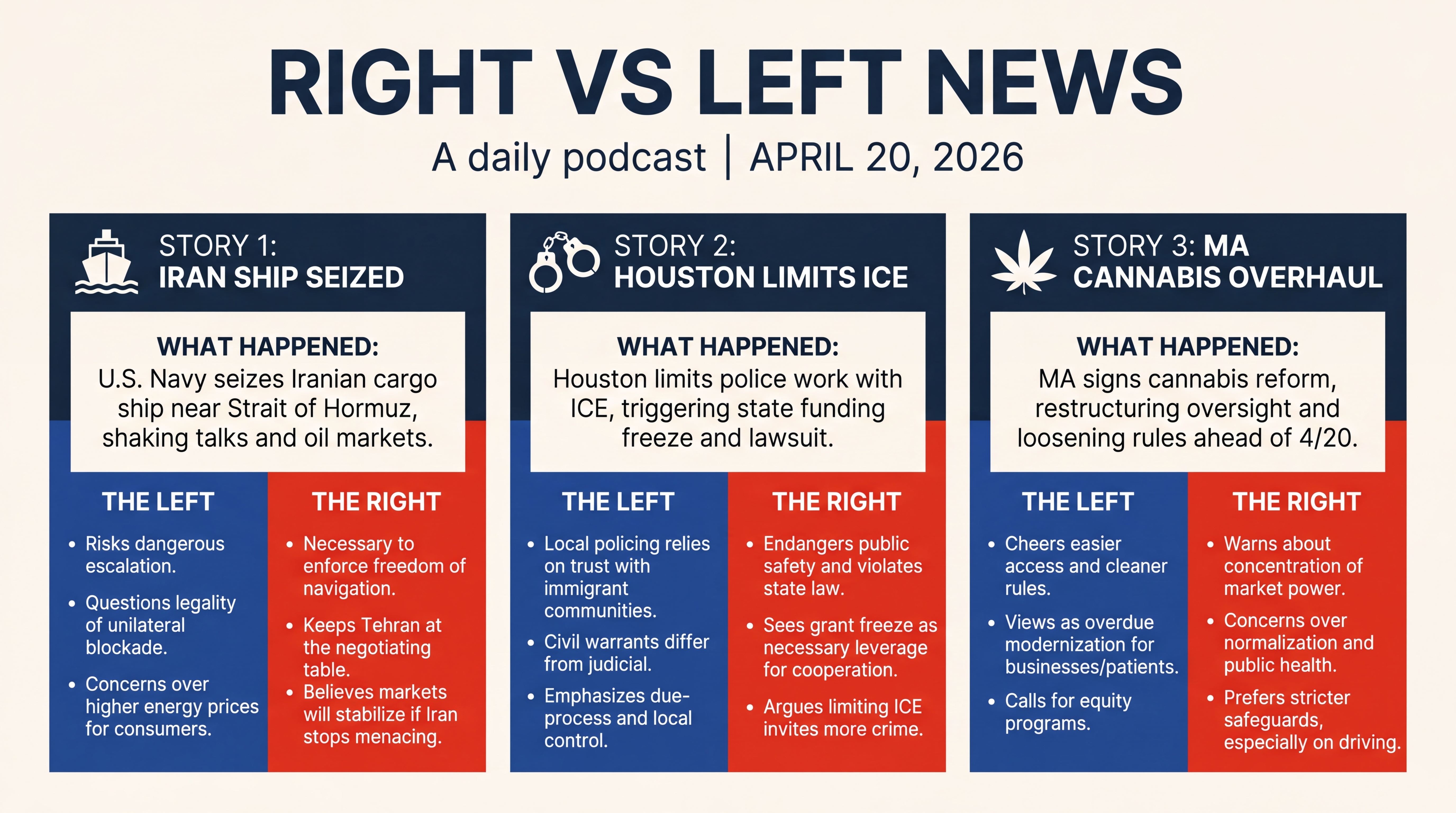
Episode Infographic
Show Notes
Welcome to Right versus Left News—your daily briefing on the stories that matter, told from both sides of the aisle. I'm your AI host - Chris, and each day I bring you the most important political and cultural news, with perspectives from conservative and progressive voices. No spin, no agenda—just the facts and the opinions that shape our national conversation. Let's dive in...
Quick overview of what we’re covering today...
The U.S. Navy disables and seizes an Iranian-flagged cargo ship near the Strait of Hormuz — a move that shakes new talks in Pakistan and jolts oil markets.
Houston limits when city police can work with I-C-E, triggering a state funding freeze and a court fight with Texas leaders.
Massachusetts signs a sweeping cannabis overhaul into law — just ahead of four-twenty.
It’s monthly filing day at the F-E-C, and A-I-linked political money is suddenly a big twenty twenty-six storyline.
And the dispute between Colombia and Ecuador escalates again, as Colombia’s president vows a lawsuit and both sides ratchet up tariffs.
[BEGINNING_SPONSORS]
American forces intercepted the Iranian-flagged cargo ship Touska in the Gulf of Oman on Sunday, April nineteenth, after disabling its engine room. The ship had allegedly tried to breach a new U.S. naval blockade. Reports say the move immediately clouded President Trump’s plan to send negotiators to Islamabad for another round of talks between the U.S. and Iran. Iran’s military called the seizure piracy and threatened a response. Oil prices jumped roughly six percent as trading opened.
U.S. Central Command — CENTCOM — released imagery of the boarding, and night-vision video of the operation aired widely. The broader stakes at Hormuz loomed large — about a fifth of the world’s oil typically flows through that strait.
From the right: Retired General David Petraeus argues Iran’s military has been dramatically degraded — but urges caution amid the blockade and Hormuz tensions. The seizure is framed as necessary to enforce freedom of navigation and to keep Tehran at the table. Some also say markets will stabilize if Iran stops menacing shipping and negotiates in good faith.
From the left: Progressive voices highlight escalation risks, questions about the legality of a unilateral blockade, and the knock-on effects for consumers through higher energy prices. They tie oil swings and diplomatic frictions to the administration’s Iran strategy — warning that a misstep could upend fragile regional cease-fires and derail talks. Many also press for congressional oversight and a clear endgame before actions that could widen the war.
Houston approved an ordinance limiting when city police may cooperate with Immigration and Customs Enforcement — especially on administrative warrants — and the state fired back. Governor Greg Abbott’s office threatened to pull more than one hundred ten million dollars in public-safety grants unless the city repeals the measure. Texas Attorney General Ken Paxton also sued. Local coverage says funds tied to police, fire, and even twenty twenty-six World Cup security were frozen. By Thursday, the mayor canceled a special repeal meeting, saying the state extended its deadline from April twentieth to April twenty-second. A state letter posted by the city had set the original April twentieth compliance demand.
From the right: Conservatives argue the ordinance endangers public safety and violates Texas law — particularly after the state banned so-called sanctuary policies. They see the grant freeze as leverage to ensure cooperation with federal immigration enforcement. Narrowing contacts with I-C-E, they contend, invites more crime and undermines the rule of law.
From the left: Progressives counter that local policing depends on trust with immigrant communities — and that civil I-C-E paperwork isn’t the same as a judicial warrant. They emphasize due-process concerns, local control, and the potential blowback from yanking public-safety funds. Some Democrats warn that conditioning grants on local immigration policy sets a precedent that could hit city services — and World Cup security — far beyond immigration.
On Sunday, April nineteenth, Massachusetts Governor Maura Healey signed a major cannabis reform bill that restructures state oversight and loosens some rules — just ahead of four-twenty. The law shrinks the Cannabis Control Commission from five members to three, all appointed by the governor. It also adjusts license caps and governance after past turmoil. The commission posted guidance saying it will implement the new mandates, and recent bulletins flagged a doubling of personal purchase and possession limits — from one ounce to two — once the law takes effect. Many local outlets frame it as a reset for a sector under pricing stress.
From the right: Skeptics warn about concentration of market power as license caps expand, question aggressive normalization around four-twenty, and prefer stricter public-health safeguards — especially on impaired driving. They also bristle at consolidating power under the governor’s appointees, arguing the regulator could become more political.
From the left: Progressives cheer easier access and cleaner rules after years of bureaucratic gridlock — while calling for strong equity programs and guardrails on big operators. Many frame the bill as overdue modernization aimed at stabilizing businesses and improving patient access on the medical side.
[MIDPOINT_SPONSORS]
It’s April twentieth, which means monthly F-E-C reports are due for national party committees and monthly-filing PACs — today offers a snapshot of who’s raising and spending as we barrel toward the midterms. Recent coverage has flagged a wave of A-I-focused groups stockpiling cash and building scorecards to influence primaries and policy debates. Nonpartisan trackers show party committees and PACs already sitting on significant war chests heading into twenty twenty-six.
From the right: Commentators argue Washington should set a light-touch, uniform federal A-I framework and preempt a patchwork of state rules — warning that overregulation could undercut competitiveness and national security. They also cast well-funded A-I groups as a counterweight to Big Tech lobbying and blue-state restrictions that, in their view, stifle growth.
From the left: Progressives focus on money-in-politics concerns — who funds these A-I groups, how transparent their spending is, and whether new tech money will skew policymaking. They push for disclosure, guardrails on industry influence, and substantive privacy and civil-rights protections in any A-I bill. Data from nonpartisan watchdogs fuels calls for tougher campaign-finance transparency.
On Sunday, April nineteenth, Colombia’s President Gustavo Petro said he would sue Ecuador’s President Daniel Noboa over claims that Petro had ties to the gang leader known as Fito — deepening a months-long trade war. In recent weeks, Ecuador hiked tariffs on Colombian imports to one hundred percent — and Colombia matched — after earlier rounds at fifty percent. Regional outlets note tit-for-tat levies and suspended technical talks, with real risk to cross-border commerce and the Andean Community framework.
From the right: Conservative commentary stresses border security, narco-trafficking, and the need for hard deterrence — often praising Noboa’s crackdowns and pressing Bogotá to cooperate more tightly on counter-narcotics. They argue the short-term trade pain is the cost of restoring order and curbing cartel flows.
From the left: Progressive voices warn that both leaders are escalating rhetoric that punishes workers and small businesses on both sides of the border. They favor de-escalation, rolling back punitive tariffs, and restoring diplomatic channels — while scrutinizing the human-rights implications of militarized counter-crime operations. Coverage emphasizes the economic hit alongside the political brinkmanship.
Quick recap...
The U.S. seizure of an Iranian ship is roiling markets and diplomacy. Houston’s I-C-E fight spotlights how immigration policy collides with city budgets. Massachusetts’ four-twenty-eve cannabis reset could reshape a major state market. Today’s F-E-C deadline will reveal who’s fueling the twenty twenty-six fight — including new A-I money. And tensions between Colombia and Ecuador are rising with lawsuits and tariff walls. We’ll keep tracking each as they evolve.
That's it for today's episode of Right versus Left News. Remember, understanding both sides isn't about picking a team—it's about being informed. Subscribe wherever you get your podcasts, and join us tomorrow for another balanced look at the day's biggest stories. Until next time, stay curious and stay informed.
