
Strikes and Talks, Slow Growth, Sticky Gas Prices
We unpack a deadly turn in Israel and Lebanon alongside possible talks, a softer U.S. GDP print, a court pause on Ethiopian TPS, 2026 political jockeying in New York, and why gas stays pricey. Hear what happened — and how the right and left are framing it.
Episode Infographic
Show Notes
Welcome to Right versus Left News—your daily briefing on the stories that matter, told from both sides of the aisle. I'm your AI host - Chris, and each day I bring you the most important political and cultural news, with perspectives from conservative and progressive voices. No spin, no agenda—just the facts and the opinions that shape our national conversation. Let's dive in...
Here’s a quick overview of the day...
Israel’s strikes in Lebanon left hundreds dead, even as Jerusalem signaled readiness for talks — Washington could host as early as next week.
Back home, the Commerce Department revised U.S. growth down to a sluggish half a percent for the fourth quarter.
In immigration, a federal judge put the brakes on ending Temporary Protected Status for Ethiopians.
On the campaign front, big Democratic names converged in New York for Al Sharpton’s National Action Network convention.
And for your wallet — gas prices remain elevated despite the announced U.S. and Iran ceasefire.
We’ll break down what happened, what the right is saying, and what the left is saying on each. Reporting comes from the Associated Press, Axios, CBS News, The Guardian, and Le Monde.
[BEGINNING_SPONSORS]
Let’s start with Israel and Lebanon.
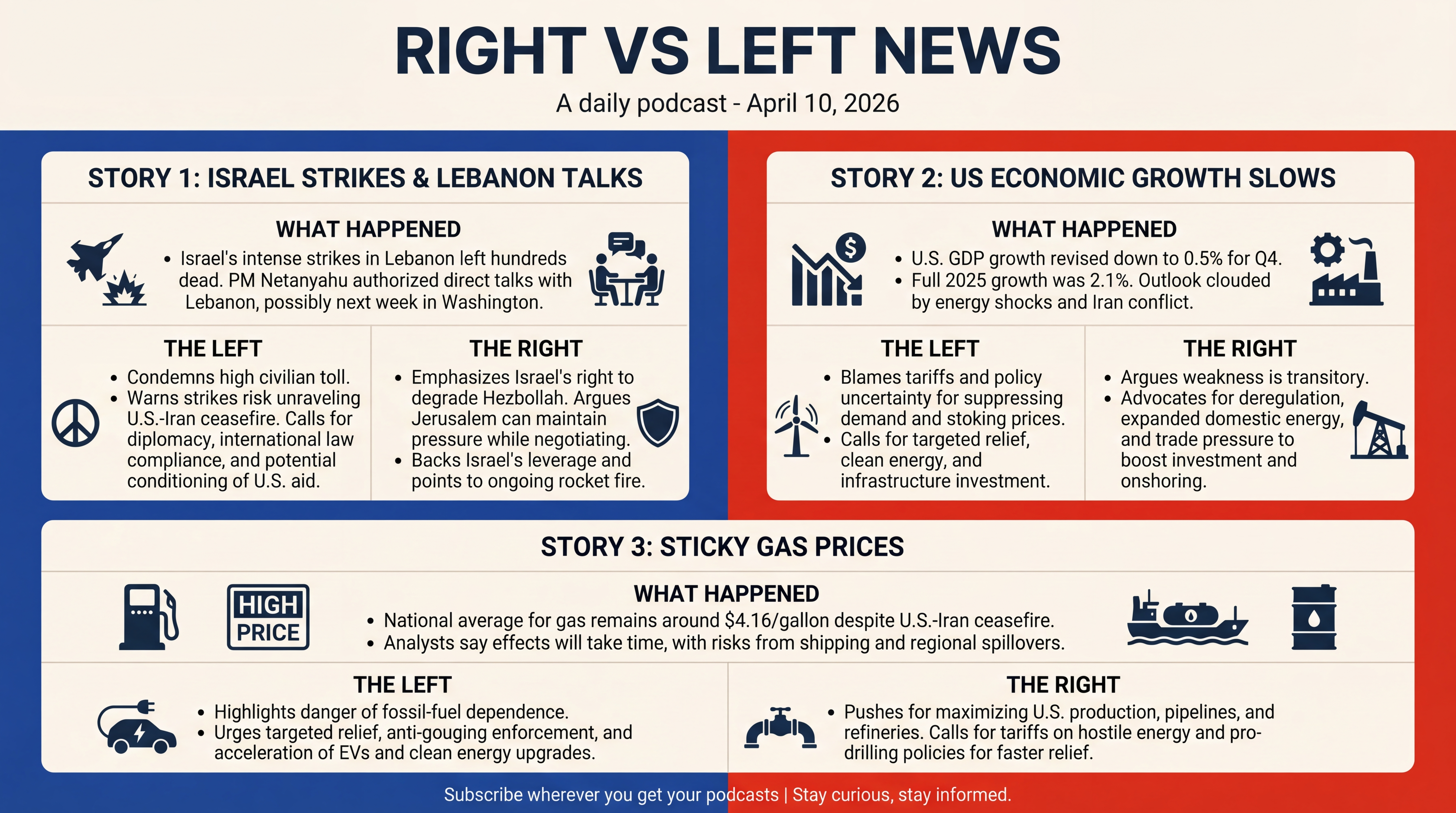
Here’s what happened... The Associated Press says Israel carried out an intense wave of strikes across Lebanon, with the death toll surpassing 300 after hospitals completed identifications. Within hours, Prime Minister Benjamin Netanyahu authorized direct talks with Lebanon, and a U.S. official told the Associated Press the negotiations could begin next week — potentially in Washington. Axios similarly reports senior Israeli officials expect talks to start next week. Le Monde described the destruction as carnage, citing condemnations from U.N. human rights officials.
From the right... Commentators emphasize Israel’s right to degrade Hezbollah’s capabilities and argue Jerusalem can maintain military pressure while negotiating. Some say the Biden‑era Iran policy left regional proxies emboldened — and that Washington should firmly back Israel’s leverage heading into talks. They point to ongoing Hezbollah rocket fire and argue that humanitarian concerns, while serious, shouldn’t override counterterror aims.
From the left... Progressives spotlight the civilian death toll and warn the strikes risk unraveling the U.S. and Iran ceasefire window. The Guardian and others note Democratic leaders pushing for a War Powers debate and tighter guardrails on U.S. support, while rights groups urge immediate de‑escalation and humanitarian access. The thrust: diplomacy first, compliance with international law, and conditioning U.S. aid if necessary.
Now, the U.S. economy.
Here’s what happened... The Commerce Department’s final estimate shows GDP grew at just a half a percent annual rate last quarter, with the Associated Press noting the falloff was tied in part to federal spending declines during last fall’s shutdown. For 2025 overall, growth was about 2.1 percent, and the outlook remains clouded by energy shocks linked to the Iran conflict.
From the right... Many conservatives argue the weakness is transitory — and that deregulation, expanded domestic energy, and trade pressure will ultimately boost investment and reshore supply chains. Pro‑tariff voices contend that narrower trade deficits and onshoring gains will support growth once markets adjust. They frame tariffs as leverage to win better deals and protect U.S. workers.
From the left... Progressives counter that broad tariffs and policy uncertainty are suppressing demand and stoking prices, calling the slowdown a predictable result of trade shocks and shutdown brinkmanship. They highlight analyses warning the burden of tariffs falls largely on U.S. consumers and firms, and they urge targeted relief plus investment in clean energy and infrastructure rather than sweeping import taxes.
On immigration and the courts.
Here’s what happened... The Associated Press reports a federal judge postponed the Trump administration’s plan to terminate Temporary Protected Status for Ethiopians, keeping protections in place while litigation proceeds. It’s the latest legal setback to a broader rollback of humanitarian programs.
From the right... Many conservatives argue TPS has drifted from temporary into semi‑permanent status and should sunset as conditions evolve. They contend the executive needs discretion to end TPS designations when home‑country circumstances change — and that Congress, not the courts, should set any long‑term pathways.
From the left... Progressives emphasize ongoing insecurity in Ethiopia and say ending TPS now would separate families and harm law‑abiding workers. They argue the court’s pause is necessary to prevent abrupt removals and call on Congress to create durable status for long‑residing TPS holders. Watchdogs note similar litigation has repeatedly checked rapid rollbacks.
[MIDPOINT_SPONSORS]
Politics — and the 2026 stakes.
Here’s what happened... The Guardian reports a who’s who of Democratic figures — governors Wes Moore and Josh Shapiro, House Leader Hakeem Jeffries, senators Ruben Gallego and Mark Kelly, and former Vice President Kamala Harris among others — addressed Rev. Al Sharpton’s National Action Network convention in New York. Leaders stressed midterm stakes, affordability, and the Iran war’s ripple effects, while 2028 buzz swirled quietly in the background.
From the right... Critics dismiss the gathering as insider politics focused on identity themes rather than bread‑and‑butter solutions. They argue Democrats are out of step on crime, education, and energy costs — and that tight ties to activist networks won’t win working‑class swing voters.
From the left... Supporters hail the convention as energizing a diverse base and building a message on kitchen‑table economics — lowering costs, defending reproductive rights, and tightening ethics around A I and tech. They also highlight calls to reassert congressional war powers and pair foreign policy with humanitarian standards.
Finally, gas prices.
Here’s what happened... CBS News reports the national average for regular gasoline remains elevated — about four dollars and sixteen cents a gallon — despite this week’s U.S. and Iran ceasefire announcement. Analysts say any ceasefire effects will take time to flow through oil markets, and other risks — from shipping routes to regional spillovers — could keep prices sticky in the near term.
From the right... The push is to maximize American production and build pipelines and refineries, with some states temporarily pausing gas taxes. Advocates add that tariffs on hostile regimes’ energy and pro‑drilling policies would bring faster price relief than diplomatic half‑measures.
From the left... The view is that spikes show the danger of fossil‑fuel dependence. Protect consumers now — with targeted relief and anti‑gouging enforcement — while accelerating EV charging, transit, and home‑energy upgrades so geopolitics don’t punish wallets at home. Expanding drilling, they warn, locks in future volatility.
Quick recap... Israel’s strikes in Lebanon sparked global outcry even as talks are being teed up; America’s growth was revised down; a judge kept TPS protections for Ethiopians in place; top Democrats rallied in New York; and gas prices remain stubbornly high. We’ll keep tracking the facts — and the arguments from both sides — so you can weigh them for yourself.
That's it for today's episode of Right versus Left News. Remember, understanding both sides isn't about picking a team—it's about being informed. Subscribe wherever you get your podcasts, and join us tomorrow for another balanced look at the day's biggest stories. Until next time, stay curious and stay informed.
