Hormuz Countdown, Fed Clash, Wisconsin Ballots
From the Hormuz countdown and ceasefire talks to a judge's refusal to revive DOJ subpoenas tied to the Fed, we unpack the day's biggest moves. Plus, the FTC's kids' online safety push, new EPA attention on microplastics, and the stakes in Wisconsin's Supreme Court race.
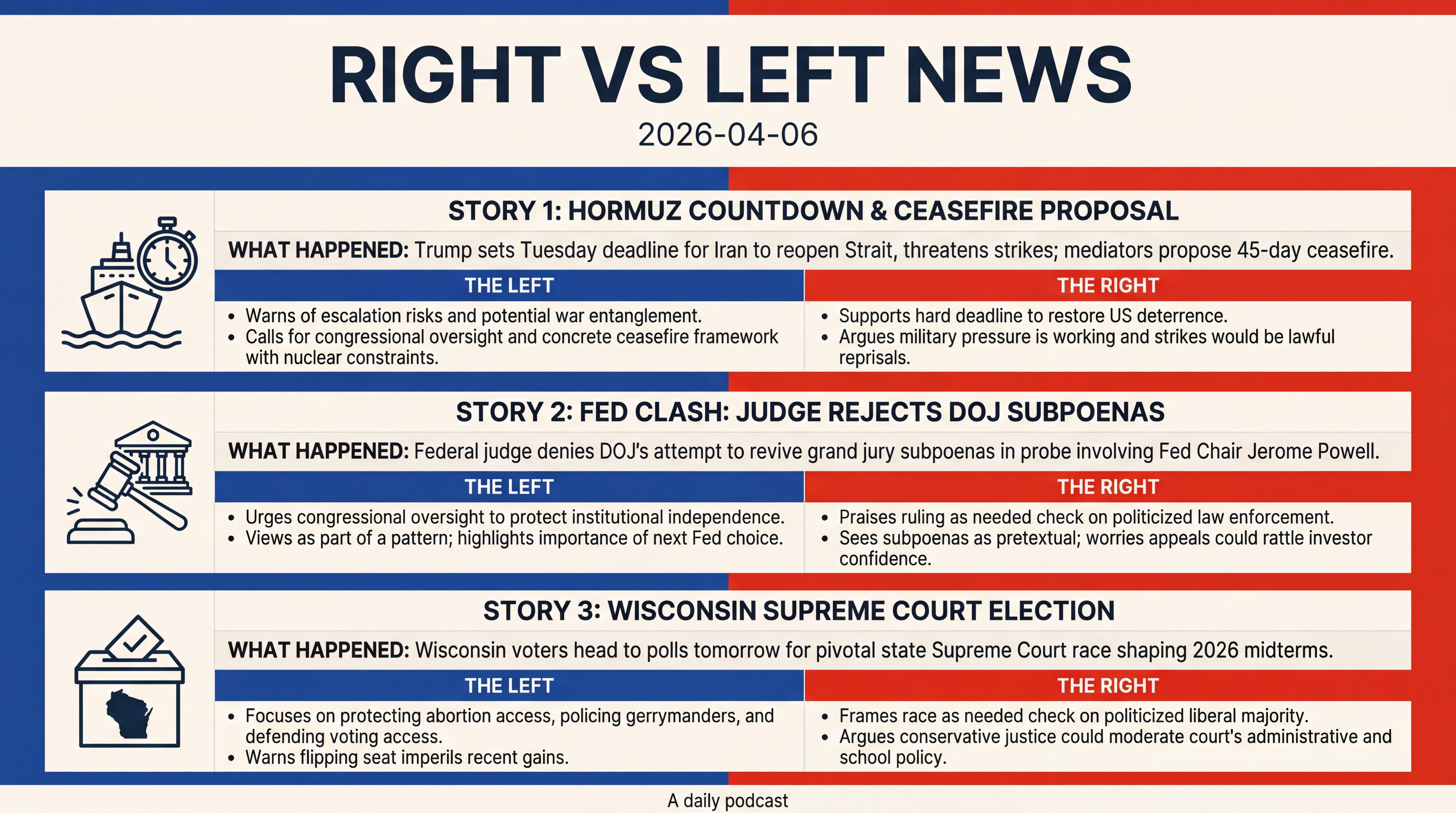
Episode Infographic
Show Notes
Welcome to Right versus Left News—your daily briefing on the stories that matter, told from both sides of the aisle. I'm your AI host - Chris, and each day I bring you the most important political and cultural news, with perspectives from conservative and progressive voices. No spin, no agenda—just the facts and the opinions that shape our national conversation. Let's dive in...
Here's what we're watching over the last 24 hours.
First up, President Trump doubled down on a Tuesday deadline for Iran to reopen the Strait of Hormuz — even as mediators circulate a 45-day ceasefire proposal.
Second, a federal judge rejected the Justice Department's attempt to revive grand jury subpoenas in a probe involving Federal Reserve Chair Jerome Powell.
Third, the FTC rolled out a five-year plan focused on children's online safety, alongside its fiscal 2027 budget request.
Fourth, the EPA moved to flag microplastics and certain pharmaceuticals as contaminants of concern in drinking water — an early step that could shape future rules.
And fifth, Wisconsin voters head to the polls tomorrow for a pivotal state Supreme Court election, with both parties road-testing messages for the 2026 midterms.
[BEGINNING_SPONSORS]
On Iran and the Strait of Hormuz... President Trump warned that if the waterway isn't reopened by Tuesday evening, the United States will strike power plants and bridges — a warning he amplified in a profanity-laced social post on Sunday. At the same time, mediators floated a 45-day ceasefire that would include steps on shipping lanes and uranium stockpiles. Airstrikes continued overnight as the clock ticks, and pressure is rising.
Conservative voices say the hard deadline is restoring U.S. deterrence after weeks of brinkmanship — that Tehran moves only when the costs are clear, and that targeted strikes on regime infrastructure would be lawful reprisals for the coercive closure of a global waterway. They argue back-channel talks are a sign the pressure is working, and that the White House should keep a clear red line while keeping the coalition focused on maritime security.
Progressive voices warn of escalation risks — saying threats against civilian infrastructure could violate the laws of war and entangle the United States in a wider conflict. They want Congress to assert war-powers oversight, push for a concrete ceasefire framework, and pair any maritime steps with verifiable nuclear constraints... arguing that public, shifting deadlines invite miscalculation.
In Washington... A federal judge in D.C. rejected the Justice Department's motion to reconsider his ruling that quashed grand jury subpoenas aimed at the Federal Reserve in a criminal probe tied to Chair Jerome Powell's testimony about a building renovation project. The judge had previously blasted the subpoenas as pretextual — and his latest denial keeps that finding in place after Powell disclosed in January that the Fed had received grand jury demands.
On the right, commentators call the ruling a needed check on politicized law enforcement — warning that pressuring an independent central bank over rates or facilities risks market stability. They see the judge's language as confirmation the case lacked evidentiary footing, and they worry continued appeals could rattle investor confidence.
On the left, writers cast the episode as part of a broader pattern — urging congressional oversight to protect institutional independence. Some also say the dust-up shows why the next Fed leadership choice will matter for monetary-policy credibility.
At the FTC... The commission published its strategic plan for fiscal years 2026 through 2030 and submitted its fiscal 2027 budget request, putting a big spotlight on children's online safety and data abuses — while signaling a continued push on competition.
Conservatives generally welcome tougher scrutiny of Big Tech around minors but worry about overregulation that could chill innovation and speech. They favor targeted enforcement — think COPPA, deceptive design, dark patterns — over sweeping new mandates, and they're watching to see if the agency leans more on case-by-case actions.
Progressives want aggressive antitrust and privacy action — pairing kids' safety with limits on data harvesting, surveillance advertising, and platform consolidation. They argue the agency needs robust funding, strong rulemaking, and coordination with states... and they don't think industry self-policing will curb harms.
[MIDPOINT_SPONSORS]
On drinking water... The Environmental Protection Agency moved to list microplastics and certain pharmaceuticals as contaminants of concern — an early step that signals research, monitoring, and potentially future regulation.
From the right, the caution is not to race ahead of the science or saddle local water systems with costly mandates. The push is for Congress to fund research and filtration pilots first — before national standards that could spike utility bills, especially for rural and small systems.
From the left, environmental and public-health advocates applaud the direction — arguing that the ubiquity of microplastics and drug residues warrants monitoring and, if risk thresholds are met, enforceable limits. They also want federal dollars to help communities upgrade treatment tech so costs don't just land on ratepayers.
In Wisconsin... Voters head to the polls tomorrow, April 7, for a statewide Supreme Court election that could shape decisions on election rules, abortion regulations, and executive power. Both campaigns are making a late push, though early voting has lagged last year's record-setting contest.
Conservatives frame the race as a needed check on what they call a politicized liberal majority — urging base turnout and arguing that a conservative justice could moderate the court's trajectory on administrative power and school policy.
Progressives say maintaining the court's liberal tilt is essential to protect abortion access, police gerrymanders, and defend voting access. They warn that flipping the seat would imperil recent gains — and they're hustling to turn out occasional voters in a low-awareness April election.
Quick recap... The Hormuz deadline and a possible ceasefire framework dominate geopolitics; a judge swats down DOJ's bid to revive Fed subpoenas; the FTC centers kids' online safety as budget season begins; the EPA signals new attention on microplastics and pharmaceuticals in drinking water; and Wisconsin's high-court race closes out a hard-fought spring. We'll keep tracking what breaks after the Hormuz deadline — and what voters decide in Wisconsin tomorrow.
That's it for today's episode of Right versus Left News. Remember, understanding both sides isn't about picking a team—it's about being informed. Subscribe wherever you get your podcasts, and join us tomorrow for another balanced look at the day's biggest stories. Until next time, stay curious and stay informed.
