
Airman Rescue, Campus Data Fight, Ballroom Standoff
High-stakes rescue in Iran, a court fight over college admissions data, and the White House’s halted $400 million ballroom project. Plus, Zelenskyy’s warning on support for Kyiv and how the Iran war is squeezing global aid.
Episode Infographic
Show Notes
Welcome to Right versus Left News—your daily briefing on the stories that matter, told from both sides of the aisle. I'm your AI host - Chris, and each day I bring you the most important political and cultural news, with perspectives from conservative and progressive voices. No spin, no agenda—just the facts and the opinions that shape our national conversation. Let's dive in...
Here’s what we’re watching today... A dramatic overnight rescue of a U.S. airman in Iran. A federal judge pauses the administration’s push for race-related admissions data from colleges. The White House scrambles to restart its controversial $400 million ballroom after a court-ordered halt. Ukraine’s president warns the Middle East war could drain support for Kyiv. And aid groups say the Iran war is already squeezing food and medicine worldwide.
According to reporting from the Associated Press and the Washington Post, that rescue — and the wider ripple effects — are shaping today’s national security and economic storylines.
[BEGINNING_SPONSORS]
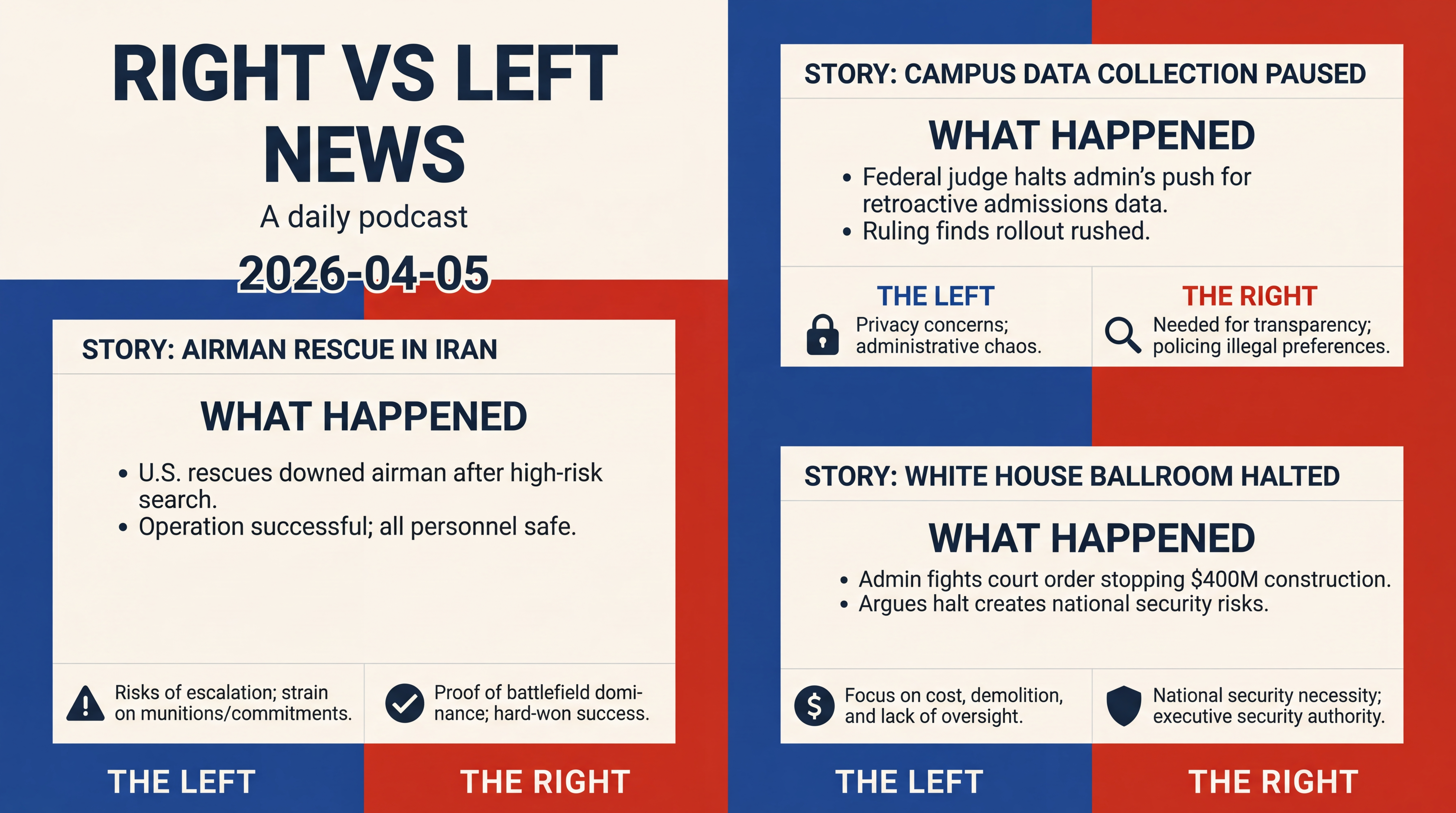
The United States says it rescued the missing crew member from an F-15E shot down over Iran on Friday. Just after midnight Sunday, President Trump posted: We got him. Officials told the Washington Post the injured weapons systems officer was recovered after a high-risk, days-long search across mountainous terrain. The operation wrapped up early Sunday, local time — and all U.S. personnel returned safely.
On the right, coverage frames the rescue as proof U.S. forces retain battlefield dominance even after losses. Fox News highlights the earlier downing but emphasizes air superiority — and the complexity of friendly fire risks in crowded airspace. National Review argues the campaign has degraded Iran’s missile and naval assets — casting the rescue as a hard-won success within broader momentum.
On the left, outlets underscore the political stakes of recovering a downed aircrew inside enemy territory — and the risks of escalation. The Washington Post warns a longer war could strain munitions supply lines and broader U.S. commitments, while the Guardian highlights mounting costs and diplomatic fallout.
A federal judge in Boston issued a preliminary injunction Friday, halting the administration’s plan to require universities to submit detailed, retroactive admissions data broken down by race and sex. AP reports Judge Dennis Saylor IV — a George W. Bush appointee — found the rollout rushed, siding for now with 17 Democratic attorneys general who sued. The Washington Post adds that the order pauses a policy the Education Department said was meant to ensure compliance with the 2023 Supreme Court ruling on race-conscious admissions.
On the right, Fox News casts the injunction as a temporary setback for transparency they say is needed to police illegal preferences — noting prior Justice Department moves to compel elite schools, including Harvard, to turn over records. Editorial voices argue taxpayers deserve clarity on whether campuses are skirting the Court’s ruling through proxies in essays and recommendation letters.
On the left, local and national outlets stress privacy concerns and administrative chaos — portraying the push as a sweeping federal intrusion that could chill lawful diversity efforts. They highlight the coalition of state attorneys general arguing the demand was hasty and poorly designed.
After a federal judge paused construction on the White House’s new $400 million ballroom, the administration filed an emergency motion — arguing the halt creates national security risks by leaving the Executive Mansion open and exposed. The filing says the facility would be heavily fortified, with shelters and a medical suite.
On the right, coverage emphasizes the temporary window for appeal — and the White House argument that Congress has long delegated latitude over security-related improvements. Some voices stress the claim the project won’t burden taxpayers, and say preservation lawsuits are weaponizing process to hobble executive security.
On the left, outlets focus on the price tag, the demolition of the old East Wing footprint, and the administration’s assertive legal posture. They question whether such a vast complex requires explicit congressional approval and independent review — while raising transparency and rule-of-law concerns about building a hardened facility with minimal oversight.
[MIDPOINT_SPONSORS]
Ukraine’s President Volodymyr Zelenskyy — in an interview published Sunday from Istanbul — warned that a prolonged U.S.–Israeli war with Iran could sap Western support for Kyiv, and further delay deliveries of key air defense missiles like Patriot. Multiple outlets echo his concern that the package will be smaller and smaller day by day if the conflict drags on.
On the right, commentary argues the best path to long-term European security is decisive success against Iran to deter adversaries more broadly. National Review contends U.S. operations have sharply curtailed Iran’s strike capacity — suggesting bandwidth exists to support Ukraine if Washington prioritizes production and alliances.
On the left, mainstream coverage amplifies concerns that stockpiles of air-defense interceptors and industrial limits could force trade-offs — urging a clearer strategy and predictable funding for Ukraine rather than ad hoc diversions shaped by Middle East events. Progressives also warn that fading attention risks emboldening Moscow.
Aid organizations warn the Iran war is disrupting shipments and spiking fuel costs — making it harder to move food and medicine in fragile regions from the Horn of Africa to the Middle East. Some stockpiles could run out within weeks without more funding and secure corridors.
On the right, analysts acknowledge civilian suffering but argue Tehran and its proxies are ultimately responsible for the turmoil — and that finishing the job by reopening shipping lanes and dismantling strike networks is the fastest way to stabilize markets and humanitarian access.
On the left, reporting stresses immediate safeguards: ceasefire windows, sanctions carve-outs, and more funding — warning that prolonged conflict will ripple through food and health systems and could intensify displacement from Lebanon to Somalia. Analysts frame it as a real-time test of balancing defense and aid budgets.
That’s the rundown... The U.S. rescues a downed airman in Iran. A judge pauses the administration’s college data push. The White House fights to restart its halted ballroom. Ukraine warns of attention — and missile — shortfalls. And aid groups sound the alarm about war-driven shortages.
We’ll keep tracking confirmations, court filings, and battlefield updates as they land today.
That's it for today's episode of Right versus Left News. Remember, understanding both sides isn't about picking a team—it's about being informed. Subscribe wherever you get your podcasts, and join us tomorrow for another balanced look at the day's biggest stories. Until next time, stay curious and stay informed.
