
Whiplash Week: DOJ, NIL, Jobs, Illinois
A rapid-fire breakdown of Washington’s latest shake-ups, a sweeping college sports directive, fresh jobs data, and the money-soaked Illinois primaries. We map how the right and left are framing each story—and what to watch next.
Episode Infographic
Show Notes
Welcome to Right versus Left News—your daily briefing on the stories that matter, told from both sides of the aisle. I'm your AI host - Chris, and each day I bring you the most important political and cultural news, with perspectives from conservative and progressive voices. No spin, no agenda—just the facts and the opinions that shape our national conversation. Let's dive in...
Here’s your quick overview.
In the last 24 hours, Washington moved fast... and the economy did too. President Trump fired Attorney General Pam Bondi and elevated her deputy, Todd Blanche, to lead the Justice Department. The White House is signaling more Cabinet moves—while insisting it won’t be a wholesale shake-up. The President also issued a new directive to save college sports by tightening rules on name, image, and likeness deals and transfers. The March jobs report showed 178,000 new jobs, with unemployment edging down to 4.3 percent. And Illinois’ primary results are still driving headlines as open-seat fights and outside money reshape several races. We’ll break down what happened—and what the right and the left are saying.
[BEGINNING_SPONSORS]
First up—the Justice Department shake-up.
President Trump removed Attorney General Pam Bondi and elevated Deputy Attorney General Todd Blanche to take the helm at the Justice Department. Blanche, who previously represented Trump in multiple legal battles, is stepping in as acting attorney general. Inside the department, some career staff voiced concern about independence as the Justice Department recalibrates after months of friction with the White House. The move followed the President’s dissatisfaction with the pace and outcomes of several high-profile investigations targeting his critics, according to reporting from the Washington Post.
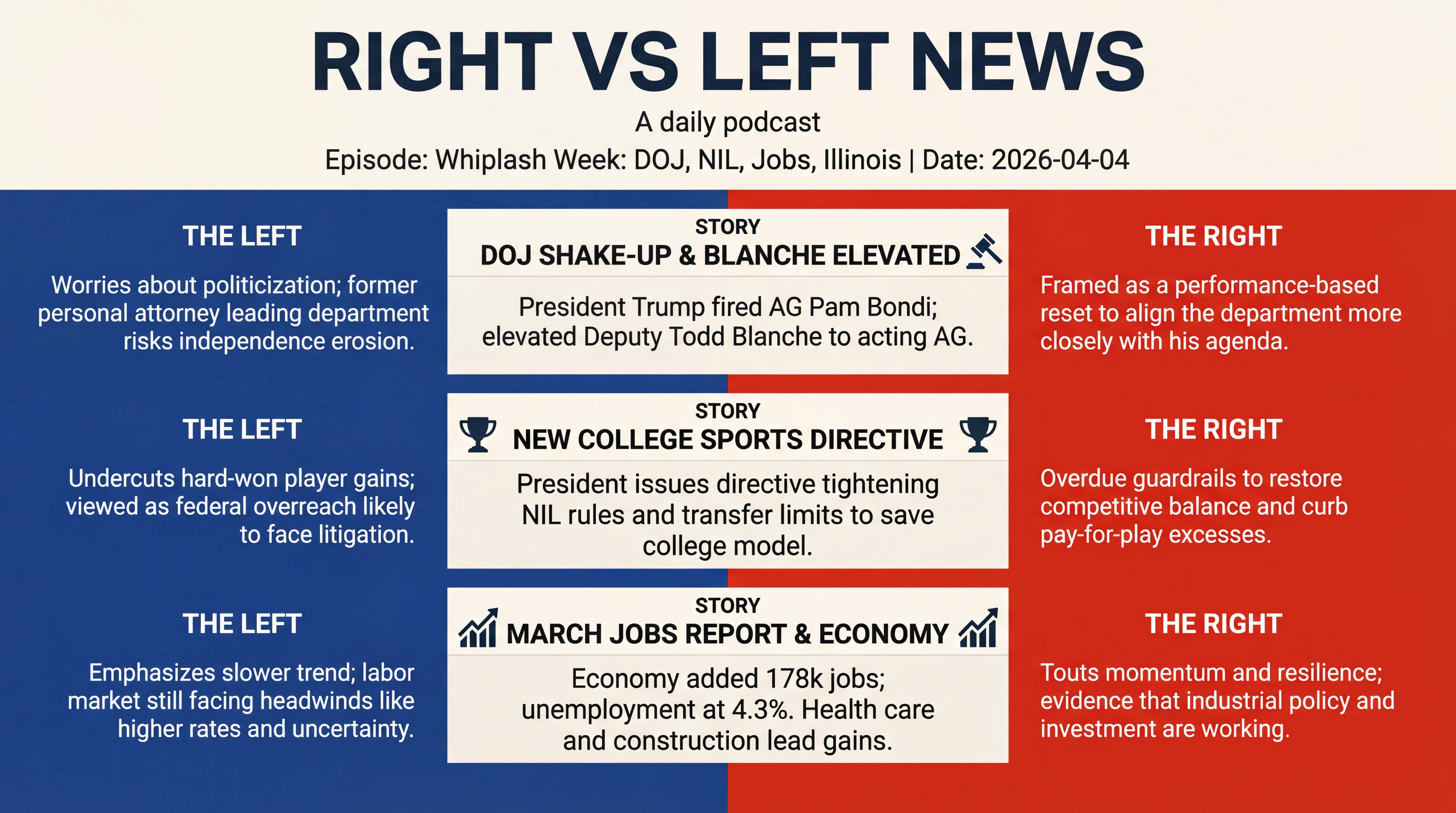
On the right, Fox News highlighted Blanche’s denial that Bondi’s ouster had anything to do with the department’s handling of the Epstein files—framing the change as a performance-based reset presidents are entitled to make. Some opinion voices argued Trump often uses firings to spur results, and that a reset could align the department more closely with his agenda.
On the left, the Washington Post emphasizes worries about politicization—that a former personal attorney leading the department, amid pressure to charge the President’s adversaries, risks eroding independence and the rule-of-law norms that insulate prosecutors from political demands.
Next—potential Cabinet changes.
After firing Bondi—and last month’s removal of Homeland Security Secretary Kristi Noem—the President is weighing more Cabinet moves. Commerce Secretary Howard Lutnick and Labor Secretary Lori Chavez-DeRemer are described as vulnerable, while Director of National Intelligence Tulsi Gabbard appears secure after the White House reaffirmed confidence in her. Still, aides say the President wants to avoid a massive shake-up, according to detailed reporting from the Washington Post.
On the right, coverage leans into bench-strength chatter—floating would-be replacements and casting turnover as accountability rather than chaos. The view: presidents can assemble teams aligned with their priorities.
On the left, it’s framed as mounting instability—a loyalty-test dynamic that can degrade governing capacity, spook agencies, and blur the line between policy and politics. Frequent high-level churn makes long-term planning hard—and can chill internal dissent.
Now to college sports.
The President issued a new directive aimed at saving the college model—pushing for stricter rules on athlete compensation under name, image, and likeness, tighter transfer limits, and a five-year participation window. Legal experts quickly flagged likely court clashes, given recent rulings that curtailed NCAA restrictions. The order also dovetails with a bill from Senator Tommy Tuberville, a former coach, to rein in transfers.
On the right, conservatives who warn the current NIL marketplace is chaotic—and say women’s and Olympic sports need guardrails—view the order as overdue structure. Supporters argue federal nudges can restore competitive balance and curb pay-for-play excesses.
On the left, progressives and athletes’ rights advocates say the order undercuts hard-won gains for players—calling it a federal overreach likely to collide with precedent and invite litigation from athletes and third parties.
[MIDPOINT_SPONSORS]
On to the economy.
The March jobs report showed employers added 178,000 positions, and the unemployment rate ticked down to 4.3 percent. Revisions left January and February a net 7,000 lower than previously reported, and labor force participation edged to 61.9 percent. Health care, construction, and transportation added jobs—while federal employment slipped again. That’s straight from the Bureau of Labor Statistics.
On the right, the White House touts momentum—pointing to manufacturing activity, a narrower goods trade deficit, and the idea that tariff-driven reshoring and investment are fueling resilience even amid global shocks. Supporters say a steady labor market, plus industrial policy, show America is winning again.
On the left, analysts emphasize the slower trend line—average monthly gains are soft, participation is subdued, and prior months’ revisions show a labor market still working through headwinds like higher rates, trade frictions, and geopolitical uncertainty. Better than February, yes... but not a breakout.
Illinois primaries—and the money shaping them.
Illinois’ primary results, particularly for an open U.S. Senate seat and multiple open House seats, continue to reverberate. Five House Democrats retiring around Chicago opened bruising primaries, with heavy outside spending from groups aligned with AIPAC and with crypto interests shaping key contests. On the Senate side, Democrats saw a high-profile clash featuring Lieutenant Governor Juliana Stratton, Representative Raja Krishnamoorthi, and Representative Robin Kelly.
On the right, the results are framed as evidence of rising centrist strength over Squad-style progressives—and a test of Governor J. B. Pritzker’s clout—while spotlighting outcomes like Melissa Bean’s comeback bid and Don Tracy’s GOP Senate nod. The through-line: Democratic divisions, plus big-money influence, could shape November.
On the left, detailed race coverage highlights resource imbalances and interest-group spending that set the terms of debate inside the Democratic Party—from Israel policy to tech and finance—while underscoring the diversity and ideological range of the contenders who advanced. Supporters say contested primaries sharpen messages for November; critics warn money is doing too much talking.
Quick recap: a consequential Justice Department handoff... hints of more Cabinet churn... a sweeping college-sports order likely to be tested in court... a jobs report that’s better but still cautious... and Illinois primaries that preview the ideological and money dynamics of 2026. We’ll keep tracking these stories—and how both sides make their case—as new facts land.
That's it for today's episode of Right versus Left News. Remember, understanding both sides isn't about picking a team—it's about being informed. Subscribe wherever you get your podcasts, and join us tomorrow for another balanced look at the day's biggest stories. Until next time, stay curious and stay informed.
