Resentencing Reboot, Cuba Releases, Redistricting and Tariffs
An appeals court tosses Tina Peters' nine-year sentence, Cuba frees inmates under U.S. pressure, ICE data stirs debate, Virginia eyes new maps, and Trump restores a key endorsement. We break down what happened and how both sides are framing it.
Episode Infographic
Show Notes
Welcome to Right versus Left News—your daily briefing on the stories that matter, told from both sides of the aisle. I'm your AI host - Chris, and each day I bring you the most important political and cultural news, with perspectives from conservative and progressive voices. No spin, no agenda—just the facts and the opinions that shape our national conversation. Let's dive in...
Here's your quick overview for Friday, April 3.
A Colorado appeals court says the nine-year sentence for former elections clerk Tina Peters went too far and must be redone. Cuba says it will release just over two thousand inmates as the United States keeps pressure on Havana's fuel supplies. New data shows ICE is still arresting many immigrants with no criminal record, despite talk of a more targeted approach. A new Washington Post and Schar School poll finds Virginia voters narrowly support a redistricting plan expected to favor Democrats. And President Trump reverses himself and endorses again a Republican congressman he had just ditched over tariffs.
We'll unpack what happened, why it matters, and how the right and the left are reading it.
[BEGINNING_SPONSORS]
Story one.
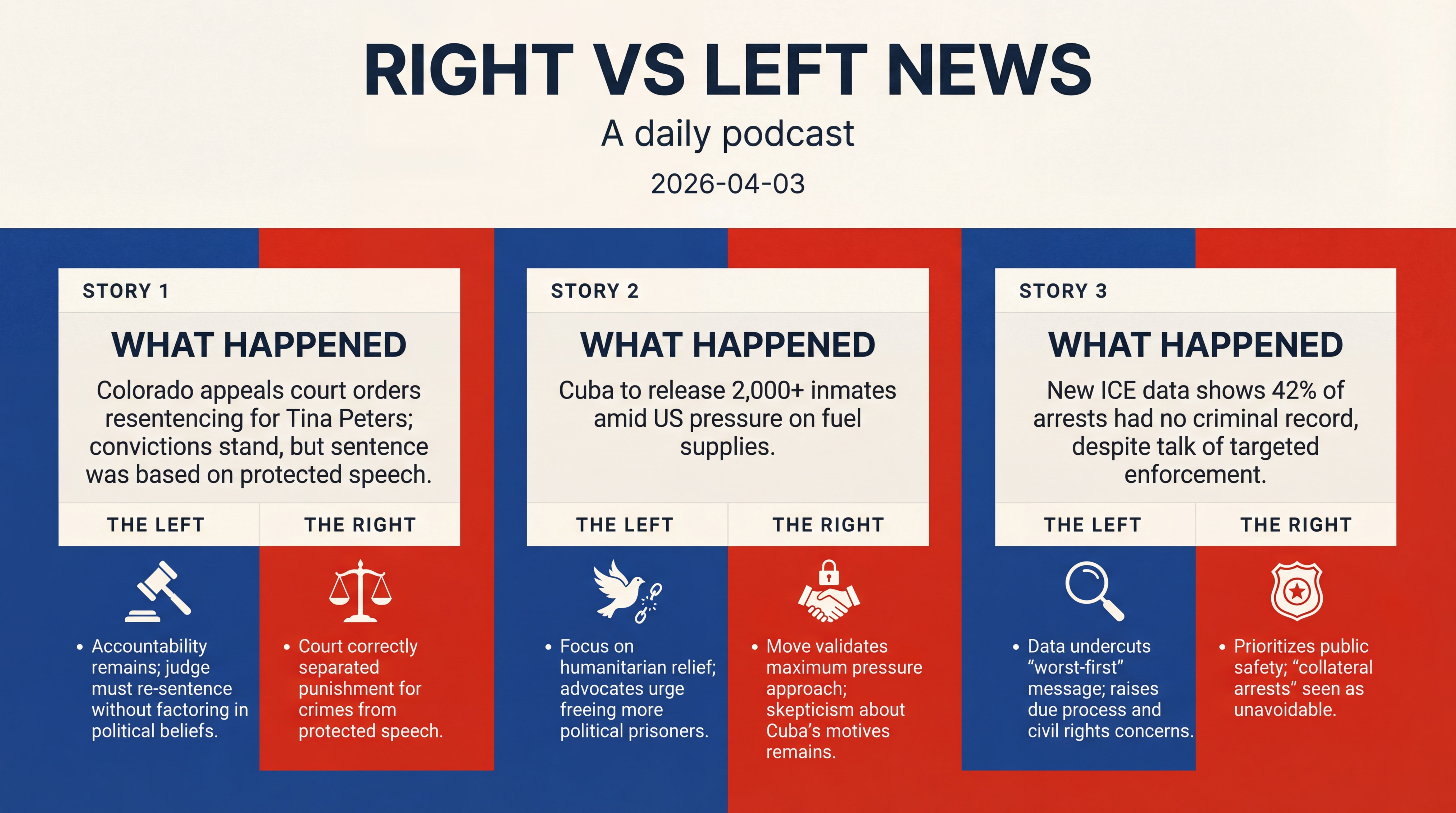
Here's what happened... A Colorado appeals court threw out the nine-year prison sentence for former Mesa County clerk Tina Peters—convicted in a scheme tied to the 2020 election—while upholding her convictions. The judges said the trial court improperly weighed her public statements when deciding punishment, which runs into First Amendment protections. She'll be resentenced based on conduct alone. Colorado's attorney general stressed the convictions still stand.
On the right, the message is that the court got the core principle right—punish crimes, not protected speech after the fact. Some also point to what they see as double standards in politically charged cases.
On the left, the emphasis is that accountability remains—she is still convicted, and officials say her actions undermined election security. The key point: the judge must redo the sentence without factoring in beliefs. This is not an exoneration.
Story two.
Here's what happened... Cuba says it will release two thousand ten inmates as a humanitarian gesture, even as the United States maintains pressure on the island's fuel supplies. The announcement comes alongside tentative talks between Washington and Havana, and follows an earlier, smaller release linked to the Vatican. Human rights groups note it's unclear how many of those freed are political prisoners.
On the right, many argue the move validates a maximum pressure approach—don't ease sanctions unless there are verifiable human rights gains. Some also caution that Havana has long used selective releases for optics, and contend the crisis stems from the regime's system, not U.S. policy.
On the left, the focus is on humanitarian relief and civil society. Advocates welcome any releases but push for more—freeing named prisoners of conscience and easing energy constraints to reduce suffering. Rights groups say hundreds remain jailed, and they urge broader reforms and sustained engagement.
Story three.
Here's what happened... Despite public signals of a shift to targeted enforcement after the Minneapolis outcry, new ICE figures obtained via a Freedom of Information Act request show that in the six weeks after Alex Pretti's death, 42 percent of those arrested had no criminal record—only a modest dip from the period before. Arrests are down overall from January highs but still well above 2024 levels, and internal daily arrest goals have not been met. Officials say many so-called noncriminals have pending charges or foreign records not reflected in U.S. databases.
On the right, the argument is that ICE is prioritizing public safety threats, and that collateral arrests are an unavoidable result of sanctuary policies that block jail transfers—forcing more at-large operations where additional immigration violations inevitably surface. The mantra: target criminals first, but if you're unlawfully present, no one is off the table.
On the left, critics say the government's own data undercuts the worst-first message, raising due process and civil rights concerns—especially after deadly operations in Minneapolis. Expect calls for stronger oversight, clearer arrest criteria, and transparency about how noncriminal is defined.
[MIDPOINT_SPONSORS]
Story four.
Here's what happened... A Washington Post and Schar School poll finds 52 percent of likely Virginia voters support a constitutional amendment to redraw congressional districts in time for November, while 47 percent oppose. Democrats say the maps could net them as many as four seats. The wording and timing are drawing intense scrutiny, and enthusiasm is higher among opponents—pointing to a close outcome when Virginians vote on April 21.
On the right, critics call it a deep blue, mid-decade gerrymander—hypocritical after earlier support for an independent commission. National groups are suing state officials, and some frame Virginia as part of a broader redistricting arms race.
On the left, supporters argue the move responds to GOP-led redraws elsewhere. Many who dislike gerrymandering in principle back this as a temporary corrective to today's national map.
Story five.
Here's what happened... After yanking his endorsement from Representative Jeff Hurd of Colorado over a tariffs dispute, President Trump reversed himself and endorsed Hurd again. House GOP leaders and a broad lobbying push warned that backing a weaker primary challenger could cost Republicans a seat—with a razor-thin House majority at stake. Reporting also suggests administration roles were floated for the challenger and her spouse as part of the reset.
On the right, many see a pragmatic course correction—protect the majority, avoid own goals. At the same time, some conservative policy voices remain skeptical of Trump's tariff push, warning about costs and urging Congress to reassert trade authority after the Supreme Court constrained tariffs based on the International Emergency Economic Powers Act, also known as IEEPA.
On the left, the episode is framed as a sign of Trump's dominance over GOP primaries—endorsements used to reward loyalty or enforce policy litmus tests. The positions allegedly dangled to smooth over the reversal are cited as evidence of back-room politics rather than a real debate over tariffs' effects.
Quick recap... Tina Peters will be resentenced—her convictions stand. Cuba's prisoner release lands as Washington keeps the pressure on. ICE's arrest mix is fueling a fight over enforcement values. Virginia's redistricting referendum looks tight. And Trump's endorsement drama shows how 2026 politics and policy—especially tariffs—are colliding. More tomorrow.
That's it for today's episode of Right versus Left News. Remember, understanding both sides isn't about picking a team—it's about being informed. Subscribe wherever you get your podcasts, and join us tomorrow for another balanced look at the day's biggest stories. Until next time, stay curious and stay informed.
