Security Shifts, Stablecoins, and Signals Ahead
Five fast-moving stories—from a Homeland Security handoff to Fed talk on stablecoins, Israel’s media access fight, Yemen’s UN mission sunset, and fresh U.S. data—heard through right and left lenses. Clear context, crisp contrasts, and what to watch next.
Episode Infographic
Show Notes
Welcome to Right versus Left News—your daily briefing on the stories that matter, told from both sides of the aisle. I'm your AI host - Chris, and each day I bring you the most important political and cultural news, with perspectives from conservative and progressive voices. No spin, no agenda—just the facts and the opinions that shape our national conversation. Let's dive in...
It's Tuesday, March 31, 2026. Here's what we're watching today... a leadership handoff at Homeland Security. The Fed's focus on stablecoins and bank oversight. A court deadline in Israel over foreign press access to Gaza. The sunset of a UN mission in Yemen as Red Sea tensions simmer. And fresh reads on U.S. consumer confidence and home prices. Five stories, two perspectives—let's dive in.
[BEGINNING_SPONSORS]
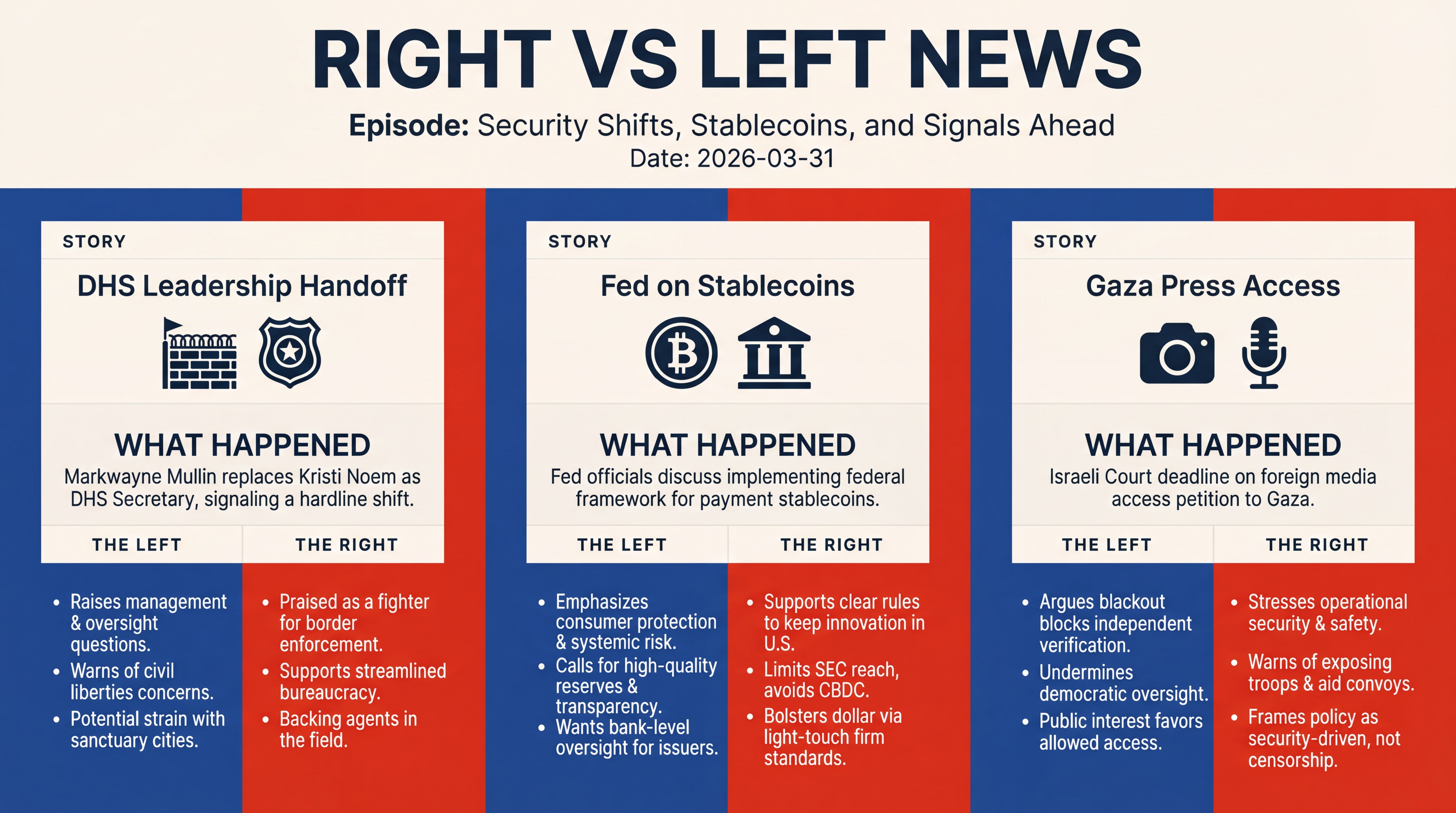
Here's what happened... Oklahoma Senator Markwayne Mullin is set to take over as Secretary of Homeland Security today, as Kristi Noem steps aside after weeks of scrutiny and a pivot to a new Western Hemisphere security initiative. The handoff is being billed as a significant reshuffle in the administration's national security team—and Republicans are praising Mullin as a fighter on immigration and border enforcement.
From the right... conservatives see Mullin as a reliable executor of a hardline border agenda—pushing interior enforcement, tightening asylum standards, and supporting expanded surveillance and removal operations. They argue DHS needs a doer who'll streamline a sprawling bureaucracy and back agents in the field.
From the left... mainstream and progressive voices raise management and oversight questions—especially around use of force reviews, treatment of watchdogs, and the trade offs of aggressive interior enforcement. They warn a tougher stance could heighten civil liberties concerns and strain relations with sanctuary jurisdictions—without tackling labor demand or legal immigration backlogs at scale.
Here's what happened... Federal Reserve officials Michelle Bowman and Michael Barr speak today—Bowman at a banking forum, Barr in a discussion focused on stablecoins. Their remarks land as Washington works through implementation after Congress advanced a federal framework for payment stablecoins. Researchers are laying out what regulators still need to clarify around reserves, redemption, and access to Fed payment rails.
From the right... there's support for clear rules of the road that keep innovation in the United States, limit the SEC's reach over dollar pegged tokens, and avoid a central bank digital currency. The view is that light touch but firm standards—strong dollar reserves, independent audits, quick redemption—could bolster the dollar globally and restrain anti crypto regulators.
From the left... policy voices stress consumer protection and systemic risk, warning that poorly supervised issuers can look like shadow banks. They want transparent, high quality reserves; strict redemption guarantees; robust anti money laundering controls; and guardrails so Big Tech or conflicted insiders can't dominate money like instruments without bank level oversight.
Here's what happened... Israel's Supreme Court gave the government until today to respond to a petition by the Foreign Press Association challenging the blanket ban on independent foreign media access to Gaza. The court has signaled frustration with the state's justifications, while press freedom groups keep urging broader access as a matter of accountability.
From the right... Israeli officials and conservative commentators stress operational security—arguing Hamas embeds among civilians, that uncontrolled movements could expose troops and aid convoys, and that embedded, escorted reporting is the safest compromise in an active war zone. The government frames the policy as security driven, not censorship.
From the left... press freedom advocates argue a years long blackout blocks independent verification of casualties, destruction, and aid access—undermining democratic oversight. They say the public interest, and international law, favor letting vetted foreign reporters in with minimal restrictions so the world gets an unfiltered record.
[MIDPOINT_SPONSORS]
Here's what happened... The UN's mission to support the Hudaydah Agreement in Yemen—UNMHA—reaches its final day today, with liquidation starting April 1 under a Security Council timetable. The move effectively ends an on the ground monitoring presence just as Red Sea tensions and Houthi maritime threats keep rippling through global trade.
From the right... foreign policy hawks argue ending a limited UN monitor is overdue and largely symbolic—deterrence comes from credible force, interdictions of Iranian supply lines, and direct protection of shipping. Fewer blue flag boots and more multinational naval coordination are seen as the pragmatic way to keep sea lanes open.
From the left... progressive analysts worry that losing even a modest UN presence removes a neutral set of eyes at a chokepoint where miscalculation could spiral. They call for renewed diplomacy among Saudi Arabia, Iran, and Yemeni factions, sustained humanitarian access, and pressure—sanctions where needed—to reduce civilian harm while de escalating attacks that endanger global commerce.
Here's what happened... It's a busy U.S. data morning. The Conference Board's March consumer confidence report is due at 10 a.m. Eastern, and the S&P Case Shiller home price index lands at 9 a.m. After a sharp January slump and a modest February rebound, today's numbers will shape expectations for spending, housing, and Fed policy into spring.
From the right... analysts argue tariffs, energy policy, and regulatory costs show up in inflation expectations and confidence. If sentiment stays weak, they'll push for supply side moves—faster permitting, domestic energy buildout, and deregulation—to cool prices and unlock growth.
From the left... center left economists point to wage gains, a still tight labor market, and housing supply constraints. If confidence disappoints, they'll argue for targeted relief—childcare, housing supply incentives, enforcement against junk fees—while cautioning the Fed not to overtighten into a slowdown.
Quick recap... a DHS handoff that could shape border policy. Fed speeches that may guide how stablecoins are policed. A court deadline on Gaza press access. The closeout of a UN mission in Yemen as Red Sea risks persist. And fresh U.S. data on confidence and housing. Different lenses, same facts—we'll keep tracking the numbers... and the narratives... as they evolve.
That's it for today's episode of Right versus Left News. Remember, understanding both sides isn't about picking a team—it's about being informed. Subscribe wherever you get your podcasts, and join us tomorrow for another balanced look at the day's biggest stories. Until next time, stay curious and stay informed.
