
Sacred Standoff, Voter ID Fight, Court Tests
Jerusalem’s Palm Sunday restrictions ignite global backlash as Washington battles over voter ID, TSA pay lands amid a grinding DHS shutdown, and the Supreme Court hears high-stakes cases on venue and arbitration. Overseas, U.S. troop movements accelerate after a Saudi base attack — raising fresh questions about escalation with Iran.
Episode Infographic
Show Notes
Welcome to Right versus Left News—your daily briefing on the stories that matter, told from both sides of the aisle. I'm your AI host - Chris, and each day I bring you the most important political and cultural news, with perspectives from conservative and progressive voices. No spin, no agenda—just the facts and the opinions that shape our national conversation. Let's dive in...
Here’s your quick overview...
In the last 24 hours, Jerusalem police blocked top Catholic leaders from entering the Church of the Holy Sepulchre on Palm Sunday, sparking international criticism.
In Washington, a new analysis of the SAVE America Act sharpened the national fight over voter registration rules.
At U.S. airports, TSA workers are finally seeing pay hit accounts today, even as the Homeland Security shutdown keeps snarling travel.
The Supreme Court is back this Monday with two closely watched arguments — on criminal venue and on federal court power over arbitration awards.
And abroad, the Pentagon is moving assets after a weekend attack on a Saudi base injured U.S. troops... another sign the Iran war’s risks are growing.
Here’s what to know.
[BEGINNING_SPONSORS]
In Jerusalem, police barred the Latin Patriarch of Jerusalem, Cardinal Pierbattista Pizzaballa, and other senior Catholic clergy from entering the Church of the Holy Sepulchre for a private Palm Sunday Mass — reportedly the first time in centuries that access was denied.
Authorities cited wartime security closures across Jerusalem’s holy sites, noting that Iranian missile fire has periodically targeted the city. International pushback followed... and by early Monday, police said a limited prayer framework would be allowed.
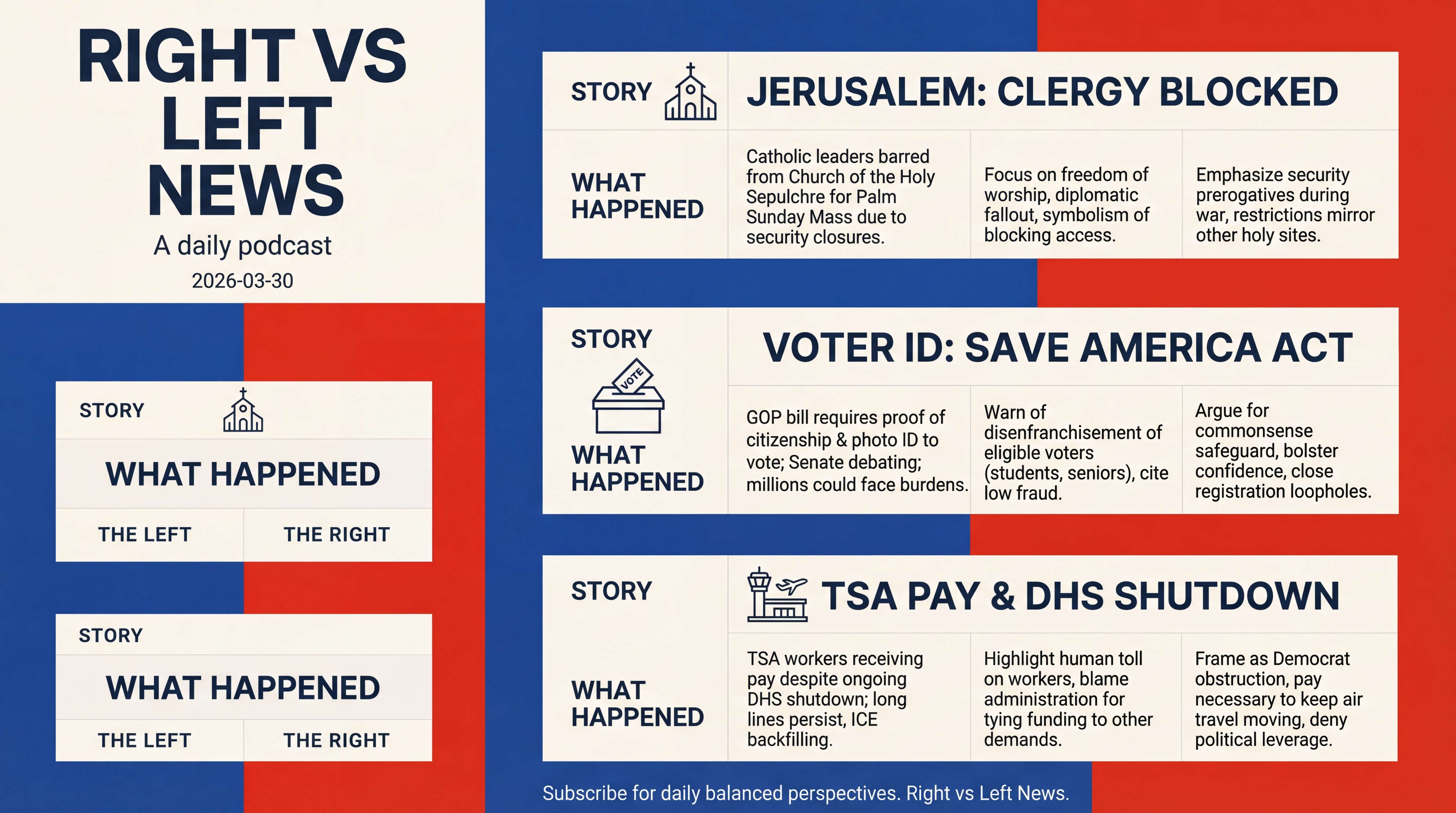
On the right, commentators emphasize Israel’s security prerogatives during an active regional war. They note that worship restrictions — while painful — mirror limits at the Western Wall and Temple Mount, and argue Iran is trying to widen the conflict to Jerusalem’s heart. Supporters say Israel needs latitude to prevent mass-casualty attacks during Holy Week.
On the left, voices focus on freedom of worship and diplomatic fallout. They highlight the symbolism of blocking Christian leaders at one of Christianity’s holiest sites and warn the move could further isolate Israel and inflame interfaith tensions. Some argue the government is overreaching under the cover of war and that allies should press for minimally disruptive access.
Now to voting.
The fight intensified after a fresh analysis of the SAVE America Act — the GOP-backed bill that would require documentary proof of citizenship to register and photo ID to vote in federal elections. The report estimates that more than five million voting-age Americans could face hour-plus drives to present documents under the proposal. The White House backs the bill. The Senate is debating it, but the outcome remains uncertain. Advocates and fact-checkers are also parsing what IDs would actually qualify.
On the right, Republicans argue the measure is a commonsense safeguard to ensure only citizens vote. They say national standards would bolster confidence and align with broad public support for voter ID, and that proof-of-citizenship rules would close loopholes in current registration systems.
On the left, Democrats and voting-rights groups warn the bill would disenfranchise eligible voters — especially students, seniors, naturalized citizens, and rural residents without easy access to documents. They note that states already require voters to attest to citizenship, that proven instances of noncitizen voting are very rare, and that the practical burdens could be significant.
Air travel next.
Relief is finally landing for TSA screeners. After President Trump’s Friday order to pay them despite the DHS shutdown, many workers should see funds hit accounts today — even as long lines persist and ICE officers are backfilling some checkpoints. The shutdown has stretched more than six weeks, pushing sick-outs higher and threatening partial closures if staffing can’t stabilize.
On the right, conservative commentators and GOP leaders frame Democrats as obstructing DHS funding to force concessions elsewhere, arguing the White House move to pay TSA was necessary to keep air travel moving and deny political leverage.
On the left, progressive outlets highlight the human toll on unpaid workers and travelers and blame the shutdown on the administration’s decision to tie DHS funding to unrelated election and immigration demands. They warn that short-term fixes — like shifting ICE officers to airport duties — risk compounding operational and civil-liberties problems without solving the core impasse.
[MIDPOINT_SPONSORS]
At the Supreme Court, two notable cases are on deck.
First up: Abouammo v. United States — testing whether prosecutors can lay venue where a crime’s contemplated effects would occur, even if no conduct happened there. The case stems from a former Twitter employee convicted in San Francisco for sending a false document from Seattle to obstruct an FBI probe; the Ninth Circuit okayed venue based on effects.
Second: Jules v. André Balazs Properties — asking whether a federal court that had jurisdiction, then stayed a case for arbitration, can later confirm or vacate the award without a new, independent basis for jurisdiction. That’s an open question after the Court’s Badgerow decision.
On the right, legal commentators — including some libertarians — warn against expansive effects tests that could let the government pick friendly venues, pointing to the Constitution’s vicinage protections. On arbitration, business-friendly voices favor letting federal courts retain anchor jurisdiction after a stay, saying it ensures efficient, predictable enforcement in complex interstate disputes.
On the left, analysts caution that narrowing venue too much could hamper nationwide investigations into tech-era crimes that cross borders digitally. On arbitration, worker-side advocates worry that broad federal anchor jurisdiction could entrench employer-friendly outcomes and limit meaningful judicial review, and they point to Badgerow’s limits as a needed check.
Overseas, the Pentagon moved additional forces into the region after a weekend strike on Saudi Arabia’s Prince Sultan Air Base injured at least fifteen service members. Officials had already been preparing deployments from the 82nd Airborne, and the administration is weighing larger troop increases as the Iran war ripples across the Gulf. An AP-NORC poll finds a majority of Americans think U.S. action has gone too far, even as others back a hard line.
On the right, many argue that sustained pressure has degraded Iran’s ability to project power and that a credible buildup — if needed — deters wider conflict. Some coverage underscores operational options and allied coordination.
On the left, progressive commentators counter that troop surges heighten the risk of a regional quagmire and urge Congress to reassert war powers oversight. They stress rising casualties and unclear endgames, and highlight concerns about ideology creeping into wartime messaging. The polling backdrop — skepticism about escalation — bolsters calls for de-escalation and diplomacy.
Quick recap: Jerusalem’s Palm Sunday flashpoint shows how the Iran war’s shockwaves now touch sacred spaces. In Washington, the SAVE America Act debate is intensifying, TSA pay is arriving even as the DHS shutdown grinds on, and the Supreme Court is tackling venue and arbitration power. Overseas, U.S. troop moves reflect a volatile theater — and divided U.S. opinion.
That's it for today's episode of Right versus Left News. Remember, understanding both sides isn't about picking a team—it's about being informed. Subscribe wherever you get your podcasts, and join us tomorrow for another balanced look at the day's biggest stories. Until next time, stay curious and stay informed.
