
Aid Flotilla, Peak Blossoms, Debt Debate, Travel Hurdles
From a Gaza aid convoy to D.C.'s cherry blossoms, we break down five stories shaping Sunday — with the key arguments from both sides and what they mean for daily life. Plus, where passport fairs are easing bottlenecks as visa services in Israel remain limited.
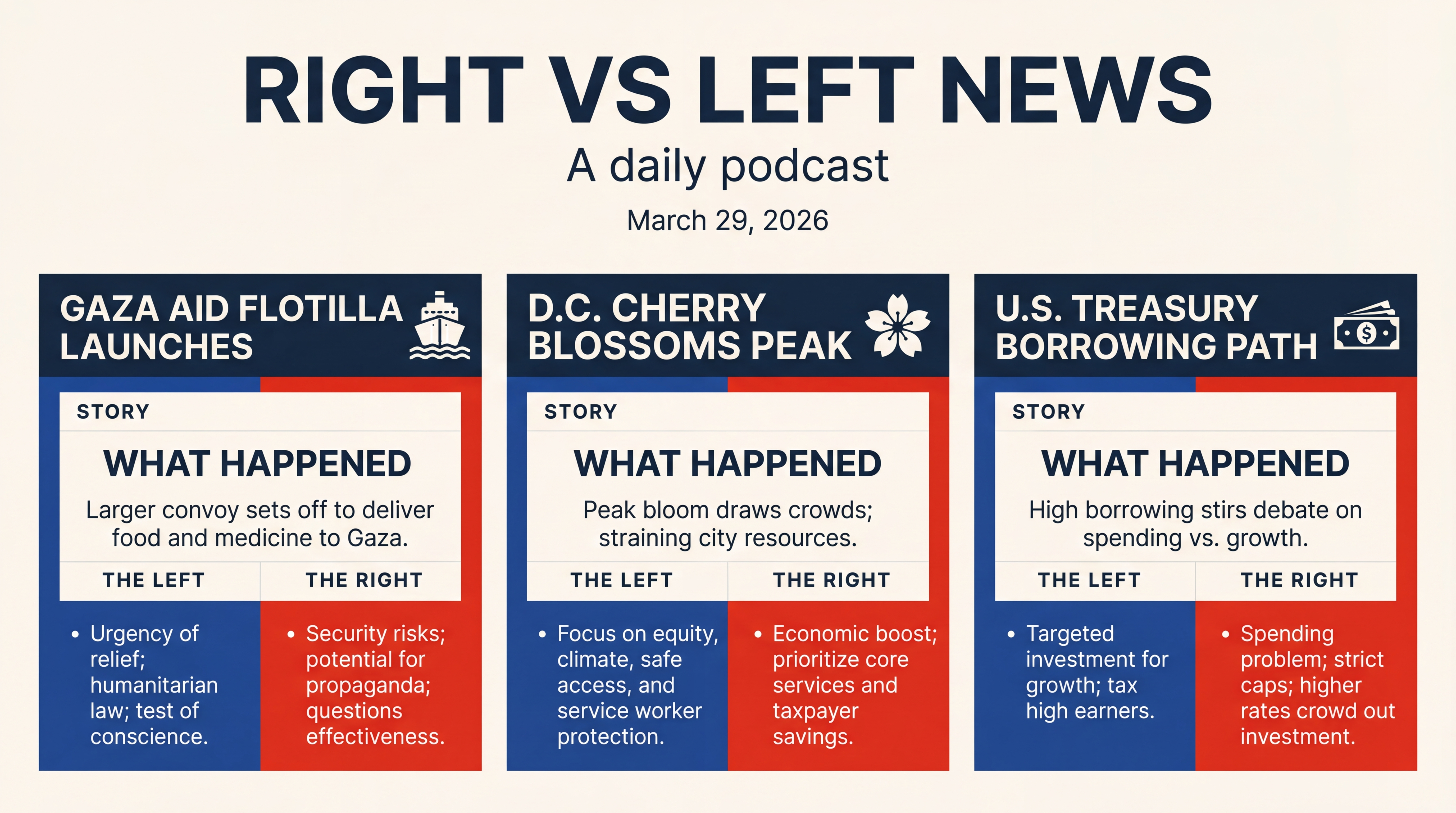
Episode Infographic
Show Notes
Welcome to Right versus Left News—your daily briefing on the stories that matter, told from both sides of the aisle. I'm your AI host - Chris, and each day I bring you the most important political and cultural news, with perspectives from conservative and progressive voices. No spin, no agenda—just the facts and the opinions that shape our national conversation. Let's dive in...
It's Sunday, March 29. Here's what we're watching from the last 24 hours... activists behind a Gaza aid flotilla say ships are setting off today... Washington, D.C., enters its peak cherry blossom window... the U.S. Treasury's latest borrowing path is stirring fresh debate over spending and growth... U.S. visa services remain constrained in Israel after recent disruptions... and the State Department is holding Sunday passport fairs to chip away at demand. Five stories, multiple angles — let's get to it.
[BEGINNING_SPONSORS]
Organizers of a new international aid flotilla say a larger convoy is slated to depart today for Gaza, alongside overland efforts to move relief. Al Jazeera has tracked the plans and highlighted a public timeline for a late March launch. Not all ports and routes are public — for security reasons — but the goal is simple: move more food and medicine into the enclave and draw attention to humanitarian shortages.
On the right, commentators warn that flotillas can be exploited by militants, complicate naval inspections, and turn into propaganda theater. They emphasize Israel's right to intercept ships, verify cargo, and enforce maritime security — especially during an ongoing regional conflict. They also question whether these convoys actually increase aid flows, or mostly create high-profile confrontations that adversaries can leverage.
On the left, progressives stress the urgency of getting relief in, point to widespread food insecurity, and argue that civil-society pressure can open bottlenecks when diplomacy stalls. They invoke international humanitarian law — medical supplies and staple foods should move regardless of politics — and call for negotiated inspection regimes that speed, rather than block, deliveries. Activists frame today's launch as a test of the world's conscience.
D.C.'s famed Yoshino cherry trees are hitting peak bloom between today and April 1, according to the National Park Service. The National Cherry Blossom Festival draws hundreds of thousands of visitors — straining Metro, roads, and public safety resources at the Tidal Basin and along the Mall.
On the right, conservatives welcome the economic boost but push for crowd management that protects public property and reduces taxpayer overtime. They call for a focus on core city services — transit reliability, cleanliness, and policing — over costly add-ons. Some fiscal hawks use festivals like this to argue that basic infrastructure should be prioritized over new wish lists.
On the left, progressives lean into equity and climate angles: more car-free access, extra Metro capacity, safe pedestrian routes, and preservation of the Tidal Basin shoreline against flooding and tree loss. They also press to make big civic events more inclusive — bilingual signage, ADA accommodations, and protections for service workers who keep the city running during peak tourism.
The U.S. Treasury's latest quarterly guidance points to elevated near-term borrowing and a hefty end-of-March cash balance — rolling over debt and funding operations while markets digest war-related uncertainties. That update is shaping today's debate over the mix of issuance and the cost of interest.
On the right, fiscal hawks say the borrowing path underscores a spending problem. Expect calls for stricter caps, regulatory rollbacks to spur growth, and reforms to the major drivers of the debt. They warn that higher real rates can crowd out private investment — and that global shocks can punish countries seen as unserious about deficits.
On the left, progressive economists counter that cutting too fast in a fragile environment is risky. They argue targeted public investment — in energy, infrastructure, and supply chains — can raise long-run growth and lower the debt-to-GDP ratio over time. Revenue, they say, can be raised by closing corporate tax loopholes and ensuring high earners contribute more, while preserving safety-net outlays that act as automatic stabilizers.
The State Department recently confirmed limited visa services at the U.S. Embassy in Jerusalem and the Tel Aviv branch office. Applicants are being asked to monitor email for rescheduling updates as conditions allow. Those constraints continue to ripple into travel planning this weekend as families and businesses navigate a volatile period.
On the right, conservative foreign-policy voices highlight the primacy of security for U.S. personnel and applicants. They back a cautious, conditions-based return to normal operations — and argue that a deterrence-first Middle East posture ultimately creates the stability needed for consular services to resume fully. They also advocate tougher pressure on regional spoilers seen as driving the disruptions.
On the left, progressives emphasize the human impact — students, workers, and families stuck in limbo — and push for creative workarounds: more third-country processing, virtual interviews where legal, and urgent humanitarian exceptions. They link the visa backlog to a broader case for diplomacy to de-escalate fighting and restore predictable civilian mobility across the region.
To meet demand and shorten wait times, the State Department is hosting special passport acceptance fairs on weekends — including today — at post offices, libraries, and colleges. One of today's events is at Rockland Community College in New York, with others scheduled across the country through the spring.
On the right, commentators welcome customer-service steps and urge scaling what works — clearer timelines, more appointments, measurable performance goals. Some also press for stronger identity verification and anti-fraud tools across federal and state documents.
On the left, advocates praise weekend access as pro-worker and family-friendly. They call for fee relief for low-income applicants, multilingual outreach, and expanded mobile units in rural and underserved areas. It's also framed as a push to modernize digital services — so people can renew or apply without taking unpaid time off.
[MIDPOINT_SPONSORS]
Quick recap before we go... activists say a larger Gaza aid flotilla is launching today to push relief into the enclave... the District's cherry blossoms are at peak bloom — bringing celebration and crowd control challenges... Treasury's borrowing path keeps the debt debate front and center... U.S. visa services in Israel remain constrained amid regional instability... and those Sunday passport fairs aim to make government a little easier to reach. Different issues, shared stakes — security, prosperity, and how policy touches daily life. We'll keep tracking developments into Monday.
That's it for today's episode of Right versus Left News. Remember, understanding both sides isn't about picking a team—it's about being informed. Subscribe wherever you get your podcasts, and join us tomorrow for another balanced look at the day's biggest stories. Until next time, stay curious and stay informed.
