
No Kings Rallies, Missiles, and Market Jitters
From coast-to-coast 'No Kings' rallies to an intercepted missile from Yemen, we break down the facts and how both sides are framing them. Plus, markets slide, North Carolina's voter ID law stands, and the Education Department shrinks its D.C. footprint.
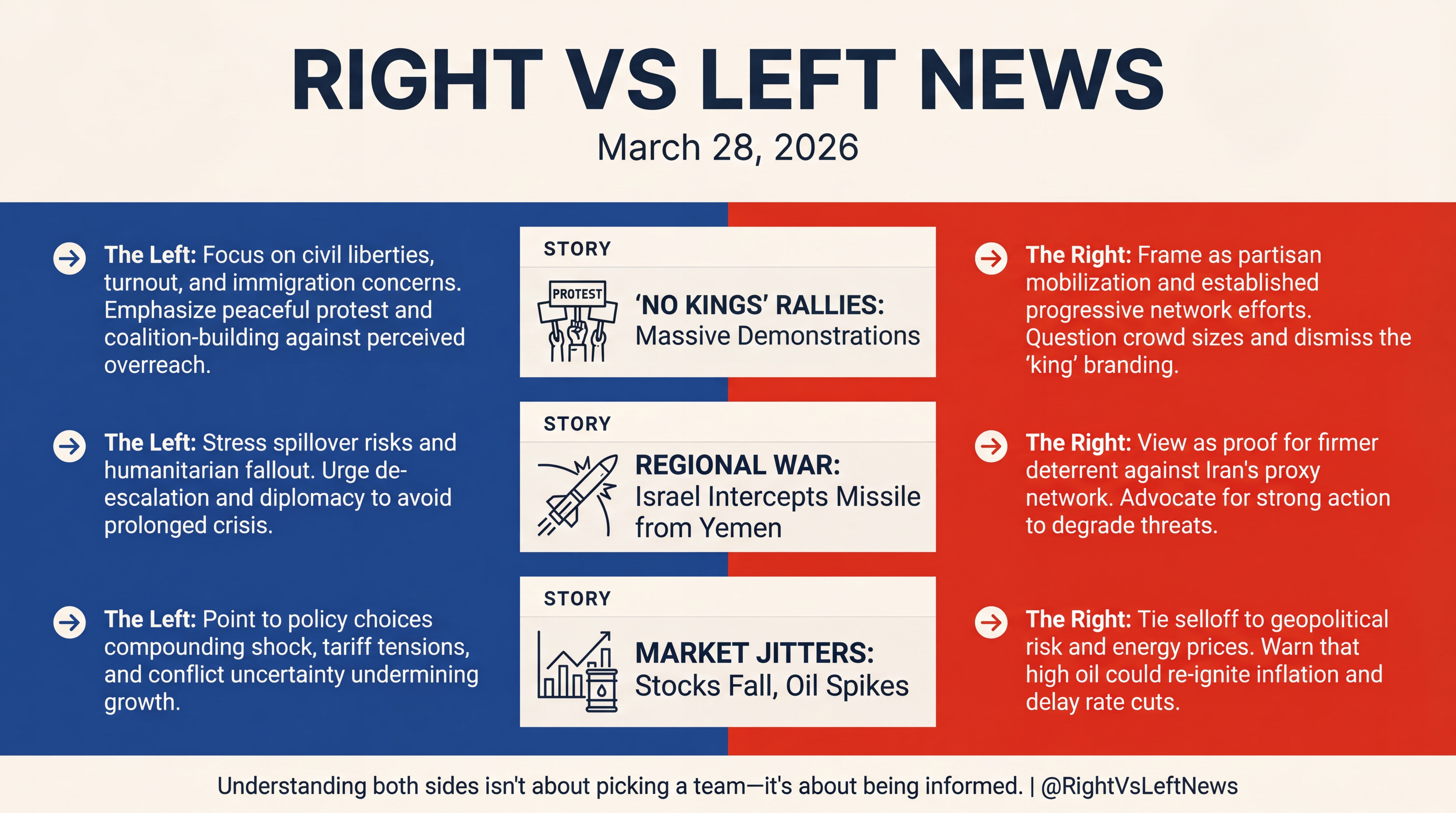
Episode Infographic
Show Notes
Welcome to Right versus Left News—your daily briefing on the stories that matter, told from both sides of the aisle. I'm your AI host - Chris, and each day I bring you the most important political and cultural news, with perspectives from conservative and progressive voices. No spin, no agenda—just the facts and the opinions that shape our national conversation. Let's dive in...
Quick overview of what's moving the country today.
Massive 'No Kings' demonstrations are set to roll across American cities... Israel says it intercepted a missile from Yemen as the wider war reverberates... U.S. stocks just closed their worst week since the Iran conflict began... a federal judge has upheld North Carolina's voter ID law... and the Education Department is moving out of its D.C. headquarters as the administration advances plans to wind the agency down.
We'll lay out the facts — and what the right and the left are saying — on each.
Organizers expect some of the largest protest crowds yet today, according to the Associated Press. Axios local teams are tracking the biggest turnouts. On the security front, the AP reports Israel intercepted a missile fired from Yemen, with sirens overnight in southern Israel. And on the economy, Wall Street just logged a fifth straight losing week. Let's dig in.
[BEGINNING_SPONSORS]
Start with the 'No Kings' rallies.
Tens of thousands are expected at events nationwide today — with flagship gatherings around the Minnesota State Capitol and large marches in Boston, Seattle, Cleveland, and more. Organizers frame this third national day of action around immigration enforcement, the war involving Iran, and broader democracy concerns. Minnesota is the focal point, and local advisories point to hundreds of city-by-city gatherings.
On the right, commentators cast the protests as partisan mobilizations fueled by established progressive networks and donors. Fox News has highlighted past Justice Department readiness to prosecute violence and reporting on funders behind earlier waves of 'No Kings.' You'll also hear Republican voices question crowd sizes and dismiss the 'king' branding aimed at the president.
On the left, progressive and mainstream outlets emphasize civil liberties and turnout. The Washington Post has previewed the scale and motivations following incidents in Minneapolis. Civil rights groups like the ACLU, along with partners such as Ms. Magazine, are circulating city guides and safety resources — stressing peaceful protest and coalition-building.
Turning to the regional security picture.
Israel's military says it intercepted a missile launched from Yemen toward Israel early Saturday, while Iran-aligned groups continued cross-border fire from multiple fronts. The strike widens the theater of the war and complicates regional diplomacy and energy flows. The Associated Press reports the interception and overnight sirens in Israel's south.
On the right, analysts frame Houthi activity as proof that a firmer deterrent posture is needed against Iran's proxy network — and that Western resolve should not waver until missile and drone threats are degraded. Fox News correspondents and commentators underscore the Houthis' links to Tehran, arguing strong action is justified.
On the left, U.S. and international outlets stress spillover risks and humanitarian fallout, urging de-escalation and diplomacy. Al Jazeera's tracking highlights how each new front — from Lebanon to Yemen — raises civilian risk and prolongs a regional crisis already driving energy and inflation shocks.
Now, the markets.
Wall Street capped a fifth straight weekly loss — the worst since the Iran conflict began — as oil spikes and doubts about rate cuts hit stocks. The AP's market wrap says the major indexes slid again Friday. Axios notes the averages have moved into correction territory, as headlines whipsaw sentiment around ceasefire talks and shipping bottlenecks.
On the right, Fox Business ties the selloff chiefly to geopolitical risk and energy prices — warning that sustained oil above $100 could re-ignite inflation and keep the Federal Reserve from cutting rates as soon as investors hoped.
On the left, center-left analysis points to policy choices compounding the shock — arguing tariff tensions and conflict uncertainty are undermining growth while markets yo-yo on ceasefire rumors. The Week links investor anxiety to fears the war could expand and keep traffic through Hormuz throttled, stalling disinflation progress.
[MIDPOINT_SPONSORS]
Back at home — voting rules in North Carolina.
A federal judge upheld North Carolina's photo voter ID requirement on Thursday, rejecting claims that the law was enacted with discriminatory intent. The ruling found the statute consistent with the state constitution and the Voting Rights Act — clearing the way for stricter ID rules heading into this year's elections, according to the AP.
On the right, supporters say voter ID boosts trust and safeguards elections. They cite years of polling support and frame the ruling as part of a broader election-integrity push. Right-leaning outlets also point to prior federal actions challenging North Carolina's voter-roll practices as evidence the system needs guardrails.
On the left, voting-rights groups warn the decision burdens eligible voters who face hurdles obtaining IDs — especially students, the elderly, and low-income residents. The Brennan Center and Democracy Docket have flagged litigation and administrative changes that could force additional steps on tens of thousands of registrants — arguing the cumulative effect risks disenfranchisement.
Finally, the Education Department's footprint in Washington.
The department says it's relocating to a smaller D.C. office as part of the administration's plan to wind the agency down — an effort that began last year and has included staff cuts and program transfers. The AP reports the Department of Energy will assume the current building's lease while Education consolidates operations elsewhere.
On the right, many conservatives back a major federal retrenchment — arguing education decisions belong closer to parents and states. National Review has championed reforms it says could mark the beginning of the end for the department, and Fox News has highlighted Republican bills to abolish it outright — noting Congress would ultimately need to act.
On the left, teachers' unions and progressive advocates call the move illegal or unworkable. They warn it could disrupt funding streams and civil-rights enforcement for millions of students. AFT president Randi Weingarten argues that gutting the department undermines public schools and violates statutory obligations.
Quick recap... massive protests are set to test America's civic temperature... the Middle East war just widened with a missile fired from Yemen... markets are wobbling under the weight of conflict and oil... North Carolina's voter ID law stands — for now... and Washington's education footprint keeps shrinking.
We'll keep tracking facts and perspectives from across the spectrum — so you can decide what matters most.
That's it for today's episode of Right versus Left News. Remember, understanding both sides isn't about picking a team—it's about being informed. Subscribe wherever you get your podcasts, and join us tomorrow for another balanced look at the day's biggest stories. Until next time, stay curious and stay informed.
