
Showdowns, Moratoriums, and a Beijing Reset
Airports feel the DHS funding squeeze, progressives push an AI data‑center pause, the DOJ backs off Powell, Trump’s Beijing trip is set, and a House ethics case hits a key date. Clear snapshots from both sides so you can decide what matters.
Episode Infographic
Show Notes
Welcome to Right versus Left News—your daily briefing on the stories that matter, told from both sides of the aisle. I'm your AI host - Chris, and each day I bring you the most important political and cultural news, with perspectives from conservative and progressive voices. No spin, no agenda—just the facts and the opinions that shape our national conversation. Let's dive in...
Here’s what we’re watching over the last 24 hours... as of Thursday, March 26, 2026.
The DHS funding standoff is rippling through airports. Progressives unveiled a federal moratorium bill for AI data centers. The Justice Department’s probe of Fed Chair Jerome Powell just stumbled again. The White House set mid‑May dates for President Trump’s Beijing trip. And a House Ethics hearing for Representative Sheila Cherfilus‑McCormick is on the calendar today.
[BEGINNING_SPONSORS]
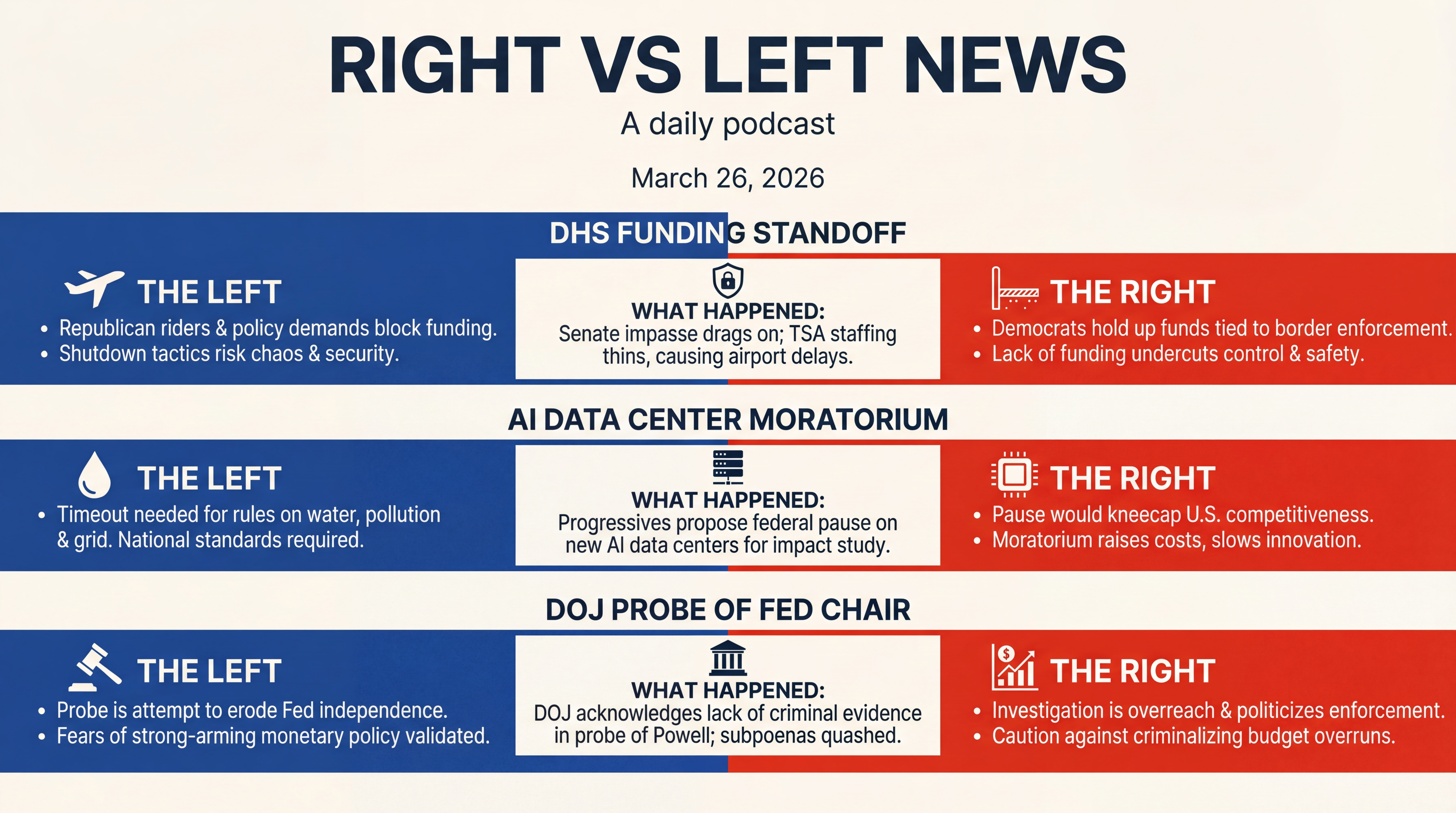
The DHS funding impasse in the Senate has dragged into another day, and the strain is showing at airport checkpoints as TSA staffing thins. Senators are in a high‑stakes stare‑down over enforcement conditions and how to handle broader administration priorities. Airport disruptions and absenteeism have mounted since the partial DHS shutdown began, and leadership changes haven’t stabilized operations. Talks ran late into Wednesday night... still no breakthrough.
On the right, commentators argue Democrats are holding up money tied to border enforcement and aviation security, and that keeping DHS unfunded undercuts border control and traveler safety.
On the left, voices focus on Republican policy riders and broader White House priorities folded into the bill. They’ve floated ideas like splitting off TSA funds or limiting interior‑enforcement dollars, warning that shutdown tactics risk chaos for travelers while hardening policies they oppose.
A new front in the AI debate is opening. Senator Bernie Sanders and Representative Alexandria Ocasio‑Cortez rolled out a bill to pause new AI data centers nationwide while the government studies power, water, and local impacts. It faces long odds — but it spotlights growing friction between rapid AI build‑outs and community and climate concerns.
On the right, critics say a pause would kneecap U.S. competitiveness with China. They favor requiring Big Tech to procure or build its own power — not halting projects — warning a moratorium could raise costs, slow innovation, and push investment abroad.
On the left, supporters frame it as a timeout to write rules on water use, backup‑generation pollution, and electricity costs that can shift to households. They point to state and local moves — including tighter data‑center siting rules in places like Florida — and call for national standards on siting, transparency, and grid impacts before another wave of projects.
The power struggle over the Fed continues. The Justice Department’s criminal probe into Fed Chair Jerome Powell — focused on testimony about the Fed’s headquarters renovation — took another hit. In a newly revealed transcript, prosecutors acknowledged they lack criminal evidence, following a March 11 ruling by Chief Judge James Boasberg that quashed subpoenas to the Fed and criticized the probe’s pretext.
On the right, some call the investigation an overreach that risks politicizing law enforcement and the Fed — even as others who are skeptical of the renovation’s costs caution against criminalizing budget overruns without evidence.
On the left, editorials cast the probe as part of a broader attempt to erode the Fed’s independence. They argue the court’s rebuke — and prosecutors’ concession — validate fears that law enforcement was being used to strong‑arm monetary policy. Notably, several Republican senators publicly defended Fed independence — a rare cross‑party alignment.
[MIDPOINT_SPONSORS]
U.S.–China diplomacy is getting a reset. The White House set May 14 and 15 for President Trump’s rescheduled summit with President Xi in Beijing. The original late‑March trip was postponed amid the administration’s focus on the Iran conflict, and Treasury Secretary Scott Bessent has been laying the groundwork with Vice Premier He Lifeng in Paris.
On the right, coverage frames the meeting as a chance to press Beijing on trade barriers, chip and AI controls, and fentanyl precursors — projecting strength after postponing the trip during a war crisis. Commentators urge sustained economic pressure, tight export‑control enforcement, and no concessions that could dull America’s tech edge.
On the left, many welcome renewed dialogue to steady trade ties and reduce military risk — but warn a headline summit shouldn’t overshadow labor, human rights, and climate leverage. They want clear benchmarks on de‑escalation, supply‑chain resilience, and curbing synthetic‑opioid flows.
A House ethics case hits a key date today. The House Ethics Committee moved Representative Sheila Cherfilus‑McCormick’s adjudicatory hearing to today — Thursday, March 26 — after her counsel withdrew earlier this month. Committee leaders announced the shift on March 3, part of a crowded month for oversight.
On the right, media often highlight ethics cases involving Democrats as a test of consistent enforcement, pressing for transparency and a firm timeline for resolution.
On the left, commentators emphasize due process and warn against politicizing committee work in an election year. They want methodical reviews, clear findings, and no trial‑by‑soundbite — especially with scheduling and representation changes in play.
Quick recap: Airports remain stressed as the DHS standoff drags on. A left‑led bill seeks a pause on AI data centers. The DOJ’s case against the Fed chair keeps eroding. A mid‑May summit between Trump and Xi is on the books. And a House ethics hearing lands today. We’ll keep tracking outcomes — and how each side frames them — so you can make up your own mind.
That's it for today's episode of Right versus Left News. Remember, understanding both sides isn't about picking a team—it's about being informed. Subscribe wherever you get your podcasts, and join us tomorrow for another balanced look at the day's biggest stories. Until next time, stay curious and stay informed.
