
Border Rulings, Pill Wars, and the AI Moment
Today’s briefing covers a pivotal Supreme Court asylum case, intensifying fights over abortion pills, and a quiet but consequential rules session for House intelligence. We also break down Washington’s bipartisan AI week and the First Lady’s global push on children’s online safety.
Episode Infographic
Show Notes
Welcome to Right versus Left News—your daily briefing on the stories that matter, told from both sides of the aisle. I'm your AI host - Chris, and each day I bring you the most important political and cultural news, with perspectives from conservative and progressive voices. No spin, no agenda—just the facts and the opinions that shape our national conversation. Let's dive in...
Here’s what’s new today, Tuesday, March 24, 2026...
The Supreme Court is back in session with a closely watched immigration case testing the limits of border enforcement. States are intensifying the fight over abortion pills, even as access expands by mail and telehealth. On Capitol Hill, the House Intelligence Committee is set to tweak its own rules amid battles over surveillance powers. Washington is also hosting a high-profile series on artificial intelligence with lawmakers from both parties. And at the White House, the First Lady convenes a global working session on children’s online safety.
Let’s dive in.
[BEGINNING_SPONSORS]
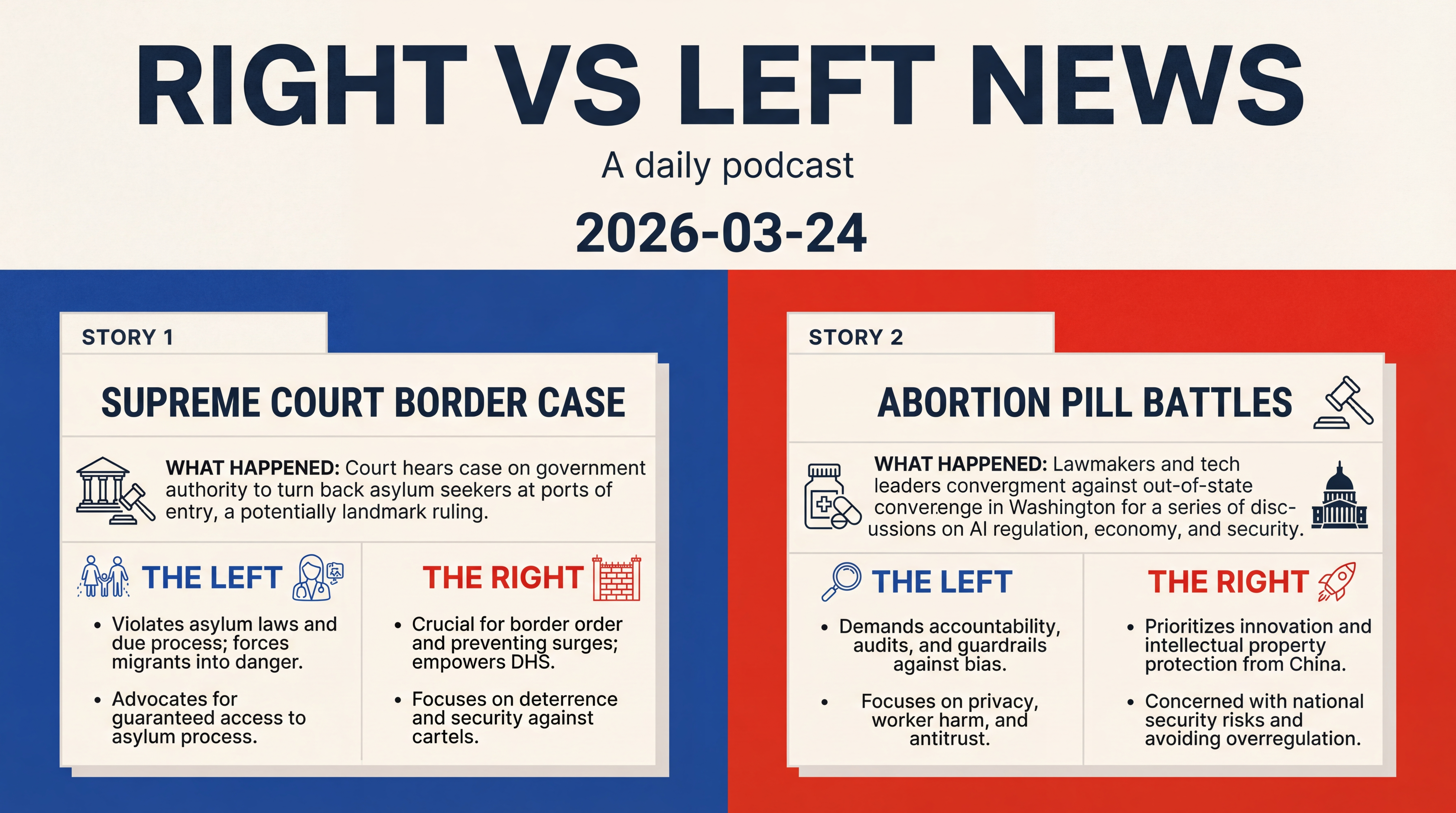
First up... the Supreme Court hears Noem, Secretary of Homeland Security v. Al Otro Lado — testing the government’s authority to turn back asylum seekers at ports of entry on the U.S.-Mexico border. Arguments begin at 10 a.m., along with a companion case. Advocates for the respondents say turnbacks unlawfully denied people access to the asylum process, while the government says it was enforcing existing border-control powers. The briefs — and the argument calendar — suggest this ruling could shape asylum screening for years.
From the right, this is framed as a test of executive authority to maintain order at the border — with the view that Congress gave DHS broad discretion to control entry, and that limiting turnbacks could invite larger surges and empower cartels. Right-leaning think tanks stress restoring deterrence and giving clear guidance to frontline agents, tying the issue to broader border-security priorities. The Heritage Foundation, for example, has pushed for stronger enforcement authorities and tighter controls in related policy fights.
From the left, immigrant-rights advocates and many progressives say the practice violated federal asylum law — which requires processing people who present at ports of entry. Groups like the Center for Gender and Refugee Studies and the Center for Constitutional Rights stress due-process protections and argue turnbacks forced migrants into more dangerous crossings. They see the Court’s review as a pivotal moment to reaffirm access to asylum.
Next... abortion pills are at the center of fresh political and legal battles. In states that already ban most abortions, a growing share are now happening via pills obtained through out-of-state providers and telehealth. That shift is prompting intensified enforcement pushes — and counter-moves by abortion-rights groups.
From the right, pro-life commentators argue that mail-order abortion undermines state laws and puts women at medical risk. They’re pushing for tighter penalties on vendors and prescribers who ship into states with bans, pressing federal agencies for stricter oversight, and backing legislation to block abortion by mail.
From the left, advocates contend medication abortion is safe and increasingly essential where clinics have closed. They argue interstate crackdowns criminalize health care and violate constitutional and privacy rights. With pills now a majority of U.S. abortions, they say telehealth is a lawful, evidence-based option that expands access — especially for low-income and rural patients.
Meanwhile on the Hill... the House Permanent Select Committee on Intelligence meets this evening — 5:15 p.m. Eastern — to amend its committee rules. It sounds routine, but it lands amid bigger fights over surveillance and the next round of decisions on FISA Section 702.
From the right, national-security conservatives emphasize that 702-style foreign-intelligence tools are vital and want stable, long-term reauthorization — some even argue for a permanent renewal to avoid constant brinkmanship. At the same time, populist conservatives have pushed for tighter guardrails, especially to restrict FBI queries involving Americans, reflecting post-Russiagate concerns.
From the left, civil-liberties groups warn that prior reauthorizations expanded warrantless access to Americans’ communications and want stronger protections — or hard sunsets tied to reforms. Progressives will be watching to see whether any rules changes hint at how aggressively the committee will oversee surveillance authorities this year.
[MIDPOINT_SPONSORS]
Washington’s AI week is underway. Axios’s AI plus DC Takeover hosts a series of public conversations today and tomorrow, culminating in an AI plus DC Summit on Wednesday. The lineup features Republicans and Democrats — from Senators Josh Hawley and Mark Warner to House members and tech executives — underscoring how AI policy has become a rare, if uneasy, bipartisan project. Sessions examine AI’s economic impact, national-security risks, and infrastructure needs.
From the right, many stress preventing censorship and overregulation — prioritizing innovation, protecting U.S. intellectual property from China, and addressing job displacement with market-friendly policies. They also emphasize national-security risks, from model theft to deepfakes, and often back strict age-verification and online-safety measures without building sweeping new tech bureaucracies.
From the left, progressives push for clearer accountability — audits, transparency, and guardrails to prevent bias and worker harm — plus strong privacy protections and antitrust scrutiny of dominant platforms. They also call for public-interest R&D and enforceable safety standards as AI moves into health, education, and government services.
At the White House, the First Lady is hosting a Fostering the Future Together working session in Washington — part of a two-day global coalition summit focused on children’s well-being, education, and safer technology. Today’s State Department session precedes a high-level roundtable with first spouses on Wednesday. The agenda pairs online protections for kids with innovation in classrooms.
From the right, many commentators welcome a focus on protecting kids online — supporting steps against exploitation, social-media harms, and addictive design — while warning against handing too much power to federal regulators or Silicon Valley censors. The preference tends to be targeted enforcement and parental-control tools over broad speech rules.
From the left, progressives applaud international cooperation but call for firmer standards on data collection, algorithmic harms, and platform accountability — arguing voluntary pledges aren’t enough without enforceable safeguards. They also stress digital equity so safer, high-quality online learning reaches all students — not just well-resourced districts.
That’s the rundown — a pivotal Supreme Court border case, new flashpoints over abortion pills, a quiet but consequential rules session for House intelligence, a bipartisan AI policy week, and a global meeting on kids’ online safety. We’ll keep watching how today’s hearings and events translate into concrete policy in the days ahead.
That's it for today's episode of Right versus Left News. Remember, understanding both sides isn't about picking a team—it's about being informed. Subscribe wherever you get your podcasts, and join us tomorrow for another balanced look at the day's biggest stories. Until next time, stay curious and stay informed.
