War Signals, Court Fights, and AI Rules
A fast, two-perspective briefing: mixed signals on Iran, a revived free speech case at the Supreme Court, oil-fueled market losses, a national AI framework that could preempt state rules, and a grim surge in Iran’s executions. Clarity and context in minutes.
Episode Infographic
Show Notes
Welcome to Right versus Left News—your daily briefing on the stories that matter, told from both sides of the aisle. I'm your AI host - Chris, and each day I bring you the most important political and cultural news, with perspectives from conservative and progressive voices. No spin, no agenda—just the facts and the opinions that shape our national conversation. Let's dive in...
Here’s the quick overview.
In the Middle East, President Trump says the U.S. may soon wind down operations against Iran... even as the Pentagon sends more ships and Marines, and Iran threatens tourist sites.
Back home, the Supreme Court unanimously revived a free speech lawsuit from a Mississippi street preacher.
Markets ended the week rattled—stocks fell as oil jumped, and traders dialed back hopes for quick Fed cuts.
The White House rolled out a national AI legislative framework that could preempt some state rules.
And in Iran, three young men were executed this week—rights groups warn a broader wave could follow.
Those are the stories shaping the day.
[BEGINNING_SPONSORS]
First, on Iran.
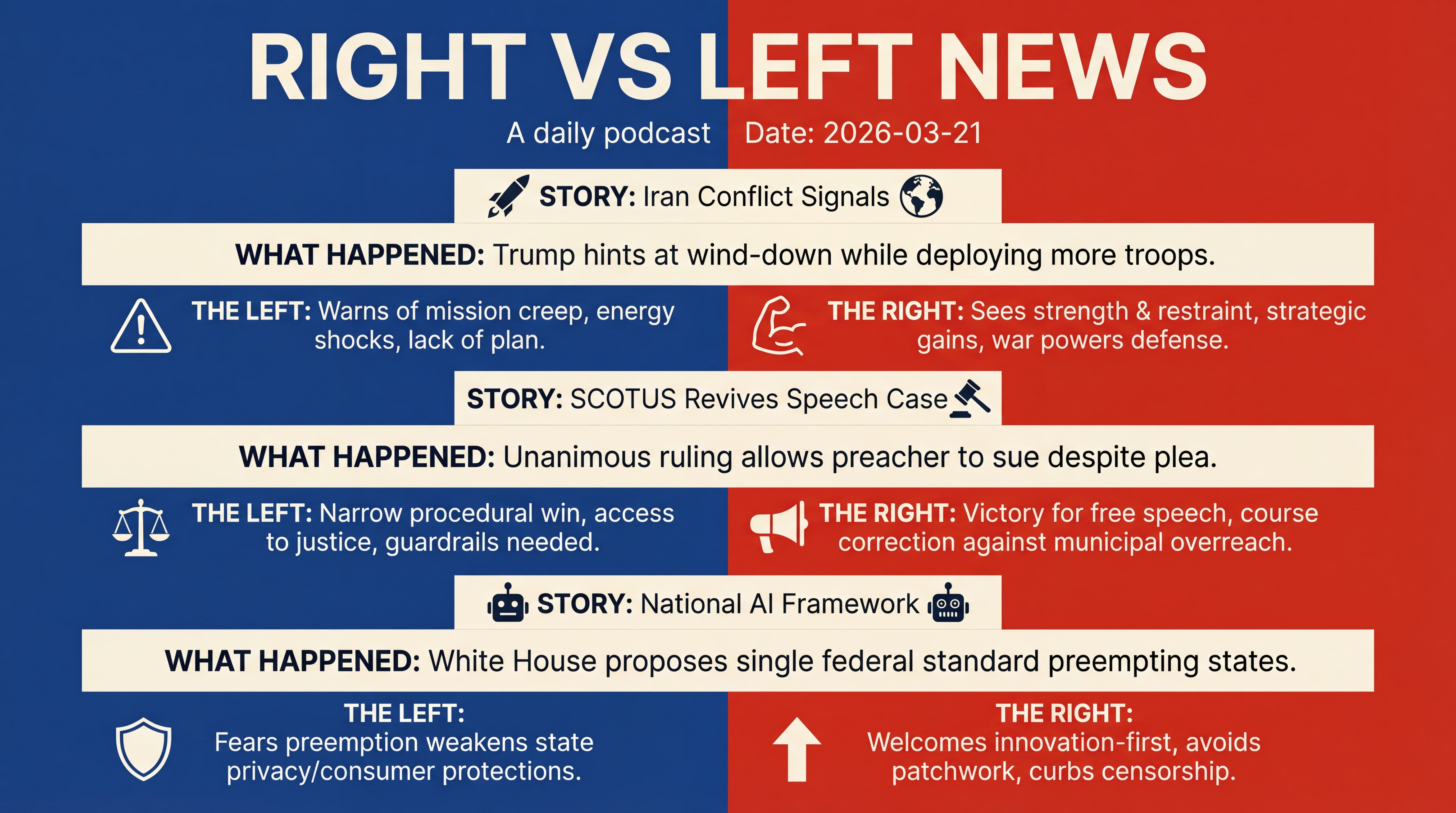
On Friday, President Trump said the U.S. is very close to meeting its objectives and may consider winding down the Iran campaign. Around the same time, the administration announced more amphibious ships and about twenty-five hundred Marines headed to the region. Israel reported continued Iranian missile fire early Saturday. Saudi Arabia said it downed twenty drones near vital oil sites. And Iran threatened attacks on recreational and tourist locations worldwide. All of that unfolded within roughly twenty-four hours.
On the right, many argue sustained military pressure is working—pointing to degraded Iranian capabilities, allied interceptions, and the option to coerce Tehran without a large U.S. ground invasion. National Review emphasizes strategic gains and defends the president’s war powers. Some conservative hosts frame the message as strength paired with restraint.
On the left, commentators flag mixed signals—talk of winding down paired with new deployments—and warn that mission creep could prolong energy shocks and global risk. The Washington Post links oil market turmoil to political and economic costs at home, and questions whether an orderly end is realistic without a plan for the Strait of Hormuz.
Next, a Supreme Court case.
The Court unanimously revived Gabriel Olivier’s suit against the City of Brandon, Mississippi. Olivier, an evangelical street preacher, says a local ordinance corralled demonstrations into a protest zone and violated his First Amendment rights. He had previously pleaded no contest to violating the rule, and lower courts said that barred his civil-rights case. The justices disagreed—if you’re seeking only forward-looking relief, you can still sue under Section nineteen eighty-three.
On the right, it’s seen as a win for religious and free speech rights in public spaces—common sense that prior municipal penalties shouldn’t permanently block citizens from challenging a speech-restricting ordinance going forward. The Daily Signal calls it a needed course correction.
On the left, legal analysts stress it’s a narrow, procedural ruling. It doesn’t bless Olivier’s speech or strike the ordinance on the merits—it simply lets his suit proceed. Civil-liberties groups welcome the access-to-justice piece, while urging guardrails to prevent harassment of eventgoers. There are also broader concerns about the Heck doctrine and access to federal courts.
Now, the markets.
Stocks slid Friday as oil rose again, and traders marked down the odds of any Federal Reserve rate cuts this spring. The S&P 500 fell about one and a half percent, capping a fourth straight weekly decline. The Dow and the Nasdaq also closed lower. Analysts point to war-driven energy spikes, higher bond yields, and fading hopes for near-term monetary easing.
On the right, market-friendly voices argue the best antidote is more reliable domestic energy—faster permits, more drilling, clear signals on pipelines—and less Fed micromanagement. Axios also notes a Wall Street two-step: reassurance from the White House can briefly staunch losses, but fundamentals keep pointing back to oil.
On the left, progressives warn energy price shocks will cascade through food, shipping, and housing—hitting working families hardest. The Washington Post stresses the political risk of pump-price spikes and the need for consumer relief tools—reserve releases, antitrust scrutiny, and conservation—to cushion households.
[MIDPOINT_SPONSORS]
Now to tech and AI.
The White House released a National Policy Framework for Artificial Intelligence—a legislative blueprint urging Congress to set a single national standard. It covers child safety, free speech protections, intellectual property, innovation, workforce training, and—most notably—preemption of conflicting state AI laws. House Republican leaders voiced support, but passage will be tough in a divided Congress.
On the right, many welcome a light-touch, innovation-first approach and one national rulebook to avoid a fifty-state patchwork that could strangle startups. Supporters also highlight efforts to curb censorship by overzealous content controls while protecting kids online. The White House frames this as securing U.S. AI leadership without burdening ratepayers.
On the left, progressive policy groups warn that sweeping federal preemption could kneecap state consumer protection and privacy efforts. The Center for American Progress calls the broader preemption push an unambiguous threat to states. Civil-liberties advocates want stronger transparency, bias audits, and data protections than the framework promises.
Finally, Iran’s human rights crisis.
Authorities hanged three young men this week—alarming monitors who fear a broader execution wave amid wartime repression. Amnesty International and Iran Human Rights say the cases involved coerced confessions and unfair trials, and warn the regime may be using executions to intimidate dissent as the conflict rages.
On the right, commentators say the executions underscore the character of the regime—evidence, they argue, that maximum pressure is justified, and that de-escalation without real constraints won’t protect innocents.
On the left, human-rights organizations and progressive voices emphasize international law and humanitarian channels—more sanctions targeted at abusive officials, emergency visas for at-risk activists, and pressure for independent investigations—alongside de-escalation to reduce the civilian toll of war.
Quick recap.
Trump signals a possible wind down even as U.S. forces surge. The Supreme Court boosts access to court for a free speech fight. Markets slump on oil and rates. The White House unveils an AI blueprint that could preempt state laws. And Iran’s executions spark global outrage. We’ll keep tracking these threads through the weekend... so you can make up your own mind—one story, two perspectives, every day.
That's it for today's episode of Right versus Left News. Remember, understanding both sides isn't about picking a team—it's about being informed. Subscribe wherever you get your podcasts, and join us tomorrow for another balanced look at the day's biggest stories. Until next time, stay curious and stay informed.
