
Illinois Votes, Lebanon Escalates, Markets Hold Breath
Illinois’ high-stakes primaries, Israel’s deeper push into Lebanon, the Fed’s pivotal meeting, storm-fueled flight chaos amid a DHS shutdown, and new Supreme Court recusal checks—here’s what’s happening and how the left and right are framing it. Clear context, fast updates, and the signals to watch next.
Episode Infographic
Show Notes
Welcome to Right versus Left News—your daily briefing on the stories that matter, told from both sides of the aisle. I'm your AI host - Chris, and each day I bring you the most important political and cultural news, with perspectives from conservative and progressive voices. No spin, no agenda—just the facts and the opinions that shape our national conversation. Let's dive in...
Here’s the quick rundown...
Illinois holds closely watched primaries today that could reshape its congressional delegation.
In the Middle East, Israel is pushing deeper into southern Lebanon as tensions among the U.S., Iran, and Israel widen—driving mass displacement.
Here at home, the Federal Reserve opens a two-day meeting that could set the tone for rates and markets this spring.
Travelers are still dealing with flight chaos after a major storm—made worse by a partial Homeland Security shutdown that’s straining TSA.
And at the Supreme Court, new conflict-checking rules quietly took effect yesterday, aimed at more transparent recusals.
[BEGINNING_SPONSORS]
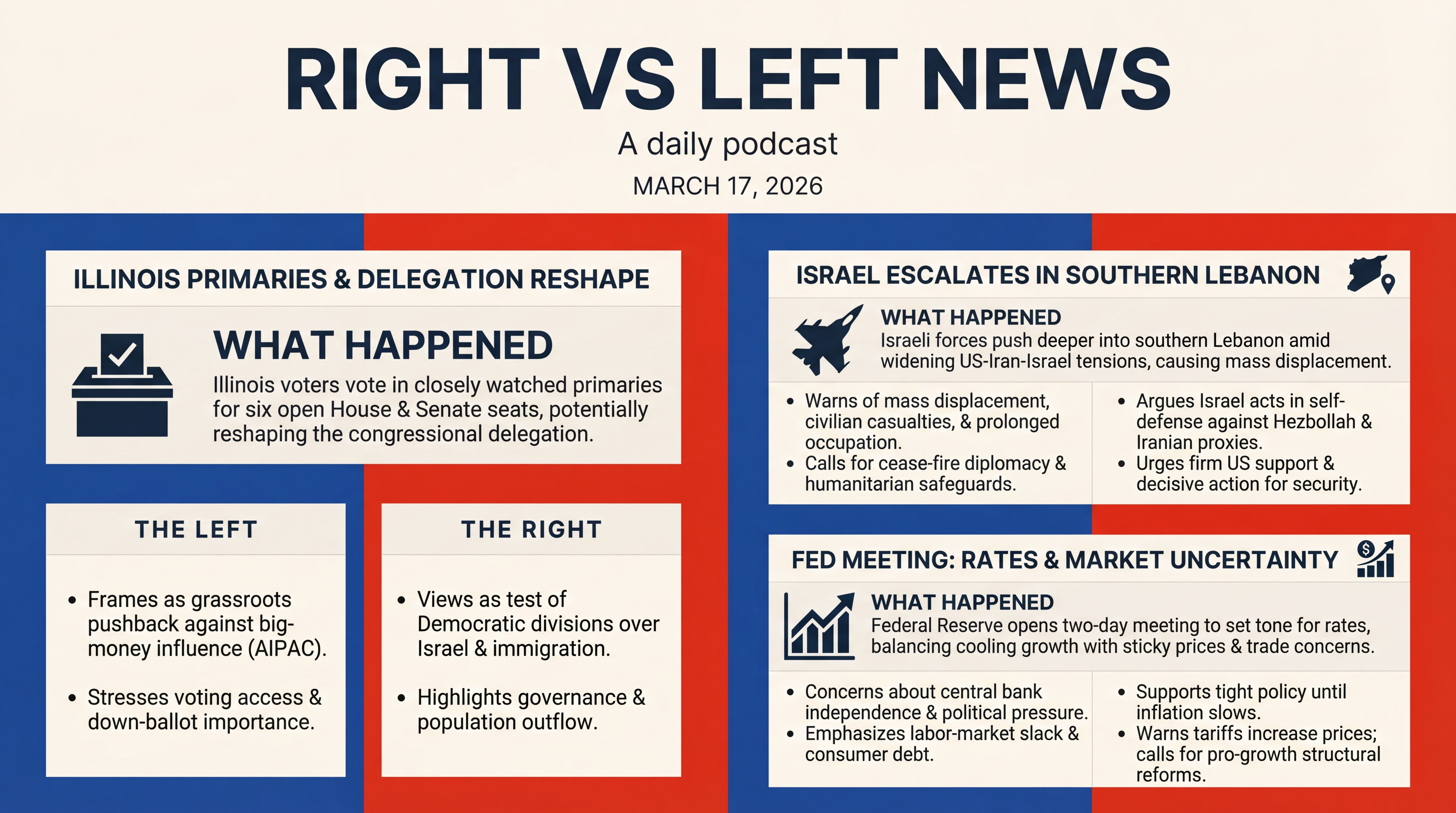
Illinois voters head to the polls today—Tuesday, March 17, 2026—with six open House and Senate seats. That’s an unusually high turnover, sparked by a wave of retirements.
In this deep-blue state, most primary winners will be favored in November. Polls in Chicago are open from 6 a.m. to 7 p.m. local time. Election officials are reminding voters about early voting options, vote-by-mail deadlines, and where to find their polling place.
On the right, commentators cast Illinois as a test of Democratic divisions over Israel and immigration. They’ve highlighted progressive attacks on AIPAC money in Democratic primaries and argue establishment candidates often talk tough about returning donations—without fully doing so.
Others point to governance in Illinois and population outflows as context for GOP messages on taxes and crime.
On the left, progressives frame the races as a grassroots pushback against big-money influence, saying AIPAC’s clout is waning as voters reassess U.S. policy toward Israel. They also stress voting access and the importance of down-ballot offices—from Cook County to the state legislature—where day-to-day change often happens.
With the region on edge after U.S. and Israeli strikes on Iran, Israeli forces are expanding ground operations in southern Lebanon. Plans call for a significant push to seize areas south of the Litani River.
Aid groups say the bombardment has displaced hundreds of thousands—approaching a million people—as strikes hit the south and neighborhoods in Beirut. Exact timelines vary, but the trend is clear: escalation on the ground and a worsening humanitarian strain.
On the right, commentary argues Israel is acting in self-defense against Hezbollah and Iranian proxies—urging decisive action and buffer zones to prevent attacks like those on October seventh. They say U.S. support should be firm and warn against pressuring Israel to halt before Hezbollah’s capacity is dismantled.
On the left, coverage warns about mass displacement, civilian casualties, and the risk of a prolonged occupation. The push is for cease-fire diplomacy and constraints on U.S. support without clearer humanitarian safeguards and a political end state.
The Federal Reserve begins its policy meeting today—March 17 and 18—with a decision due Wednesday. Markets are watching how the Fed balances cooling growth signals with still-sticky prices, and how new trade surcharges and uncertainty feed into the outlook.
On the right, analysts say the Fed was right to pause cuts in January and should keep policy tight until inflation convincingly slows. Protectionist tariffs, they argue, risk pushing prices higher. They call for structural, pro-growth reforms—fewer regulations and more predictable trade policy—so the Fed isn’t carrying the entire burden.
On the left, the discussion has revived concerns about central bank independence amid the nomination of Kevin Warsh to chair the Fed. Some center-left economists caution against political pressure for rapid rate cuts. Expect progressives to emphasize labor-market slack, consumer debt burdens, and guardrails to keep the Fed’s mandate free from short-term politics.
[MIDPOINT_SPONSORS]
Hundreds of flights were canceled or delayed this morning after a sprawling March 13 to 17 storm dumped snow across the Midwest and pushed severe weather toward the East. The mess has compounded existing airport slowdowns as TSA staffing strains continue during a partial DHS shutdown—now weeks old—creating long security lines at major hubs.
Industry leaders and airline CEOs are urging Congress to restore DHS funding to stabilize operations.
On the right, House Homeland Security Republicans blame Senate Democrats for prolonging the impasse—calling the shutdown unsustainable for national security and pointing to hours-long TSA lines as proof that politics is getting in the way of safety. They also accuse Democrats of tying DHS funding to unrelated fights over war powers and immigration.
On the left, center-left and nonpartisan outlets note that airport workers and travelers are collateral damage. They’re pressing for immediate pay protections or carve-outs for aviation security during any stalemate, highlighting steps like restarting Global Entry—while labor groups and travel associations urge lawmakers to pay TSA on time during funding lapses.
The Supreme Court’s revised rules took effect Monday, March 16, adding technical requirements to feed new software that runs automated recusal checks—comparing parties and attorneys against lists maintained by each justice’s chambers. The Court says the tool supplements existing conflict screening, and the Clerk will update guidance to match.
On the right, legal commentators generally welcome administrative steps that improve transparency, while arguing that ethics debates shouldn’t be used to delegitimize the Court’s rulings.
On the left, critics call the move incremental and insufficient without an externally enforceable ethics code, tougher disclosure, and clearer, binding recusal standards. Some urge Congress—or an independent body—to set real rules.
Quick recap... Illinois primaries could reset the state’s delegation. Israel’s push into Lebanon raises the stakes—and the humanitarian toll. The Fed meets as tariffs and growth jitters collide. A big storm—and a DHS funding fight—snarl travel. And the Supreme Court rolls out conflict-checking rules... but the ethics fight isn’t over.
We’ll be watching results through Wednesday’s close—and the Fed decision tomorrow.
That's it for today's episode of Right versus Left News. Remember, understanding both sides isn't about picking a team—it's about being informed. Subscribe wherever you get your podcasts, and join us tomorrow for another balanced look at the day's biggest stories. Until next time, stay curious and stay informed.
