Gulf Escalation, Taiwan Tensions, Oscars on Edge
A rapid tour of the day's flashpoints — from the Gulf war's widening reach and Taiwan's air incursions to strikes on Kyiv and a high-security Oscars — plus how both sides frame the stakes and what rising oil means for U.S. politics. Facts, context, and the domestic fallout.
Episode Infographic
Show Notes
Welcome to Right versus Left News—your daily briefing on the stories that matter, told from both sides of the aisle. I'm your AI host - Chris, and each day I bring you the most important political and cultural news, with perspectives from conservative and progressive voices. No spin, no agenda—just the facts and the opinions that shape our national conversation. Let's dive in...
It’s Sunday, March 15, 2026. In the past 24 hours, the Middle East conflict has spilled further into the Gulf, China has amped up aerial pressure on Taiwan, Russia has struck the Kyiv region, and here at home, Hollywood’s biggest night is unfolding under tighter security. We’ll break down what happened, what it means, and how the right and the left are framing it — plus the domestic political fallout of a war nudging oil over one hundred dollars a barrel.
[BEGINNING_SPONSORS]
Let’s start in the Gulf.
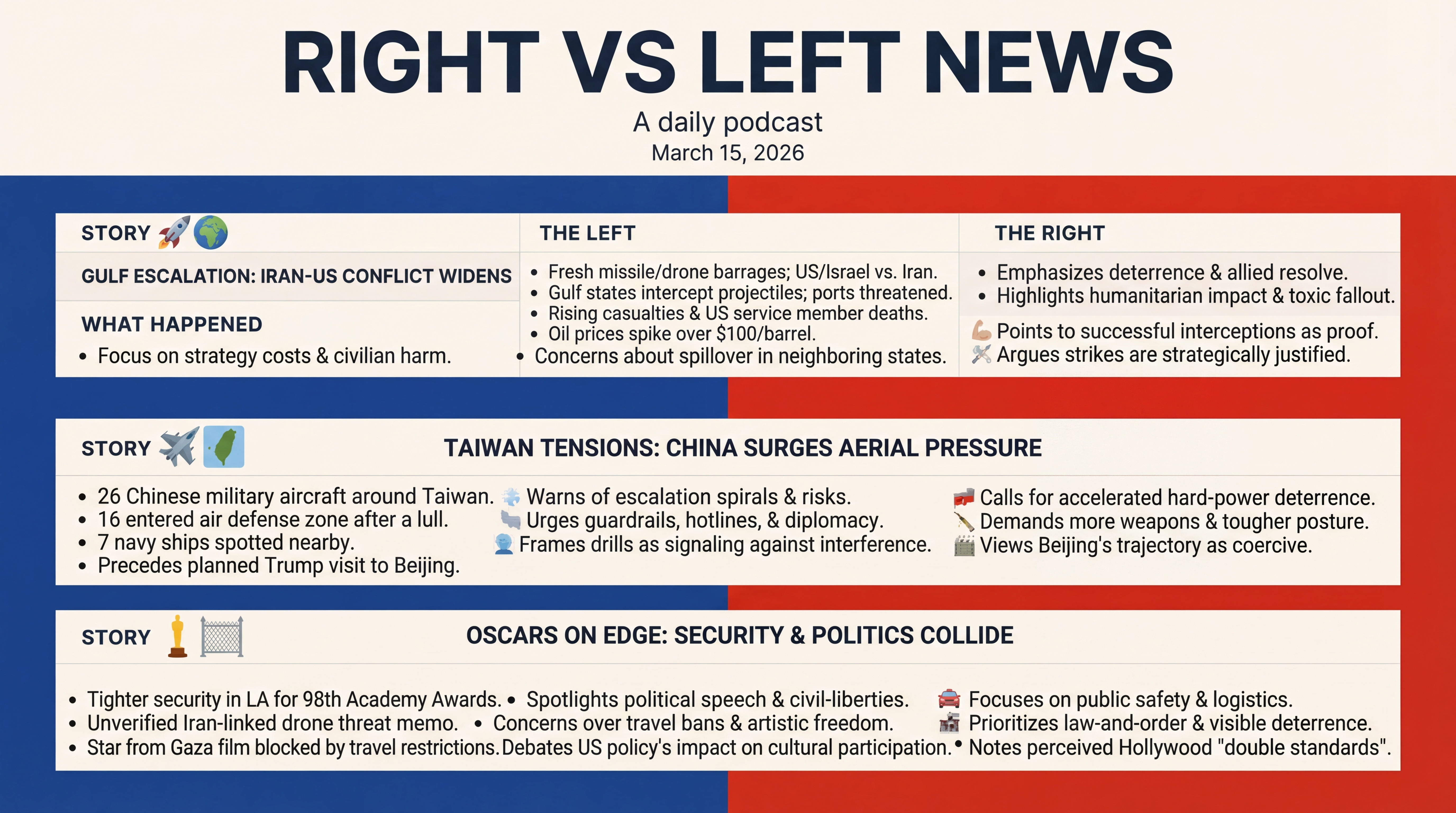
Here’s what happened... Gulf states reported fresh missile and drone barrages as the war between the United States and Israel on one side — and Iran on the other — entered week three. Bahrain, Saudi Arabia, and the United Arab Emirates said they intercepted incoming projectiles after Tehran threatened to widen its campaign and even warned major Emirati ports to evacuate. President Trump urged allies to send warships to help keep the Strait of Hormuz open. Officials are counting rising civilian casualties, and at least 13 U.S. service members have been killed since the conflict began on February 28th, according to the Associated Press.
On the right, the emphasis is on deterrence and allied resolve. Conservative outlets highlight Iran’s continued launches and point to successful interceptions as proof that sustained pressure is working. National Review argues the strikes are legally and strategically justified — while cautioning that rising costs could hit Americans’ wallets.
On the left, the focus is on strategy, costs, and civilian harm. Analysis from the Associated Press notes the White House is on its heels as American casualties, higher fuel prices, and market jitters raise voter concerns. Reporting from Tehran has underscored the humanitarian impact of fuel depot strikes — describing toxic smoke and black rainfall — bolstering calls for restraint. Al Jazeera has zeroed in on spillover across borders and the toll in neighboring states.
Now to the Taiwan Strait.
Here’s what happened... Taiwan’s defense ministry reported a surge of 26 Chinese military aircraft around the island on Saturday — 16 entered its air defense identification zone — after an unusual two-week lull. Seven Chinese navy ships were also spotted nearby. Analysts note the lull coincided with China’s legislative meetings and comes weeks before a planned Trump visit to Beijing at month’s end.
On the right, commentators see the spike as a reminder to accelerate hard-power deterrence — more interoperable weapons, a tougher posture, and a sustained presence. The view is that Beijing’s pressure campaign demands greater U.S. and Taiwanese readiness... and that the People’s Liberation Army’s long-term trajectory still points to coercion.
On the left, voices warn of escalation spirals and urge guardrails — re-opening military hotlines, managing arms sales, and tying deterrence to diplomacy. Opinion pieces argue that U.S. moves like recent arms packages risk hardening Beijing’s response if not paired with de-escalatory engagement. Coverage of earlier drills frames them as signaling against external interference — underscoring the need for crisis management as flights resume.
Over to Ukraine.
Here’s what happened... A combined Russian missile and drone strike on the Kyiv region killed at least four people and wounded 15, according to regional officials. The Associated Press reports the attacks targeted energy infrastructure and came as U.S.-brokered talks have stalled, with both Kyiv and Moscow claiming incremental gains along the front.
On the right, one prominent strand argues for continued material support to Ukraine as a check on Russian aggression — and on China’s ambitions — while also criticizing Western military readiness. The message: help Ukraine now, but posture the United States better for great-power competition.
On the left, progressives condemn the strikes, back humanitarian and defensive aid, and call for renewed diplomacy — warning that attention diverted by the Iran war could weaken Ukraine’s position and prolong suffering. Updates about delayed talks and renewed strikes fuel arguments that Washington needs to re-energize a credible negotiation track alongside defenses.
[MIDPOINT_SPONSORS]
Back home, it’s Oscars Sunday in Los Angeles — and security is tighter than usual.
Here’s what happened... The Academy detailed street closures around the Dolby Theatre for the 98th Academy Awards, while local outlets reported heightened readiness after an FBI memo about a potential, though unverified, Iran-linked drone threat. California’s governor said there’s no imminent threat, but agencies are in a prepared posture. Separately, reporting says a star of an Oscar-nominated film about a Palestinian child killed in Gaza can’t attend because of Trump-era travel restrictions.
On the right, the emphasis is on public safety and on what conservatives call Hollywood double standards — heavy fences and armed details for a glamorous event, even as progressive voices often criticize policing. Local coverage has focused on logistics and closures, reflecting a law-and-order framing that prioritizes smooth operations and visible deterrence.
On the left, progressive outlets and arts writers are spotlighting political speech around the ceremony, potential protests, and civil-liberties concerns — from travel restrictions to how activist messages are treated on the red carpet. The travel-ban story has intensified debate over whether U.S. policy is preventing legitimate cultural participation tied to the war in Gaza.
Zooming back out to U.S. politics...
Here’s what happened... Two weeks into the Iran war, the Associated Press says President Trump is facing growing domestic headwinds. American casualties, higher pump prices as oil hovers around or above one hundred dollars a barrel, and choppy markets have made it harder to sell the strategy. The White House is urging allies to help secure energy routes — while warning Iran of more strikes.
On the right, some conservatives say the war’s costs must be weighed but argue that projecting strength is vital to restore deterrence — and that short-term price spikes can be managed if Hormuz is secured. Others worry the conflict could undercut Republicans’ affordability message ahead of the midterms — as the Washington Examiner notes, strategists fear kitchen-table concerns will dominate if energy prices stay elevated.
On the left, progressives are hammering the administration for an unclear endgame — tying inflation worries to a conflict they see as escalatory and discretionary. They argue Congress should reassert war-powers oversight and pair any regional security moves with urgent diplomacy to contain energy shocks.
Quick recap... In the Gulf, Iran’s barrages met allied defenses while Washington sought a broader naval coalition. Over Taiwan, Chinese flights ticked back up. In Ukraine, Russian strikes hit civilians as talks languish. In Los Angeles, the Oscars roll under heavier security and fresh policy controversy. And at home, war-driven price pressure is shaping the 2026 political map.
We’ll keep tracking the facts — and the arguments on both sides — so you can decide where you land.
That's it for today's episode of Right versus Left News. Remember, understanding both sides isn't about picking a team—it's about being informed. Subscribe wherever you get your podcasts, and join us tomorrow for another balanced look at the day's biggest stories. Until next time, stay curious and stay informed.
