Court Cuts Tariffs, Baghdad Strike, UFO Files
The Supreme Court trims Trump’s tariff program, a drone hits a U.S. facility in Baghdad, Trump vows UFO file releases, Democrats dig into library settlement funds, and Montana’s Senate map shifts — with clear context and what both sides are saying. Fast, fair, and focused so you can decide.
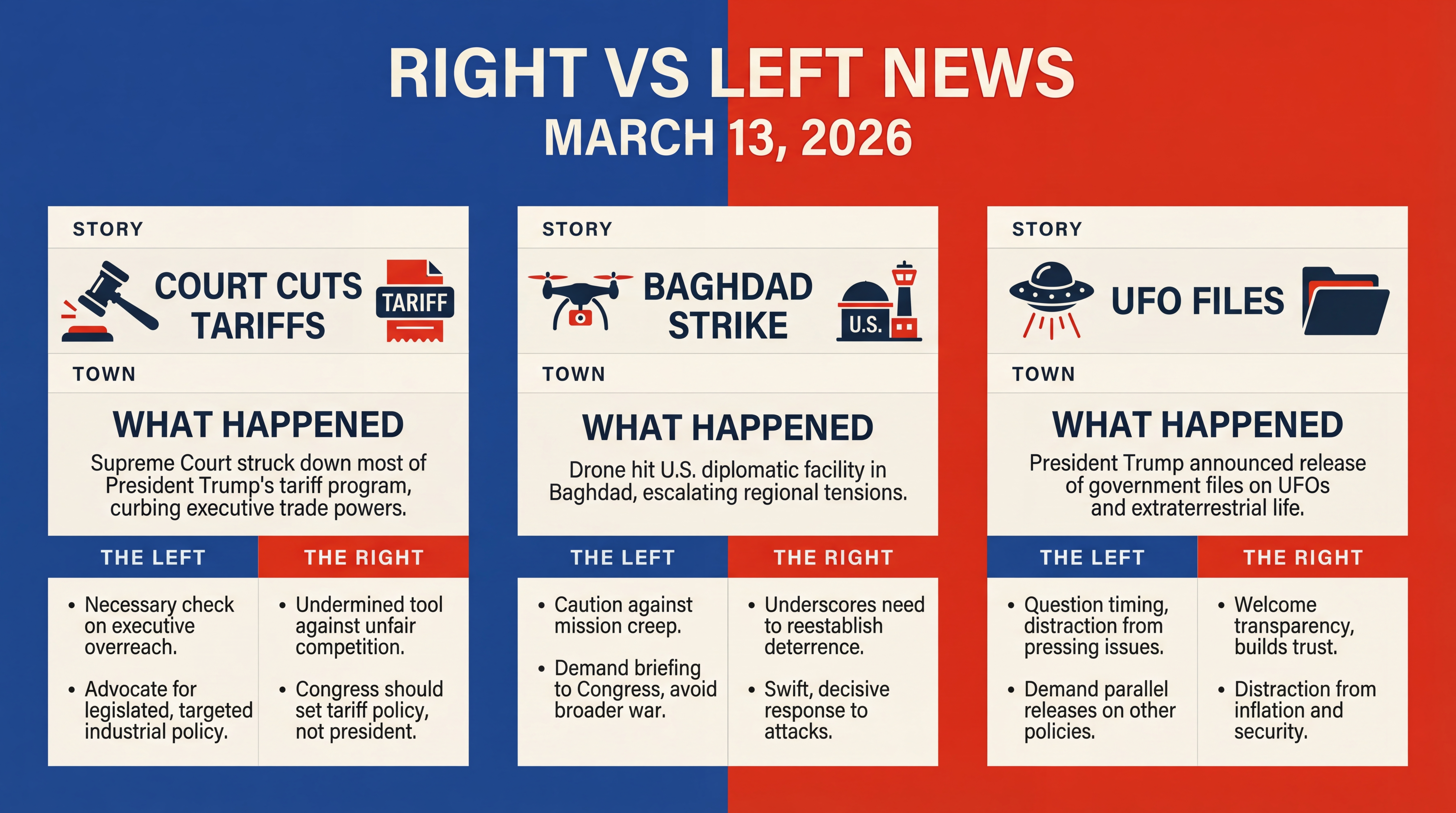
Episode Infographic
Show Notes
Welcome to Right versus Left News—your daily briefing on the stories that matter, told from both sides of the aisle. I'm your AI host - Chris, and each day I bring you the most important political and cultural news, with perspectives from conservative and progressive voices. No spin, no agenda—just the facts and the opinions that shape our national conversation. Let's dive in...
It’s Friday, March 13, 2026... here’s what’s on tap.
The Supreme Court curtailed much of the administration’s tariff program, setting up a new fight over presidential trade powers. Violence in the Middle East rippled outward as a drone strike hit a major U.S. diplomatic facility in Baghdad. At home, President Trump says he’ll release government files on UFOs and extraterrestrial life. Democrats are probing what happened to tens of millions of dollars tied to settlements with media and tech firms for the Trump presidential library. And in campaign news, Senator Steve Daines says he won’t run again in Montana — reshaping the midterm battlefield.
We’ll lay out what happened, and what the right and the left are saying... so you can decide. These developments broke between Wednesday and this morning, as reported by The Washington Post.
[BEGINNING_SPONSORS]
First up... the Supreme Court ruling.
This week, the Court struck down most of President Trump’s tariff program — a major blow to a centerpiece of his economic agenda. The full opinion is still being parsed, but the immediate effect is to curb the White House’s ability to unilaterally levy broad import duties. Trade lawyers, manufacturers, and retailers are scrambling to understand which product lines are covered — and what relief might come next. The president blasted the justices and vowed to find other ways to protect domestic industry. The decision landed Wednesday and reverberated into this morning’s market chatter.
On the right, opinion is split. Economic nationalists argue the Court undermined a needed tool to counter unfair competition from China and to onshore critical supply chains. Others with free-trade leanings say Congress — not the executive — should set tariff policy, and that rolling back broad levies could relieve pressure on consumers and small businesses already hit by inflation and high borrowing costs. The debate on the right continues over how far to go with protectionism in a wartime economy.
On the left, many see a necessary check on executive overreach. They argue the tariffs worked like a tax on consumers and farmers — and that any strategic industrial policy should be legislated, targeted, and paired with competition enforcement rather than sweeping duties. Expect Democratic calls for a narrower, Congress-led framework focused on semiconductors, critical minerals, and clean energy supply chains — instead of across-the-board tariffs.
Quick pivot...
A drone struck a major U.S. diplomatic facility in Baghdad on Wednesday, as regional violence intensified in the wake of conflict with Iran. Reporting suggests the attack was likely carried out by a militia aligned with Tehran. U.S. officials were assessing damage and potential injuries as of last night, and the incident has renewed debate in Washington over escalation risks and the safety of American personnel across the region.
The right argues this underscores the need to reestablish deterrence against Iran’s proxies — through targeted strikes, tighter sanctions enforcement, and stronger air defenses around U.S. posts. Some say wavering responses only invite more attacks, and that any future strike on Americans should be met swiftly and decisively.
Voices on the left caution against mission creep. They want the administration to brief Congress, seek clear authorization for any expanded military action, and avoid steps that could spiral into a broader war — especially with fuel prices and global shipping already volatile. They also press for intensified diplomacy with Iraqi leaders to constrain militias and reduce the risk to U.S. personnel.
On we go...
President Trump said Wednesday he will release government files related to UFOs and possible evidence of extraterrestrial life. The announcement came alongside other high-profile disclosures and was framed by the president as an overdue act of transparency. Agencies are now fielding questions about what can be declassified without compromising sources and methods.
On the right, some welcome the push for sunlight — arguing that open files build trust and could debunk myths. Others roll their eyes, calling it a sideshow that distracts from inflation, border security, and the war footing abroad.
On the left, critics question the timing. They ask whether the UFO focus is meant to dominate headlines and shift attention from more pressing oversight fights. Transparency is fine, they say, but they want parallel releases on pandemic decision-making, immigration enforcement directives, and industrial policy waivers — areas with immediate impact on people’s lives.
[MIDPOINT_SPONSORS]
Democrats are asking what happened to tens of millions of dollars tied to settlements from ABC, Meta, Paramount, and X — funds reportedly earmarked for President Trump’s presidential library. House Democrats want documentation detailing how much was paid, where the money sits now, and whether any terms shifted after the agreements were reached. The inquiry gathered steam Wednesday and carried into today.
Conservative outlets characterize the scrutiny as partisan theater — another attempt to keep the former president on defense. Some argue private settlements involving media and tech companies are being selectively framed to imply impropriety, and they call for equivalent energy on transparency questions in blue-run states and institutions.
The left points to long-running concerns about money and influence in presidential foundations. They say the public deserves clarity on any arrangements involving corporations that do business with the federal government — and they want strict guardrails to prevent donor-driven sway over exhibits, archives access, or public programming.
And finally... Montana.
Senator Steve Daines announced he will not seek reelection, setting off a scramble in both parties and adding fresh uncertainty to the 2026 Senate map. The decision — made public Wednesday — immediately triggered endorsements and phone calls as Republicans sought to clear a lane for a successor, while Democrats assessed whether a high-profile recruit could make the race competitive in a red-leaning state.
On the right, strategists say the GOP remains favored in Montana, given recent voting trends and the state’s preference for Republicans up and down the ballot. Expect quick consolidation behind a Trump-aligned candidate and a message centered on energy jobs, border security, and opposition to what they call Biden-era regulatory overreach.
On the left, Democrats see an opening around candidate quality. They argue that an open seat softens the incumbent advantage, and that a moderate with strong local ties — especially on public lands, abortion rights, and housing — could force Republicans to spend heavily here instead of focusing purely on offense. National Democrats are expected to test messages tying GOP hopefuls to unpopular tariff shocks and the war’s economic spillovers.
That’s our rundown for Friday, March 13. We covered a Supreme Court trade shock, a dangerous strike on a U.S. site in Baghdad, a high-profile declassification pledge on UFO files, a money-trail fight over a presidential library, and a Senate shakeup in Big Sky Country. Different stories, same mission — facts first, then the best of both sides... so you can make up your own mind. We’ll be back tomorrow with the latest.
That's it for today's episode of Right versus Left News. Remember, understanding both sides isn't about picking a team—it's about being informed. Subscribe wherever you get your podcasts, and join us tomorrow for another balanced look at the day's biggest stories. Until next time, stay curious and stay informed.
