Runoff Rumblings, Abortion Battles, and Wildfire Warnings
We break down Georgia’s special election, Wyoming’s six-week abortion law, a major federal workforce rule, the CDC’s measles surge, and Texas’s wildfire emergency — and how both sides are framing each story. Quick, clear context to navigate today’s political landscape.
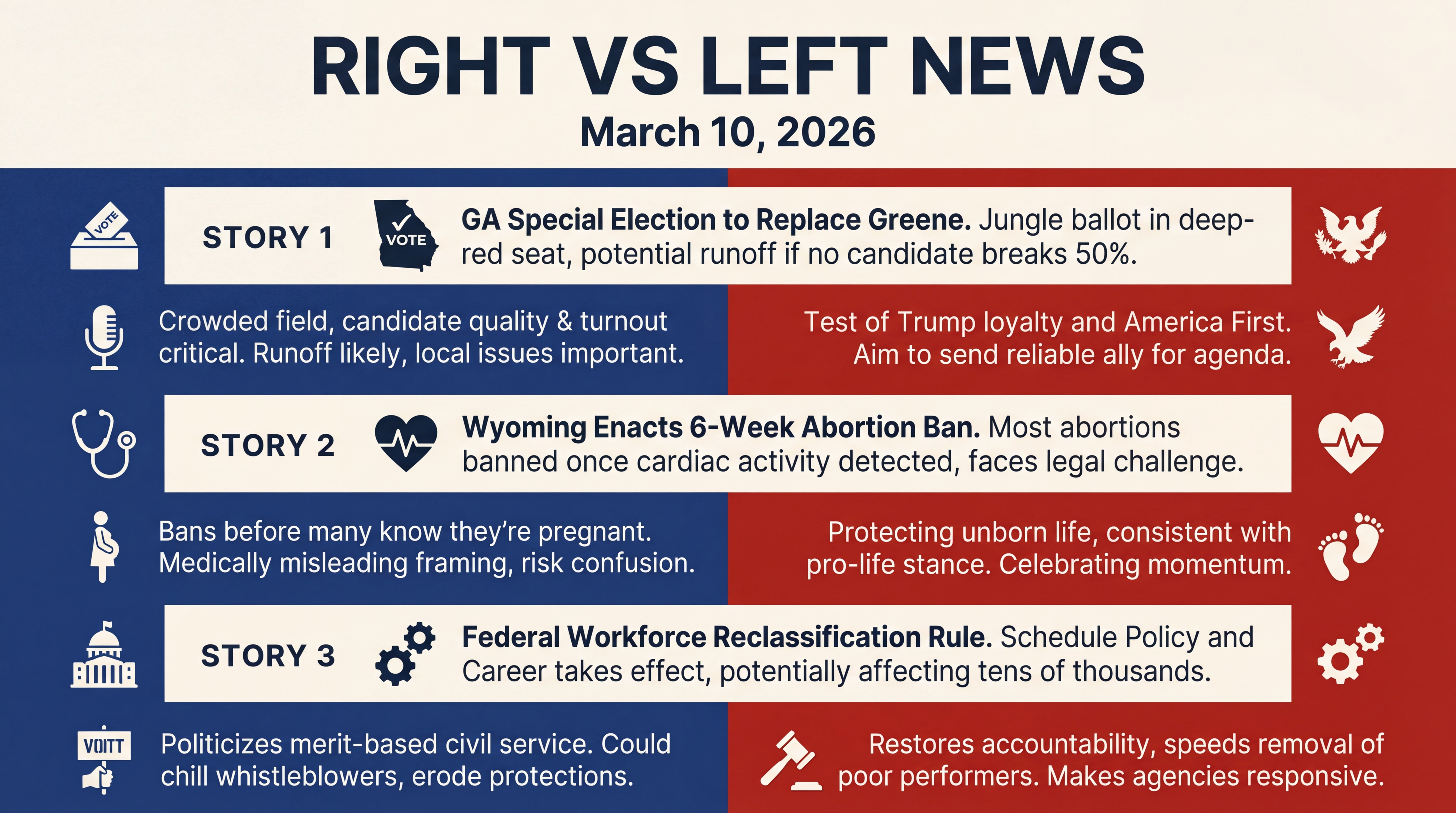
Episode Infographic
Show Notes
Welcome to Right versus Left News—your daily briefing on the stories that matter, told from both sides of the aisle. I'm your AI host - Chris, and each day I bring you the most important political and cultural news, with perspectives from conservative and progressive voices. No spin, no agenda—just the facts and the opinions that shape our national conversation. Let's dive in...
Here’s what we’re watching across the political landscape today.
Voters in northwest Georgia are heading to the polls to replace Marjorie Taylor Greene after her January resignation. Wyoming just enacted a six-week heartbeat abortion ban, immediately sparking legal and medical pushback. In Washington, a major civil service rule known as Schedule Policy and Career quietly took effect — potentially reclassifying tens of thousands of federal jobs. Public health officials are scrambling as the CDC surges support to states battling measles outbreaks. And in Texas, Governor Greg Abbott renewed a wildfire disaster proclamation as fire danger remains high.
We’ll break down what happened... and how the right and the left are framing each story.
[BEGINNING_SPONSORS]
First up — Georgia’s special election.
Here’s what happened... After Marjorie Taylor Greene resigned in early January, Georgia’s 14th Congressional District holds a special election today — Tuesday, March 10. It’s a jungle ballot — all candidates on one line — with a potential April 7 runoff if no one tops 50 percent. The Associated Press says Republicans Clay Fuller and Colton Moore, and Democrat Shawn Harris, are among the leading contenders in this solid-red seat.
On the right, conservative outlets frame the race as a test of loyalty to President Trump and America First. Fox News highlighted the timing and the district’s deep GOP tilt, noting the Cook Political Report rates GA-14 as safely Republican. The pitch to voters is simple — send a reliable ally for Trump’s agenda, avoid intraparty drama, and keep the district aligned with the White House.
On the left, reporters point to unusual dynamics — a crowded field, Greene’s public break with the president, and the idea that even in a safe seat, candidate quality and turnout matter. The Washington Post and the AP emphasize that a runoff is likely, and that local issues — from infrastructure to federal benefits — could shape who advances.
Next — Wyoming’s six-week abortion ban.
Here’s what happened... On Monday, March 9, Governor Mark Gordon signed the Human Heartbeat Act, banning most abortions once cardiac activity is detected — around six weeks — with limited exceptions. That makes Wyoming the fifth state with a ban at that threshold. Gordon acknowledged potential legal challenges, given recent Wyoming court rulings.
On the right, pro-life advocates and local conservative media hailed the move as protecting unborn life. Outlets in the state emphasized Gordon’s view that the bill is consistent with a pro-life stance, while groups like National Right to Life celebrated momentum — even as they anticipate courtroom fights.
On the left, medical groups and civil liberties advocates argue six-week bans come before many people know they’re pregnant and risk confusion for doctors. Public radio in Wyoming highlighted ACOG’s warning that heartbeat framing can be medically misleading, while civil rights groups say they’ll challenge the law’s constitutionality under Wyoming precedent. Even the governor has voiced concerns about impacts on vulnerable populations.
Now — a big federal workforce shift.
Here’s what happened... A new Office of Personnel Management rule creating Schedule Policy and Career — the successor to the short-lived Schedule F — took effect this week, on March 9. The rule enables reclassification of certain policy-influencing civil service roles into a category with fewer job protections, subject to presidential direction. OPM guidance and federal workforce outlets say conversions can move forward now that the rule is active.
On the right, supporters — including Americans for Prosperity — argue the change restores accountability, speeds the removal of poor performers, and makes agencies more responsive to elected leadership. The White House frames it as common-sense reform to align policy roles with the administration’s mandate.
On the left, unions and good-government groups warn the rule politicizes the merit-based civil service and could chill whistleblowers. AFGE has raised concerns that reclassified workers could lose incentives and protections, undermining nonpartisan expertise. Academic and advocacy groups caution that sweeping excepted-service changes erode long-standing guardrails.
[MIDPOINT_SPONSORS]
Next — the measles response escalates.
Here’s what happened... Amid growing outbreaks, the CDC on Monday, March 9, announced it’s reinforcing support to states — spotlighting coordination with South Carolina and North Carolina — and pushing MMR vaccination as the best tool to prevent spread. Health briefings warn that surging cases risk the United States losing its measles elimination status if chains of transmission aren’t interrupted. Health policy reporting also notes the political fight around vaccines and the surgeon general nomination.
On the right, commentators are trying to walk a line: many physicians urge vaccination to stop measles, but some argue public trust was weakened by heavy-handed COVID policies — so messaging should stress informed consent over mandates. Senator Bill Cassidy has pressed the administration’s surgeon general pick on vaccine guidance amid the outbreaks.
On the left, outlets stress the urgency of halting spread and critique mixed signals from political leaders. They argue that minimizing standard vaccine schedules — or ambiguity from top officials — can sow confusion at the worst time. The CDC’s message is back to basics: surge resources and boost MMR uptake.
Finally — Texas renews its wildfire emergency.
Here’s what happened... On Monday, March 9, Governor Greg Abbott amended and renewed the state’s disaster proclamation for fire-weather conditions — authorizing emergency measures and suspensions of certain procurement rules to speed response. It comes as parts of Texas face elevated fire risk heading into spring.
On the right, Texas leaders emphasize rapid response, flexible contracting to move resources, and a focus on land management and utility hardening to prevent ignition. They cast the proclamation as decisive governance that cuts red tape when lives and property are at stake.
On the left, policy analysts often tie the growing fire threat to climate change and call for stronger grid oversight, mitigation funding, and support for local departments. Advocates cite past reporting on post-fire reforms and argue state and federal leaders must invest more in prevention and resilience — not just disaster declarations.
Quick recap... Georgia’s special election could head to a runoff in a deep-red seat. Wyoming’s six-week abortion law is headed for court fights. A major civil service rule just took effect in Washington. The CDC is surging measles response as cases climb. And Texas is bracing for fires with a renewed disaster order.
We’ll keep tracking results, rulings, and reactions — and we’ll be back tomorrow with what changes next.
That's it for today's episode of Right versus Left News. Remember, understanding both sides isn't about picking a team—it's about being informed. Subscribe wherever you get your podcasts, and join us tomorrow for another balanced look at the day's biggest stories. Until next time, stay curious and stay informed.
