
Five Friday Flashpoints: Records, Schools, IDs, Cuba
From newly released Epstein files to a contentious Virginia education bill, Kansas’s ID rules, a nationwide voucher tax credit, and a DOJ move on Cuba—we break down what happened and why it matters. Clear summaries, key perspectives, and what to watch next.
Episode Infographic
Show Notes
Welcome to Right versus Left News—your daily briefing on the stories that matter, told from both sides of the aisle. I'm your AI host - Chris, and each day I bring you the most important political and cultural news, with perspectives from conservative and progressive voices. No spin, no agenda—just the facts and the opinions that shape our national conversation. Let's dive in...
Today we’re covering five fast-moving stories from Friday, March 6.
First, the Justice Department posted additional Jeffrey Epstein records that include allegations naming President Trump—sparking a new round of political crossfire. Second, Virginia lawmakers moved to restrict how January 6 is taught in public schools. Third, Kansas is enforcing a law that forces some transgender residents to surrender or reissue driver’s licenses—raising civil-rights concerns. Fourth, a new federal school-voucher tax credit is putting pressure on Democratic governors to opt in—or risk leaving money on the table. And fifth, the Justice Department has formed a working group eyeing possible charges against Cuban officials—with big foreign-policy implications, especially in Florida.
Our main sourcing today comes from The Washington Post and Fox News.
[BEGINNING_SPONSORS]
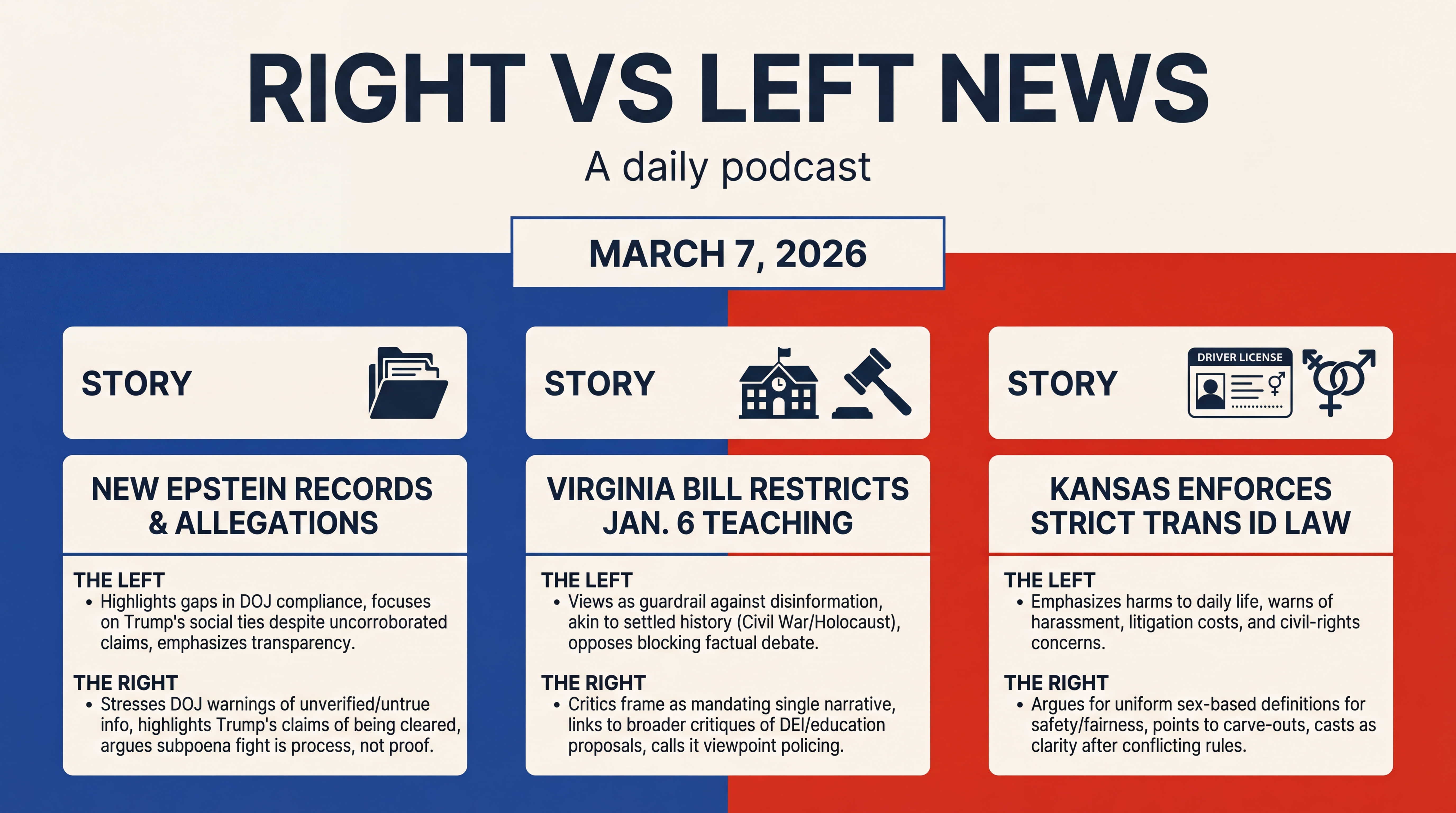
The Justice Department published additional Epstein-related records, saying they were incorrectly coded and missed in earlier releases. The new material includes FBI interview notes with allegations from a woman who says Trump and Epstein assaulted her decades ago. DOJ and the White House dispute the credibility, and major outlets say they have not corroborated the claims. The release followed bipartisan pressure under the Epstein Files Transparency Act and a House subpoena for Attorney General Pam Bondi to testify about delays.
On the right, coverage stresses DOJ’s own warnings that earlier batches contained unverified—even untrue and sensational—claims, and highlights Trump’s contention that recent document dumps clear him. Some reports say he’s weighed legal action over false assertions. National Review notes House Republicans joined Democrats to subpoena Bondi, casting the fight as process, not proof against Trump.
On the left, reporting says the new postings fill documented gaps in DOJ’s compliance after criticism that required records weren’t released by the deadline—and they keep attention on Trump’s long-scrutinized social ties to Epstein while noting the lack of corroborating evidence. The Washington Post emphasizes transparency obligations and the political stakes of what was omitted—and when.
In Virginia, lawmakers advanced a bill barring public schools from teaching that the January 6, 2021 attack was peaceful or that the 2020 election was marred by massive fraud. Supporters say it’s about evidence-based civics; opponents call it viewpoint policing. The push comes as Democrats control Richmond, and the bill has drawn national attention.
On the right, critics frame the measure as Democrats mandating a single narrative—requiring teachers to label January 6 an unprecedented, violent attack—and link it to broader critiques of new education and DEI proposals in the state.
On the left, backers see it as a guardrail against disinformation in classrooms—akin to standards that teach the Civil War or the Holocaust as settled history. Civil-liberties concerns surface, but patrons argue it doesn’t silence debate; it blocks demonstrably false claims in K-12 instruction.
In Kansas, a strict new law is now being enforced that invalidates driver’s licenses and birth certificates changed to reflect a person’s gender identity, while also tightening bathroom provisions that can carry misdemeanor penalties for repeat violations. The Washington Post profiles Kansans affected and notes legal challenges already filed. Conservative outlets have tracked state officials’ steps and court fights leading up to enforcement.
Supporters argue uniform, sex-based definitions in law are necessary for safety, fairness, and accurate records—and point to carve-outs in the statute and to prior litigation they say exposed administrative overreach on ID changes. They cast the law as clarity after years of conflicting rules.
Progressive voices emphasize harms to trans residents’ daily lives—from driving to work to using restrooms—warning the policy invites harassment and costly litigation for the state. Civil-rights groups and at least one GOP lawmaker raise bathroom-policing risks.
[MIDPOINT_SPONSORS]
A new federal school-voucher tax credit created in last year’s Republican tax-and-spending law is forcing quick choices by governors. Unlike typical vouchers, these federally backed donations can also cover some public-school expenses—complicating Democratic opposition. The Joint Committee on Taxation puts the cost at roughly 25.9 billion dollars over ten years. Many GOP-led states say they’ll opt in; several Democratic governors are undecided under intense lobbying.
Conservatives hail 2026 as the dawn of nationwide school choice—arguing the federal design supercharges state reforms and empowers parents. A White House map calling out holdout blue states is framed as the largest national expansion of education freedom in history.
Teachers unions and public-school advocates warn the program diverts scarce dollars to private schooling and could erode district finances—even if some public-school expenses qualify. Some center-left policy voices see potential upside but want detailed Treasury rules before states commit.
The Justice Department has formed a working group—coordinating with Treasury—to explore possible federal charges against Cuban officials or entities, with South Florida prosecutors involved. The move comes as the administration talks openly about pressuring Havana and follows recent Cuba-related flashpoints at sea. Reporting describes the effort as preliminary but significant, given the exile politics of Miami and the administration’s broader regional posture.
Conservative commentators call it overdue accountability for a repressive regime and see a strategic opening after shifts in Venezuela—suggesting tougher U.S. action could hasten change in Cuba.
Center-left reporting urges caution about legal grounds, unintended escalation, and humanitarian fallout—especially if prosecutions are paired with broader regime-change rhetoric. There are questions about evidentiary standards, timelines, and coordination with allies.
Quick recap... New Epstein records ignite partisan claims about what’s real and what’s rumor. Virginia moves to codify how January 6 is taught. Kansas’s ID law collides with trans rights. A federal voucher tax credit tests Democratic governors. And DOJ eyes Cuban officials, with Florida politics looming large. We’ll keep tracking what passes, what gets paused by courts—and what changes before Monday.
That's it for today's episode of Right versus Left News. Remember, understanding both sides isn't about picking a team—it's about being informed. Subscribe wherever you get your podcasts, and join us tomorrow for another balanced look at the day's biggest stories. Until next time, stay curious and stay informed.
