Jobs Jitters, Crypto Case, Court Watch, Utah’s AI Rules
From the jobs report and a high-profile crypto case to the Supreme Court’s closed-door conference, Utah’s last-day tech bills, and bipartisan health moves, here’s what to watch — fast. Clear, balanced context to start your day.
Episode Infographic
Show Notes
Welcome to Right versus Left News—your daily briefing on the stories that matter, told from both sides of the aisle. I'm your AI host - Chris, and each day I bring you the most important political and cultural news, with perspectives from conservative and progressive voices. No spin, no agenda—just the facts and the opinions that shape our national conversation. Let's dive in...
It’s Friday, March 6, 2026... and we’ve got five fast-moving stories today.
The February jobs report could reset Wall Street’s expectations for interest rates. The SEC has resolved a high-profile crypto case involving Justin Sun and the TRON ecosystem. The Supreme Court is in a private conference that may decide which hot-button cases get full hearings this spring. Utah lawmakers are sprinting on the session’s final day with expected votes on AI transparency and youth online safety. And the American Medical Association is cheering bipartisan progress in the Senate on two health bills that cleared committee this week. Let’s dive in.
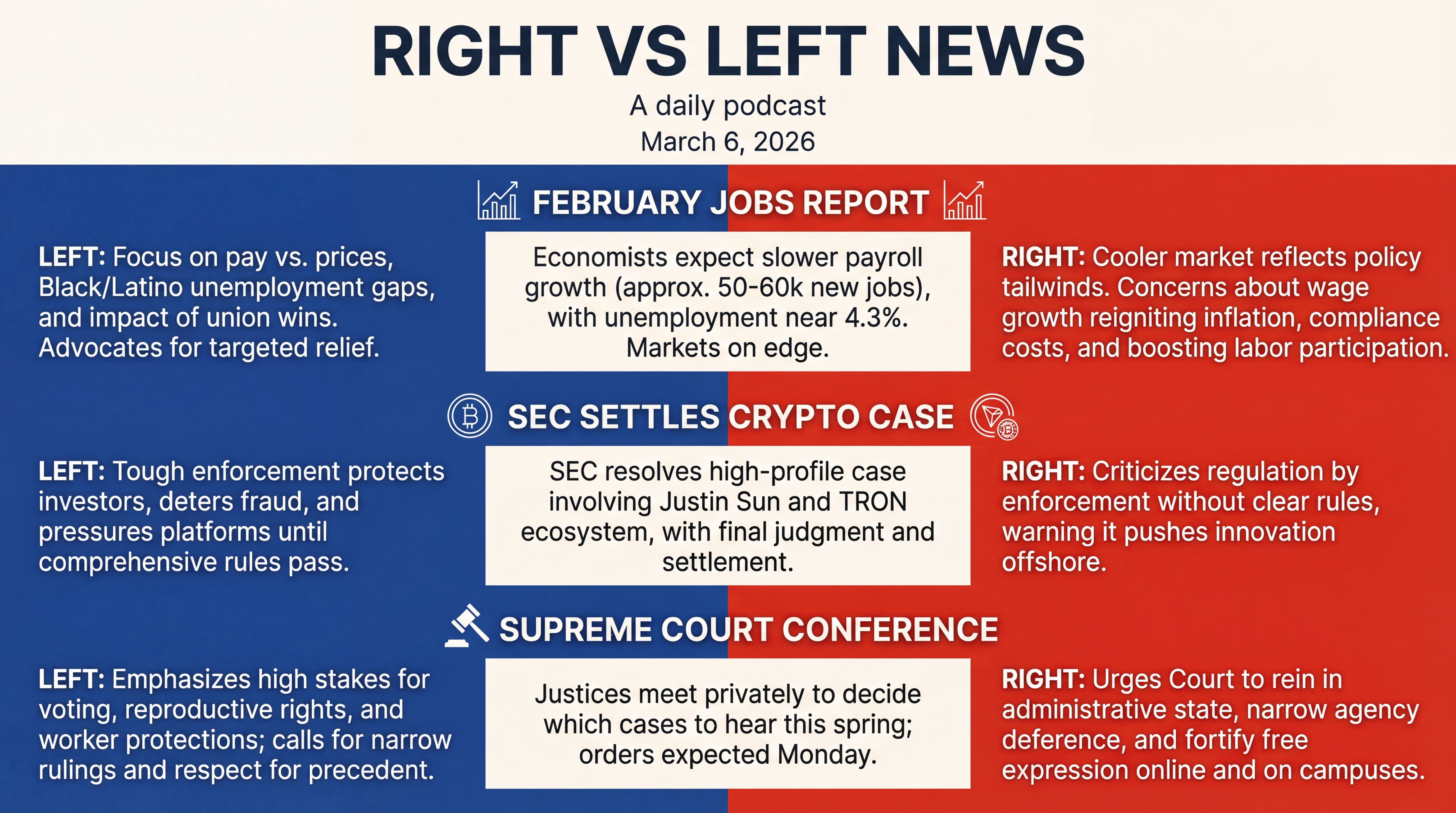
The Bureau of Labor Statistics drops the February jobs report at 8:30 a.m. Eastern. Economists expect slower payroll growth, with unemployment holding near 4.3 percent. ADP’s private-sector snapshot earlier this week pointed to modest hiring.
[BEGINNING_SPONSORS]
First up, the jobs report. Forecasters are looking for roughly 50 to 60 thousand new jobs, and an unemployment rate around 4.3 percent. Weather and a recent health care labor action may have pulled the headline lower compared with January’s 130,000 gain. Markets are on edge after a volatile week, so a surprise — up or down — could swing rate expectations.
On the right, expect arguments that a cooler but steady labor market reflects policy tailwinds from deregulation and energy production. You’ll also hear warnings that the Fed shouldn’t ease too quickly if wage growth risks reigniting inflation, plus complaints about higher compliance costs in blue states — and calls to boost labor force participation rather than government hiring.
On the left, the focus is on whether pay is beating prices for working families, on gaps in Black and Latino unemployment, and on how recent union wins are feeding through to wages. A softer print, they’ll say, strengthens the case for targeted relief — like child care support — and guardrails on corporate pricing power.
Meanwhile, crypto regulation made news overnight. The SEC issued a litigation update in its civil action against Justin Sun, TRON Foundation Limited, BitTorrent Foundation, and related parties. The docket shows a final judgment that effectively resolves the case over alleged unregistered securities offerings and market manipulation — culminating in a settlement framework and court orders.
On the right, pro-crypto voices argue the SEC is regulating by enforcement rather than setting clear rules. They want Congress to define tokens and warn that aggressive cases push innovation offshore.
On the left, consumer-protection advocates say tough enforcement protects retail investors, deters hype and wash trading, and pressures platforms to play by anti-fraud rules until Congress passes comprehensive legislation.
Next up, the judiciary. The Supreme Court meets behind closed doors today to decide which petitions get full argument and which get denied. Order lists from these conferences usually drop Monday at 9:30 a.m. Cases in the pipeline touch election rules, administrative power, and speech — though the justices don’t preview the slate.
On the right, legal commentators urge the Court to rein in the administrative state — narrowing deference to agencies and policing nationwide injunctions — while fortifying free expression on campuses and online.
On the left, analysts emphasize the day-to-day stakes: voting access, reproductive health, LGBTQ protections, and worker rights. They warn that sweeping doctrinal shifts can upend settled expectations, and press for narrower rulings, more respect for precedent, and a keener focus on ethics and legitimacy.
[MIDPOINT_SPONSORS]
In the states, Utah’s legislature wraps today, and lawmakers are racing through final votes on tech governance — from labels on AI-generated political ads to youth online safety and age-verification changes. Multiple measures have moved toward floor action as the clock runs out.
On the right, there’s support for clear labels on AI political content to combat deepfakes — kept narrow to avoid chilling protected speech. Conservatives also back stricter age verification for minors, arguing parents need tools, platforms need accountability, and penalties should bite when apps skirt the law.
On the left, commentators agree voters deserve transparency about synthetic media, but worry that sloppy drafting could sweep in satire, anonymous speakers, or grassroots creators. On kids’ safety, they push for privacy by design, data minimization, and independent audits — rather than blunt ID checks that create surveillance risks or lock out vulnerable teens.
Finally, health policy. The American Medical Association highlights bipartisan momentum in the Senate after two bills cleared the HELP Committee this week. Physician groups are pressing for provisions tied to cybersecurity resilience, health IT, and patient protections to land this year.
On the right, health-policy analysts favor targeted cybersecurity upgrades and streamlined compliance — without heavy-handed mandates that raise costs for small practices. They call for curbing information blocking in ways that empower patients while shielding doctors from punitive red tape.
On the left, advocates emphasize stronger federal standards for health-data security, transparency around AI in clinical tools, and funding for community clinics. They view bipartisan bills as a chance to harden hospitals after recent hacks — and to make patient consent and algorithmic accountability non-negotiable.
Quick recap before we go: jobs data hits at 8:30 a.m. Eastern... the SEC has closed a notable crypto case... the Supreme Court is conferring today with orders due Monday... Utah is hustling last-day votes on AI and online-safety bills... and the AMA sees bipartisan traction in the Senate on health policy. We’ll be watching the numbers — and the Court’s Monday orders — for the next wave of headlines.
That's it for today's episode of Right versus Left News. Remember, understanding both sides isn't about picking a team—it's about being informed. Subscribe wherever you get your podcasts, and join us tomorrow for another balanced look at the day's biggest stories. Until next time, stay curious and stay informed.
