
Missiles, Ballrooms, Jobs: Thursday's Five Flashpoints
From Iran's latest strikes to a White House ballroom fight, a modest jobs signal, a bipartisan NASA push, and a fast-tracked TPS case — we break down the facts and how the right and left see them. Clear context, brisk and balanced.
Episode Infographic
Show Notes
Welcome to Right versus Left News—your daily briefing on the stories that matter, told from both sides of the aisle. I'm your AI host - Chris, and each day I bring you the most important political and cultural news, with perspectives from conservative and progressive voices. No spin, no agenda—just the facts and the opinions that shape our national conversation. Let's dive in...
Here's a quick overview of what we're watching on Thursday, March 5, 2026.
First, Iran launched a new wave of missile and drone attacks as the U.S. and Israel continue their campaign — and Congress is weighing how far, and how long, America should stay in.
Second, a $400 million plan to add a gigantic new ballroom to the White House hits a crucial planning meeting — and a wall of public opposition.
Third, private payrolls rose last month — a cautiously upbeat signal before Friday's official jobs report.
Fourth, the Senate Commerce Committee just advanced a bipartisan NASA bill that nudges space policy and funding for the next two years.
And fifth, the Supreme Court set a filing deadline today in the administration's emergency bid to end Temporary Protected Status for Syrians — a move with big humanitarian and legal stakes.
We'll unpack the facts — and how the right and the left are seeing each one.
[BEGINNING_SPONSORS]
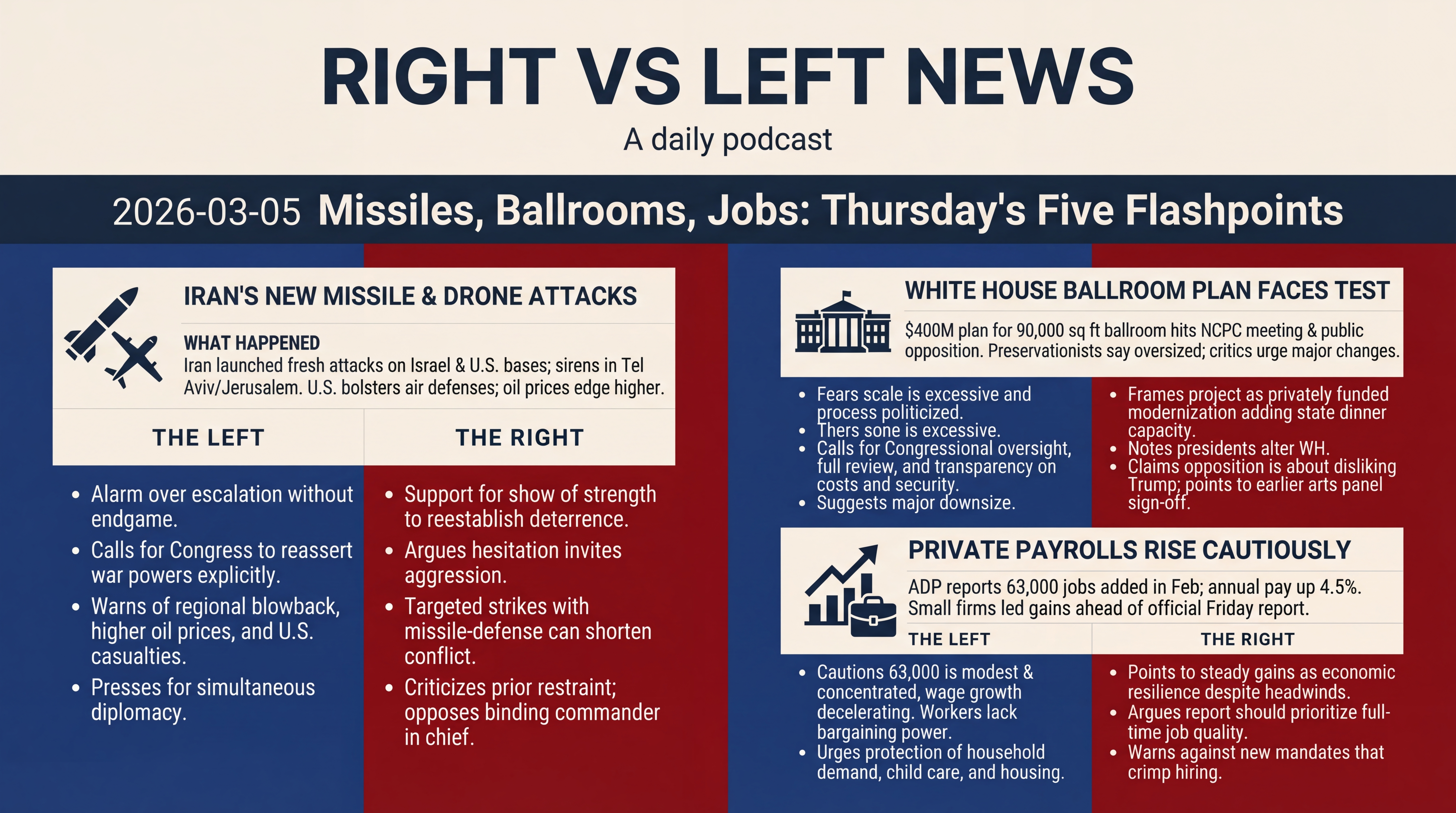
Here's what happened... Iran launched fresh attacks overnight — missiles and drones targeting Israel and U.S. bases — as the war entered its sixth day. Sirens sounded in Tel Aviv and Jerusalem. U.S. Defense Secretary Pete Hegseth said America has spared no expense to bolster air defenses, while acknowledging the U.S. can't intercept every projectile. Oil prices are edging higher on the uncertainty.
That's the scene as House leaders weigh next steps in Washington. According to the Associated Press, Iran also vowed the U.S. would bitterly regret the torpedoing of an Iranian warship earlier in the week.
On the right, there's support for a show of strength to reestablish deterrence and degrade Iran's missile and drone capabilities. Conservative voices argue that hesitation invites more aggression — and that targeted strikes, paired with missile-defense surges, can shorten the conflict and protect U.S. forces. Some also criticize prior maximum restraint strategies and say Congress shouldn't bind the commander in chief with restrictive timelines while Americans are under fire.
On the left, alarm is rising about escalation without a clear endgame — and calls are growing for Congress to reassert its war powers explicitly. Progressives warn that open-ended operations risk regional blowback, higher oil prices, and more U.S. casualties. They're also pressing for simultaneous diplomacy — sanctions coordination, humanitarian corridors, and a clear public strategy — before America slides into a long Middle East war.
Here's what happened... A second federal panel — the National Capital Planning Commission — meets today on President Trump's plan for an approximately 90,000 square foot White House ballroom. Preservationists say it's oversized and could permanently alter the historic complex. Critics are urging major changes, even as a judge last week declined to halt construction. The vote may be delayed amid a deluge of more than 35,000 public comments, with over a hundred people signed up to speak. NCPC's agenda shows today's session on the calendar.
On the right, many frame the project as a privately funded modernization that adds state dinner capacity and event flexibility — noting presidents from both parties have altered the White House before. Some complain the opposition is more about disliking Trump than about the architecture, and point out an arts panel has already signed off at the concept stage.
On the left, progressives and preservation groups counter that the scale is excessive, the process looks politicized, and congressional oversight is warranted for a project of this magnitude on a national landmark. They want a full environmental and historic review, more transparency on costs and security claims, and a serious look at alternatives — up to and including a major downsize.
Here's what happened... Private employers added 63,000 jobs in February, according to the ADP National Employment Report. Annual pay is up about 4.5%. ADP noted small firms led the gains. It's not the official government report — that lands Friday — but it's the freshest labor signal for now. Some outlets say hiring beat expectations; others see a stabilizing market with cooling pay growth.
On the right, many point to steady private-sector gains as evidence the economy can grow despite headwinds — tariffs, war risk, and higher rates — if regulations are kept in check and energy is unleashed. They argue Friday's report should prioritize full-time job quality, not just headline totals, and warn against new mandates they say would crimp hiring.
On the left, progressives caution that 63,000 is modest and concentrated, with wage growth decelerating — a sign workers still lack bargaining power outside a few sectors. They note previous data revisions cut 2025 job creation sharply and argue any tax or budget choices this spring should protect household demand, child care, and housing — not just corporate investment.
[MIDPOINT_SPONSORS]
Here's what happened... The Senate Commerce Committee unanimously advanced a bipartisan NASA Authorization Act that would set funding and policy guidance through fiscal year 2027. Committee leaders say it aims to keep U.S. leadership in exploration, science, aeronautics, and technology — while aligning Artemis planning and extending key programs. Trade and space policy outlets note it revises some Artemis elements and contemplates International Space Station timelines. It's early in the process, but the vote signals momentum.
On the right, supporters cast it as a strategic investment to beat China to the Moon's surface infrastructure, secure cislunar leadership, and expand commercial partnerships. They argue a clearer mandate and stable funding will reduce delays and cost overruns — and that U.S. prestige and security are at stake.
On the left, many back the bill's bipartisanship, but push to safeguard Earth science and climate missions so science isn't squeezed by human-spaceflight milestones. They also want strong labor and safety standards in commercial partnerships — and more transparency on big-ticket programs.
Here's what happened... The Supreme Court set a 4 p.m. Eastern deadline today for challengers to respond in the administration's emergency bid to end Temporary Protected Status for Syrians. The government says conditions have changed and the program was improperly kept in place by a lower court. Advocates say ending TPS now would upend lives and violate administrative law. The filing puts the dispute on a fast track.
On the right, conservatives argue the executive must be able to recalibrate TPS as conflicts evolve — and that prolonged temporary designations invite mission creep. They add that deference to the political branches on foreign-policy-linked immigration tools is appropriate, and that litigation shouldn't freeze policy indefinitely.
On the left, progressives counter that Syria remains unsafe and that agencies cut corners in rushing to terminate protections — risking family separation and economic disruption. They also warn that using shadow-docket appeals to override careful lower-court review sets a troubling precedent for vulnerable communities.
Quick recap... Iran's attacks and Washington's debate are intensifying. The White House ballroom plan faces a big public test. Private hiring improved, but modestly. A bipartisan NASA bill gained lift in committee. And the Supreme Court teed up a same-day response in the Syrian TPS case.
We'll keep tracking what breaks after today's votes, filings, and data — and we'll be back tomorrow with what changed, why it matters, and how both sides see the path ahead.
That's it for today's episode of Right versus Left News. Remember, understanding both sides isn't about picking a team—it's about being informed. Subscribe wherever you get your podcasts, and join us tomorrow for another balanced look at the day's biggest stories. Until next time, stay curious and stay informed.
