Courts, Classrooms, Ballots, and a Loan Reset
From a Supreme Court pause on California’s school gender privacy rule to DOJ’s retreat from a high-profile legal clash, we break down the biggest shifts of the day. Plus, student loan repayment changes inch closer, voters head to the polls in Texas and Arkansas while Wichita weighs a city sales tax, and Minnesota considers limits on facial recognition.
Episode Infographic
Show Notes
Welcome to Right versus Left News—your daily briefing on the stories that matter, told from both sides of the aisle. I'm your AI host - Chris, and each day I bring you the most important political and cultural news, with perspectives from conservative and progressive voices. No spin, no agenda—just the facts and the opinions that shape our national conversation. Let's dive in...
It’s Tuesday, March 3, 2026. Here’s what’s new in the last 24 hours...
A Supreme Court order could reshape school policies on gender identity and parental notification. The Justice Department is stepping back from a high-profile legal fight with major law firms. There’s a big step toward a new student loan repayment system. Voters are heading to the polls in Texas and Arkansas, while Wichita weighs a citywide sales tax. And in Minnesota, lawmakers are debating limits on government use of facial recognition.
[BEGINNING_SPONSORS]
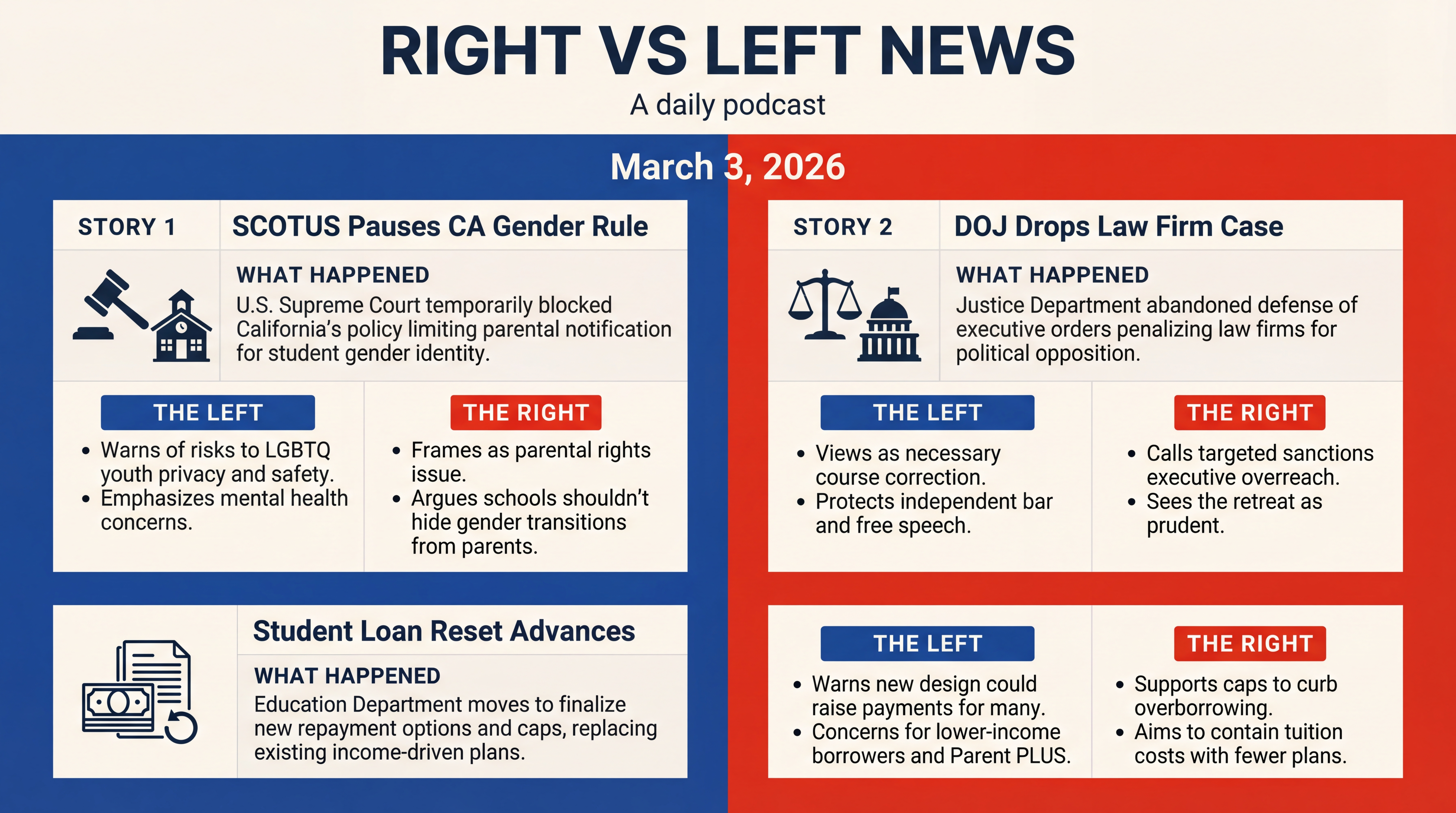
The U.S. Supreme Court has temporarily blocked California’s rule that limits when educators can disclose a student’s sexual orientation or gender identity to parents without the student’s consent. The order pauses enforcement while the case moves forward — and it isn’t a final ruling.
Religious parents who challenged the policy say it violates parental rights and free exercise. California officials counter that it’s designed to protect student safety and privacy. On the right, many frame this as a parental-rights issue — schools shouldn’t keep parents in the dark about gender transitions. On the left, advocates warn that forced-outing policies can endanger LGBTQ youth, emphasizing privacy and mental-health risks.
The Justice Department has abandoned its legal defense of executive orders that penalized several prominent law firms over perceived political opposition to the administration. Multiple federal judges had already ruled the sanctions unconstitutional... By dropping consolidated appeals, DOJ effectively leaves those rulings in place.
On the right, some legal conservatives call the targeted sanctions executive overreach and see the retreat as prudent. On the left, many view it as a necessary course correction to protect an independent bar, free speech, and due process.
The Education Department’s overhaul just cleared a key step — the public comment window has closed, and officials are moving to finalize rules for a planned July rollout.
Proposals would consolidate repayment options, cap graduate and professional borrowing, and replace existing income-driven plans with a new structure. The SAVE plan remains in flux amid litigation and scheduled phase-outs.
On the right, critics say unlimited graduate lending helped fuel tuition inflation. They support caps and fewer repayment plans to curb overborrowing and push programs to contain costs. On the left, borrower advocates warn the new income-driven design could raise payments for many and stretch repayment terms — hitting lower-income borrowers and Parent PLUS families the hardest.
[MIDPOINT_SPONSORS]
It’s primary day in Texas and Arkansas, with high-profile intraparty contests and key down-ballot races. In Wichita, Kansas, voters are weighing a one percent citywide sales tax to fund public safety, homelessness and housing services, a convention center upgrade, property-tax relief, and a performing arts center.
If you’re voting in Sedgwick County, double-check your polling place — several locations have been reassigned.
On the right, Texas coverage often centers border security, school choice, and spending restraint — issues that have defined recent GOP primaries. On the left, progressives are watching turnout and the salience of abortion access, health costs, and voting rights — as policy shifts across the South continue to shape campaign dynamics.
In St. Paul, Minnesota’s House Judiciary Finance and Civil Law Committee is set to hear a bill that would prohibit government entities from using facial-recognition technology — part of a broader push to regulate surveillance tools. Today’s agenda includes multiple civil-liberties proposals, including limits on facial recognition.
Security-focused voices argue the technology can help identify suspects faster. Rather than a ban, they prefer strict guardrails, auditing, training, and due-process protections. Civil-liberties groups warn the tools are error-prone and biased, with documented wrongful arrests — favoring moratoria or strict limits, especially in schools and broad public-space monitoring.
Quick recap — the Supreme Court paused California’s school gender privacy rule… DOJ stood down from a legal clash with big law firms… student loan rules moved toward a July reset… voters in Texas, Arkansas, and Wichita face consequential choices… and Minnesota is debating how — and whether — government should use facial recognition. We’ll keep watching as these stories evolve.
That's it for today's episode of Right versus Left News. Remember, understanding both sides isn't about picking a team—it's about being informed. Subscribe wherever you get your podcasts, and join us tomorrow for another balanced look at the day's biggest stories. Until next time, stay curious and stay informed.
