
War Drums, Austin Tragedy, and Court Clash
We break down Israel’s new offensive against Hezbollah, the Austin bar shooting under federal terrorism review, and oil’s spike as conflict spreads. Plus, the Supreme Court’s gun-and-marijuana case and the Senate’s bipartisan housing push—what the right and left are saying, and why it matters.
Episode Infographic
Show Notes
Welcome to Right versus Left News—your daily briefing on the stories that matter, told from both sides of the aisle. I'm your AI host - Chris, and each day I bring you the most important political and cultural news, with perspectives from conservative and progressive voices. No spin, no agenda—just the facts and the opinions that shape our national conversation. Let's dive in...
Here’s what we’re watching this Monday, March second...
Israel says it has launched an offensive campaign against Hezbollah after rockets from Lebanon reached the Haifa area. In Austin, a bar shooting leaves two people dead—plus the gunman—and is now under a federal terrorism probe. Oil prices are spiking as the Middle East crisis widens, rattling markets. The Supreme Court is hearing a closely watched case on whether marijuana users can be barred from owning guns. And the Senate is moving to take up a sweeping, bipartisan housing package aimed at boosting supply.
We’ll lay out the facts—and what the right and the left are saying—so you can decide.
[BEGINNING_SPONSORS]
First, Israel and Hezbollah.
The Israel Defense Forces say they’ve begun an offensive campaign against Hezbollah after the group launched rockets and drones toward northern Israel, triggering sirens near Haifa. Israel struck targets in Beirut’s southern suburbs and across southern Lebanon. Lebanese authorities report at least thirty-one deaths so far, with the split between combatants and civilians still unclear.
This escalation follows the killing of Iran’s Supreme Leader, Ayatollah Ali Khamenei, in joint U.S. and Israeli strikes days earlier. Hezbollah has answered with its own fire, and the risk of a wider regional war is rising.
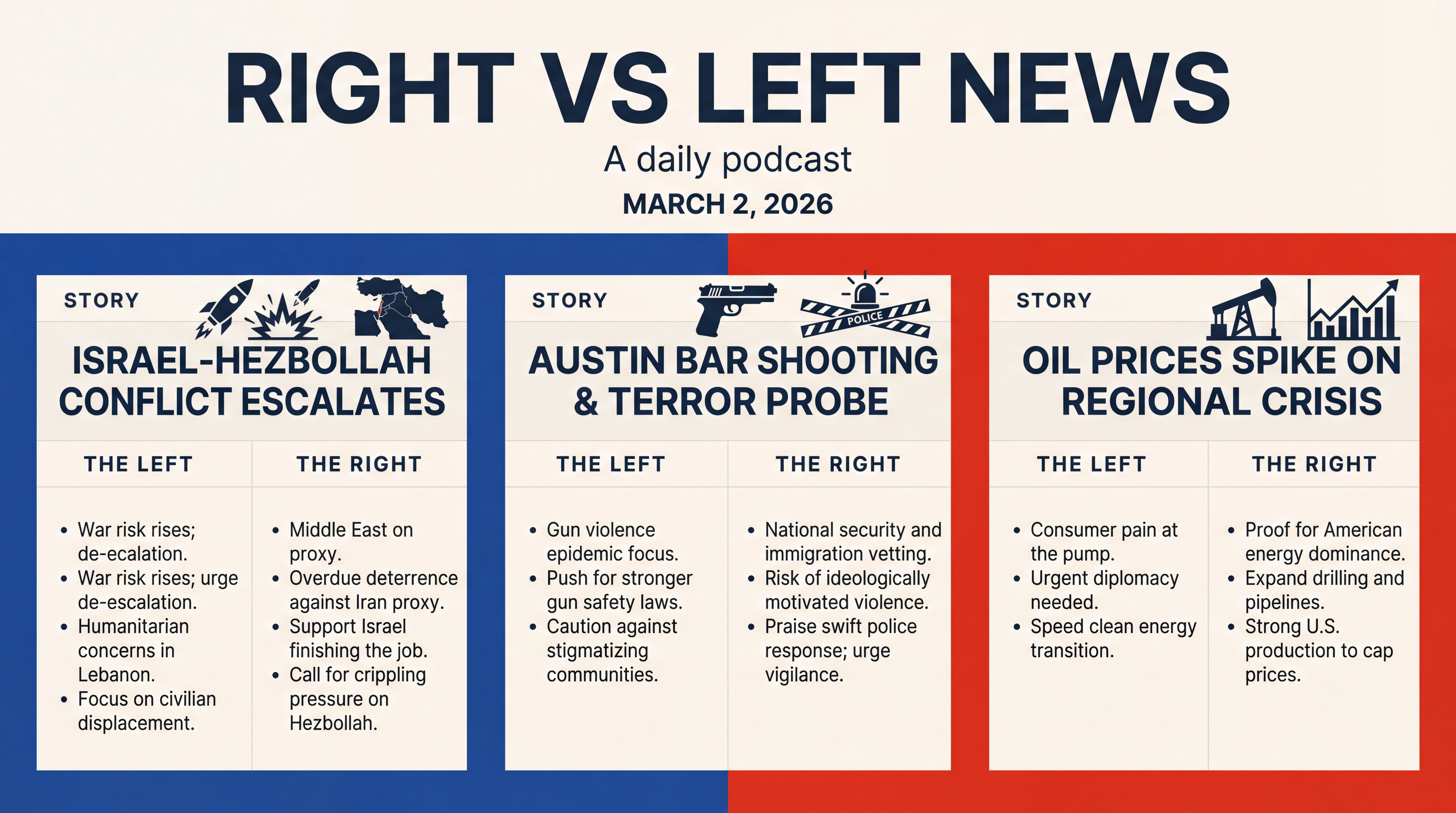
On the right, many argue this is overdue deterrence against Iran’s top proxy—saying Hezbollah invited a harsh response and that Washington should back Israel to finish the job. You’ll hear calls for crippling pressure on Hezbollah’s financing and for firm U.S. resolve against Iranian aggression.
On the left, voices warn the region is sliding toward a broader, devastating war—stressing humanitarian risks in Beirut and southern Lebanon and urging de-escalation. They highlight civilian displacement, the danger of multiple fronts opening, and the need to keep aid flowing into Gaza while borders remain tense.
In Austin...
In the Sixth Street district early Sunday, a gunman opened fire outside Buford’s Backyard Beer Garden, killing two people and injuring fourteen before police shot him dead. The FBI’s Joint Terrorism Task Force is investigating a potential nexus to terrorism, citing items found on the suspect and in his vehicle. Authorities have identified the shooter as a fifty-three-year-old naturalized U.S. citizen. Hospitals treated the wounded through the day as casualty counts were updated.
On the right, the focus is on national security and immigration vetting—arguing the incident underscores risks of ideologically motivated violence on U.S. soil and the need for an aggressive counterterrorism posture. There’s praise for the swift police response and calls for vigilance.
On the left, the emphasis is on America’s gun-violence epidemic—pushing for stronger gun-safety laws and better mental-health interventions, while cautioning against stigmatizing Muslim or immigrant communities. The debate over access to firearms is already intensifying.
In energy and markets...
Oil prices jumped sharply as trading opened this morning—Brent up roughly nine to thirteen percent at points, U.S. crude up around seven to nine—as shipping through the Strait of Hormuz slowed and airlines canceled routes amid escalating strikes and counterstrikes in the region. Stocks slipped, energy shares rose, and analysts warn a prolonged disruption could push oil toward one hundred dollars, even with a modest OPEC plus output increase on deck.
On the right, the spike is held up as proof of the case for American energy dominance—streamlining permits, expanding drilling and pipelines, and cutting policy frictions that raise costs. Former Energy Secretary Dan Brouillette argues that strong U.S. production is helping cap prices for now, but warns policy missteps can still hobble output.
On the left, the focus is on consumer pain at the pump and broader inflation risks—paired with arguments for urgent diplomacy to cool the conflict and faster clean-energy deployment. The message: fossil fuels leave economies exposed to geopolitical shocks, and the long-term answer is to speed the transition.
[MIDPOINT_SPONSORS]
At the Supreme Court...
The justices hear United States v. Hemani, testing whether people who use federally illegal drugs—especially marijuana—can be barred from possessing firearms under federal statute Section 922, subsection g, paragraph 3. The case follows conflicting lower-court rulings after the Court’s twenty twenty-two Bruen decision reshaped how judges analyze gun laws.
From the right and libertarian side, legal groups argue the ban is ahistorical, overly broad, and unconstitutionally vague—sweeping in millions as unlawful users even when they’re not intoxicated. They urge the Court to strike the provision or narrow it substantially, questioning whether mere past or occasional use can justify permanent disarmament.
From the left, the emphasis is on public safety and on the difficulty of administering gun policy after Bruen. Some propose resolving the case on narrower vagueness grounds, while warning that a sweeping Second Amendment ruling could undercut other risk-based limits.
Finally—housing.
The Senate returns this afternoon to take up House Resolution sixty-six forty-four, the Housing for the Twenty-First Century Act, with a five thirty p.m. cloture vote to proceed. The House passed the bipartisan package three hundred ninety to nine last month. The bill aims to cut red tape, modernize HUD programs, and boost construction and conversions to expand supply. Leaders in both parties are touting its supply-side focus.
On the right, there’s support for streamlining and deregulatory pieces—loosening rules on manufactured housing, speeding approvals, and empowering community lenders—while resisting broad restrictions on large investors. Many Republicans argue regulation is a core driver of high costs.
On the left, progressives welcome more supply but say zoning reform alone won’t quickly make homes affordable in high-cost cities without stronger tenant protections, more public housing, or expanded vouchers. Expect debate over investor activity, rent stabilization, and how to target funds to the lowest-income households.
Quick recap...
Israel opens an offensive against Hezbollah as the region teeters. Austin copes with a deadly shooting now under a terrorism probe. Oil spikes on war risk. The Supreme Court takes up marijuana and gun rights. And the Senate moves on a big, bipartisan housing bill.
We’ll keep tracking developments through the evening as votes, arguments, and markets evolve. Stay tuned.
That's it for today's episode of Right versus Left News. Remember, understanding both sides isn't about picking a team—it's about being informed. Subscribe wherever you get your podcasts, and join us tomorrow for another balanced look at the day's biggest stories. Until next time, stay curious and stay informed.
